Medal Bar for an Austrian Veteran of World War I
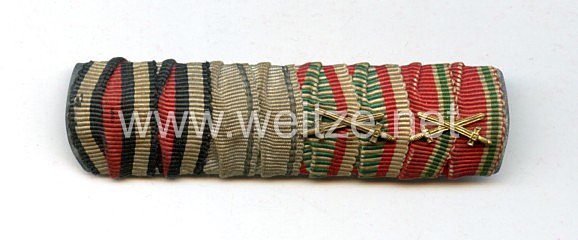
This ribbon bar represents the military career of an Austro-Hungarian veteran of World War I who fought alongside the Central Powers. The combination of four decorations tells the story of a soldier who served not only in the ranks of the Imperial and Royal Armed Forces but also had contact with the allied armies of Bulgaria and Hungary.
The Karl Troop Cross or Cross of Honor for Participants 1914-1918 was established by federal law on December 13, 1932, and was intended to be awarded to all former members of the Austro-Hungarian armed forces who served actively during World War I. This retrospective decoration of the First Austrian Republic served to recognize veterans and was worn with a characteristic red ribbon with white edge stripes. The institution occurred at a time when many European nations were honoring their war participants and institutionalizing the memory of the Great War.
The Bulgarian Bravery Medal (Order "Za Hrabrost") was one of the highest decorations of the Kingdom of Bulgaria for personal bravery in the face of the enemy. This decoration was awarded in various grades and was of particular significance during World War I, when Bulgaria fought alongside the Central Powers from 1915. The award to foreign soldiers, especially to allies from Austria-Hungary, was not uncommon, as the armed forces of the Central Powers frequently cooperated in joint operations in the Balkans, Serbia, Romania, and Macedonia.
The Hungarian War Commemorative Medal with Swords (Magyar Háborús Emlékérem kardokkal) was established in 1929 by the Kingdom of Hungary to honor all participants in World War I. The variant with crossed swords on the ribbon designated front-line combatants, while the version without swords was intended for persons who served in home services. This medal was awarded by the now independent Hungary after the collapse of the Dual Monarchy and symbolized the continuity of military tradition despite the political upheavals after 1918.
The Bulgarian War Commemorative Medal with Swords (Commemorative War Medal 1915-1918) was also established retrospectively to honor all participants in the hostilities during World War I. The swords on the ribbon or the medal itself again designated front-line fighters. Bulgaria had suffered heavy losses in World War I and fought on multiple fronts before capitulating in September 1918 as one of the first Central Powers.
The combination of these four decorations on a ribbon bar is historically revealing. It shows that the wearer was probably deployed on the Balkan theater of war, where Austro-Hungarian and Bulgarian troops fought side by side against Serbian, Romanian, and Allied forces. The joint operations, particularly the conquest of Serbia in 1915, the campaigns against Romania in 1916-1917, and operations on the Salonika Front, led to close military contact between the allies.
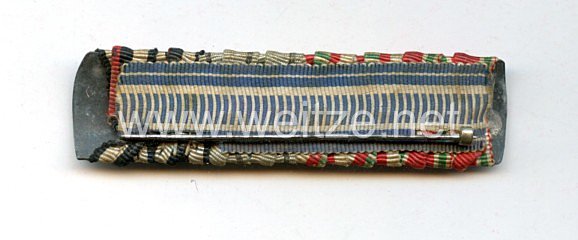
The width of 75 mm corresponds to a compact ribbon bar with four normal-sized order ribbons side by side, as was customary in the Central European tradition. The indicated condition 2 suggests a well-preserved piece that has survived the decades since World War I relatively unscathed.
Such ribbon bars were typically worn on civilian clothing or parade uniforms, especially at veterans' meetings, official occasions, and commemorative events in the interwar period. They served as a visible sign of military past and camaraderie among front-line soldiers. In the period after 1918, these memorial insignia gained special significance as the old empires had collapsed and veterans sought to preserve their identity and experiences in the new nation-states.
The fact that several of these decorations were not established until the late 1920s and early 1930s reflects a Europe-wide movement toward formal recognition of war participants. These belated honors were part of a complex process of memorial culture in which European societies attempted to process the traumatic experiences of World War I and grant their veterans belated recognition.