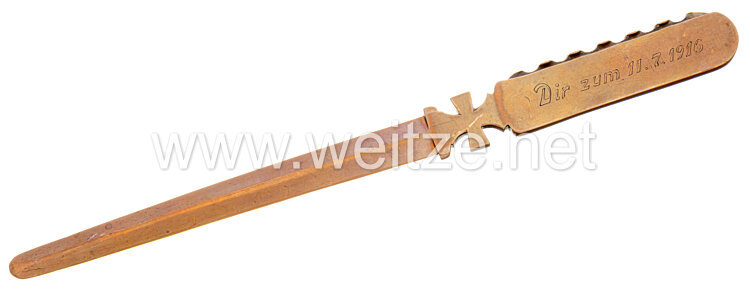
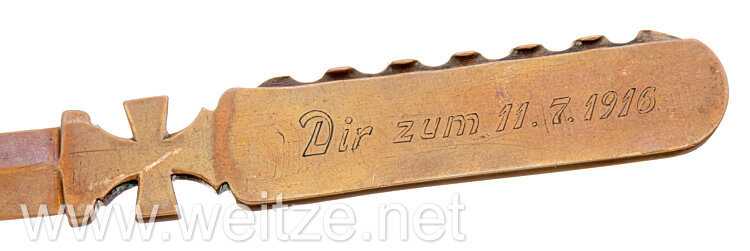
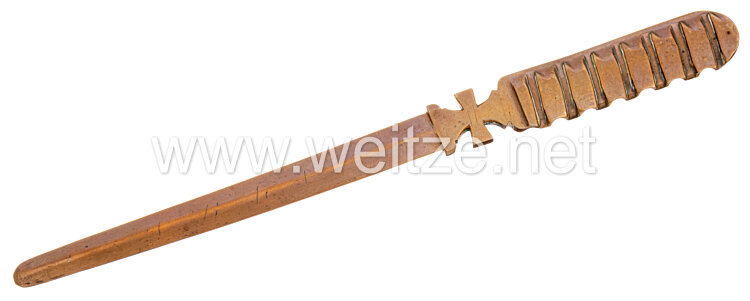
German Empire World War I Letter Opener Made from Artillery Shell Casing “To You on 11.7.1916”
Letter Openers from Shell Casings: Material Culture of World War I This letter opener, crafted from a shell casing and inscribed with the dedication “Dir zum 11.7. 1916” (To you on 11.7.1916), represents a fascinating category of militaria from World War I. These objects, known as Trench Art, were produced in great numbers between 1914 and 1918 and document the creative appropriation of military materials by soldiers, prisoners of war, and civilians. The conversion of ammunition casings into everyday objects such as letter openers, vases, ashtrays, or jewelry was widespread during World War I. After intense artillery battles, countless empty shell casings lay scattered across battlefields. These were made from brass, bronze, or copper alloys - materials that were relatively easy to work with and provided soldiers with an occupation during long periods of boredom between battles. The date of July 11, 1916 on this letter opener falls during a particularly significant phase of the war. In July 1916, the Battle of the Somme was raging, one of the bloodiest battles in human history, which had begun on July 1st. Simultaneously, German troops were engaged in intensive combat operations across various front sectors. On the Eastern Front, the Brusilov Offensive by the Russian Army was in full swing, which had begun on June 4, 1916, and was causing significant losses among the Central Powers. The specific date might mark a personal event - a birthday, a survival date after a battle, or a memorial to a fallen comrade. The manufacture of such objects occurred under various circumstances. Some soldiers crafted these pieces themselves during quiet moments at the front or while recuperating in rear positions. Others were made by prisoners of war or civilians in occupied territories, partly as souvenirs for soldiers and partly for sale. In field workshops and improvised studios, true works of art were created, often decorated with engraved inscriptions, military motifs such as Pickelhauben (spiked helmets), Iron Crosses, or regimental emblems. Letter openers made from shell casings held particular symbolic significance. They transformed instruments of destruction into tools of civilian life and communication. Letters were the most important connection between the front and home during the war. The Feldpost (military postal service) transported millions of letters and enabled emotional exchange between soldiers and their families. A letter opener made from war materials thus united the experience of war with the longing for normal life. The dedication “Dir zum” (To you on) indicates that this letter opener was intended as a personal gift, possibly for a comrade, family member, or loved one. Such personalized objects were often sent home or presented during furlough. They served as mementos and material connections to experiences at the front. The material culture of World War I encompasses a multitude of such repurposed objects. The German military had no official regulations against the production of trench art, as long as it did not interfere with military duties. On the contrary, such activities were sometimes viewed as therapeutic and helped soldiers cope with the psychological stress of trench warfare. Technically speaking, these letter openers were manufactured through various processing methods. Shell casings were cut, hammered, polished, and engraved. For finer work, soldiers used improvised tools or utilized equipment from field workshops. Quality varied greatly - from simple, crude pieces to artfully decorated objects with detailed engravings. The length of approximately 25 cm is typical for letter openers of this period. The elongated form was achieved by cutting and shaping the cylindrical shell casing, often retaining part of the original casing structure at the handle while tapering the other end into a functional blade for opening letters. Today, such letter openers are important historical artifacts. They document not only the material culture of World War I but also the human dimension of the conflict - the creativity, adaptability, and need for personal expression among soldiers amidst industrialized mass killing. Collectors and museums value these objects as authentic testimonies to the war experience. The preservation of such objects in good condition is remarkable. The brass or bronze used is relatively corrosion-resistant, which explains why many of these pieces have survived for over a hundred years. The stated “condition 2” suggests a well-preserved specimen with normal signs of use. This letter opener is thus more than a simple souvenir - it is a window into the lived experience of World War I soldiers, a testament to human creativity under extreme conditions, and a material legacy of a conflict that fundamentally changed the world. The personalized date connects this object to a specific moment in time, making it a tangible link to an individual's wartime experience during one of the most devastating periods in German and world history.