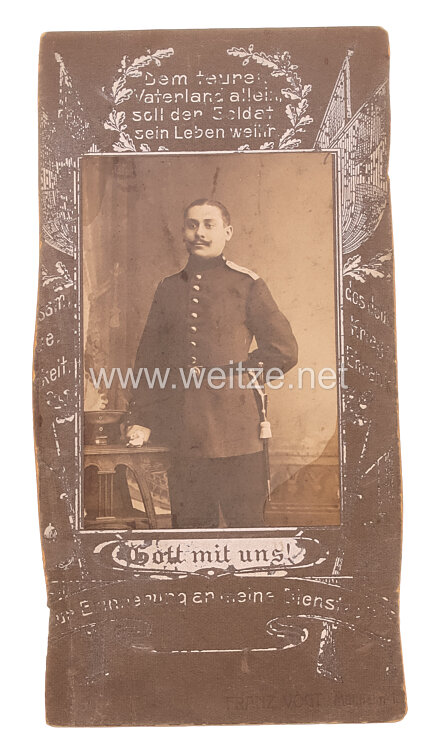
Baden Cabinet Card Photograph of a Gefreiter in the 7th Baden Infantry Regiment No. 142

Location Mühlheim i.B., circa 1910. Dimensions approximately 8.5 x 16.5 cm. Condition 2-
449726
20,00

Baden Cabinet Card Photograph of a Gefreiter in the 7th Baden Infantry Regiment No. 142

This cabinet photograph depicts a Private First Class (Gefreiter) of the 7th Baden Infantry Regiment No. 142 and dates from around 1910. It was taken in Mühlheim in Breisgau and represents a typical form of military portrait photography from the late Imperial era.

The 7th Baden Infantry Regiment No. 142 was established in 1897 as part of the army expansion of the German Empire. The regiment was stationed in Müllheim in Breisgau and belonged to the 29th (Baden) Division of the XIV Army Corps. Its regimental number 142 placed it within the comprehensive structure of the Imperial Army, with Baden traditionally providing several infantry regiments.

The soldier depicted holds the rank of Gefreiter, the lowest non-commissioned officer grade in the Imperial Army. This rank was indicated by specific sleeve insignia and represented a first promotion beyond the simple private. Gefreite assumed minor leadership responsibilities and were considered reliable, experienced soldiers.

Cabinet photography was the predominant format for portrait photography between 1860 and World War I. Typically measuring 8.5 x 16.5 cm when mounted on cardboard, these photographs were larger than the earlier carte-de-visite format and were excellently suited for preservation in photo albums or display on dressers and mantlepieces. For soldiers, such photographs held particular significance: they documented military service, which enjoyed high prestige in Wilhelmine society, and served as mementos for family and friends.

The period around 1910 was characterized by relative peace but also increasing international tensions. The German Empire under Kaiser Wilhelm II pursued an ambitious world policy and continuously expanded its armed forces. Universal conscription ensured that nearly every young man served several years of military service, making the army a central institution of society.

Military photographers were established in all major garrison towns. They specialized in photographing soldiers in their uniforms and possessed appropriate studio backgrounds and props. The photographs followed certain conventions: the soldier was usually presented in full uniform, often with a rifle or other military attributes, in a dignified posture. These photographs were not merely personal keepsakes but also expressions of pride and sense of duty.

Infantry Regiment No. 142 later participated in World War I and fought on various fronts. The regiment was deployed on the Western Front and experienced the devastating material battles of Verdun and the Somme. Many of the young men who, like the depicted Gefreiter, still served in peacetime around 1910, would find themselves in the trenches of the Great War just a few years later.

Photographs such as this possess significant cultural-historical value today. They document not only military uniforms and rank insignia but also social-historical aspects of the Wilhelmine era. The faces of these young men tell of a time when military service was considered a natural duty and honorable, just before the catastrophe of World War I irrevocably changed this world.

For collectors and historians, such cabinet photographs are important sources. They enable the reconstruction of uniform details, the identification of regiments based on insignia and equipment, and provide insight into the photographic practices of the time. The condition of such photographs varies greatly, with the noted “condition 2-” indicating good to very good preservation, with possibly minor signs of wear.