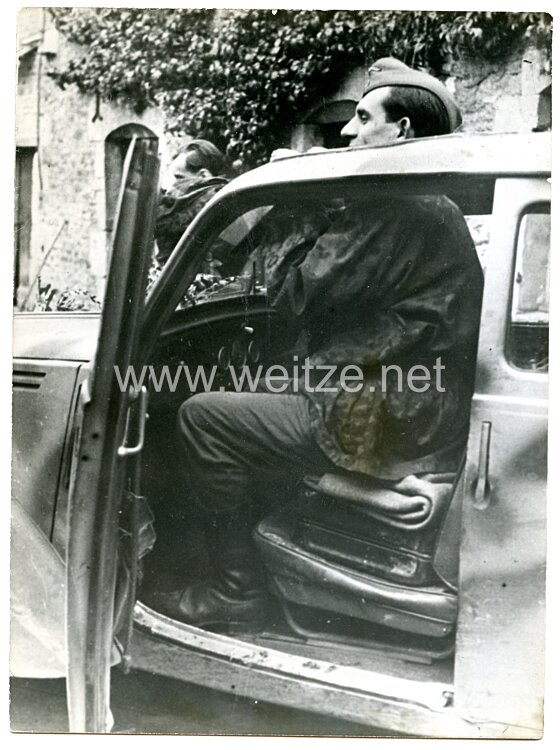
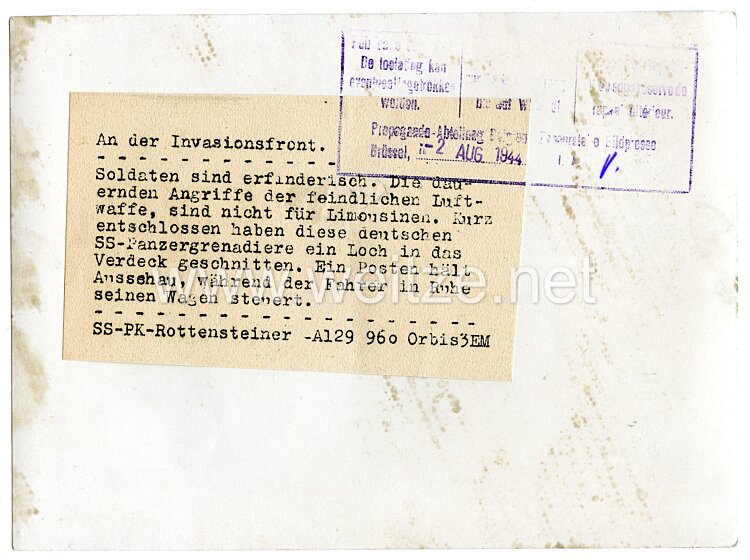
Waffen-SS Press Photograph: At the Invasion Front 2.10.1944

Dimensions approx. 13 x 18 cm. Condition 2.
466025
60,00

Waffen-SS Press Photograph: At the Invasion Front 2.10.1944

This Waffen-SS press photograph dated October 2, 1944, documents a critical moment in World War II history. Such images were part of the extensive Nazi propaganda machinery that attempted to convey a particular image of the military situation until the final months of the war.

By October 1944, the German Reich found itself in a desperate strategic position. Following the successful Allied landing in Normandy on June 6, 1944 and the subsequent breakout from the beachhead, the Wehrmacht had suffered substantial losses. The Western Front had collapsed, and Allied troops already stood at the German border. Simultaneously, the Red Army was advancing inexorably in the East.

The Propaganda Companies (Propagandakompanien or PK) of the Wehrmacht and Waffen-SS played a central role in documenting and propagandistically processing war events. These units were staffed with specially trained photographers, cameramen, and reporters who operated at the front. Their tasks included not only documenting military operations but primarily producing material for the home front and international press.

Press photographs like the present one were created and censored according to strict guidelines. The Reich Ministry of Public Enlightenment and Propaganda under Joseph Goebbels controlled the distribution of all images. Every photograph had to be approved before being released to newspapers, magazines, or for propaganda purposes. Typically, such photos bore stamps, inscriptions, and often pre-formulated captions on the reverse.

The term “Invasionsfront” (Invasion Front) was the official Nazi designation for the Western Front after the Allied landing. This terminology was intended to suggest that Germany was defending itself against an unlawful invasion, while in reality, the Nazi regime had invaded and occupied Europe. The propaganda systematically attempted to prepare the German population for a final struggle.

In autumn 1944, German propaganda increasingly focused on exhortations to persevere and the portrayal of supposed “wonder weapons.” The military reality, however, was different: the Wehrmacht was exhausted in personnel and materiel, fuel and ammunition were scarce, and Allied air superiority was overwhelming. The Waffen-SS, originally conceived as a military elite formation, had also suffered heavy losses and was increasingly filled with conscripts.

The technical characteristics of such press photographs were standardized. The format of approximately 13 x 18 cm was typical for German military photographs of this period. Images were usually printed on Agfa or other German photographic papers. Quality varied depending on the availability of materials, which became increasingly scarce toward the end of the war.

From today's perspective, such documents are important historical sources that must be analyzed critically. They do not show the objective reality of war events but rather a staged version serving political and propaganda purposes. Nevertheless, they offer insights into the self-representation of the Nazi regime, the visual language of the time, and the mechanisms of war propaganda.

The collector community today treats such objects with great caution. Serious institutions and collectors emphasize the purely historical and documentary value. In Germany, depictions with Nazi symbols are subject to criminal examination under § 86a StGB, although use for purposes of historical research and education is explicitly permitted.

The present photograph is thus a contemporary witness from the final months of World War II, documenting the propaganda efforts of a dying regime and today serving as educational material about the mechanisms of totalitarian image politics.