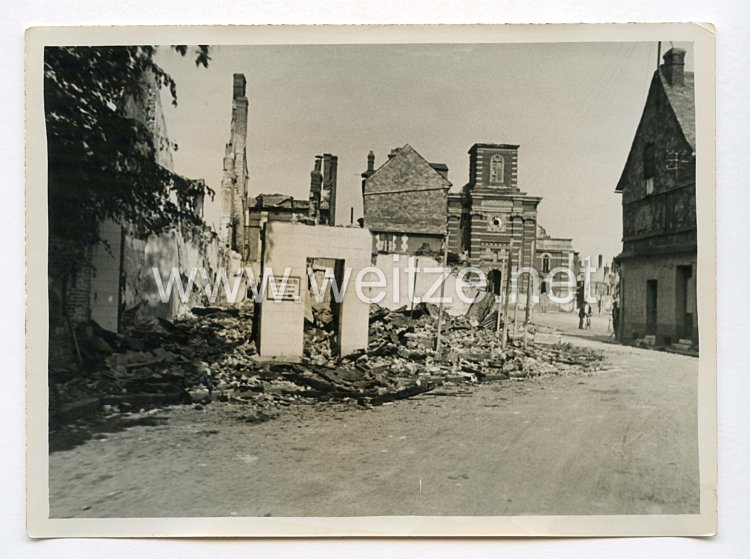
Press Photo, Occupation of France 1940:

, approx. 13 x 18 cm, condition 2.
317625
20,00

Press Photo, Occupation of France 1940:

This press photograph documents one of the most significant military campaigns of World War II: the occupation of France in 1940. Such photographs were central instruments of contemporary war reporting and propaganda, and today represent important historical sources.

The Western Campaign, officially designated as Fall Gelb (Case Yellow), began on May 10, 1940, with the German attack on the neutral Benelux countries and France. The German Wehrmacht executed a revolutionary operational approach known as the Sichelschnitt (Sickle Cut) plan. Rather than frontally attacking the heavily fortified Maginot Line, German armored units penetrated through the Ardennes, which French military strategists had considered impassable for large troop formations. This bold thrust led to the encirclement of Allied forces and France's military collapse in just six weeks.

The Wehrmacht's Propaganda Companies (Propaganda-Kompanien or PK) played a crucial role in the photographic documentation of this campaign. These units were established in 1938 and combined military organization with journalistic work. PK photographers were uniformed soldiers specially trained to document combat operations. Their task was to provide material for the home front, international press, and historical archives.

The technical specifications of the described photograph – approximately 13 x 18 cm – correspond to a standard format for press prints of this period. This size was practical for archiving, shipping, and reproduction in newspapers and illustrated magazines. Press photographs were typically developed on high-quality photographic paper and often annotated with captions, censorship stamps, and archive numbers.

The Armistice of Compiègne was signed on June 22, 1940, in the same railway car where Germany had capitulated in 1918 – a deliberate symbolic humiliation of France by the Nazi regime. France was divided into an occupied zone in the north and west, and the unoccupied zone in the south under the Vichy government led by Marshal Philippe Pétain. Paris was declared an open city on June 14, 1940, and occupied without a fight.

Press photographs from this period served multiple functions: they served domestic propaganda to boost morale, were used for international reporting, and were intended to demonstrate military superiority. The Reich Ministry of Public Enlightenment and Propaganda under Joseph Goebbels strictly controlled the distribution and use of such images. Every photograph cleared for publication had to pass through several levels of censorship.

The preservation of such documents is of considerable historical value. The indicated condition 2 suggests, according to the standard collector grading scale, a well-preserved specimen with minor signs of use. Original photographs from this period may show signs of aging such as slight discoloration, minimal edge damage, or archive-related markings.

From a military-historical perspective, such photographs document not only combat operations but also the organization of occupation troops, civilian population reactions, and the transformation of urban and rural spaces under occupation. They show German troops during victory parades, commanders taking over administrative buildings, or the establishment of military presence in French cities.

The occupation of France had far-reaching consequences for the further course of the war. It gave Germany control over important industrial resources, French ports for the U-boat war in the Atlantic, and a strategic position against Britain. Simultaneously, the French Résistance emerged, and General Charles de Gaulle established Free France (France Libre) in London.

Today, such press photographs are important research objects for historians studying the visual culture of National Socialism, propaganda mechanisms, and the everyday reality of World War II. They are preserved in archives such as the Bundesarchiv in Koblenz, the Institute for Contemporary History in Munich, or international collections, and are used for scholarly and educational purposes.