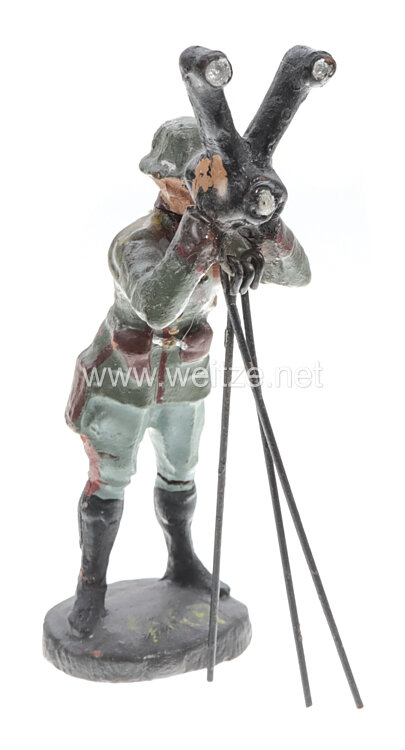
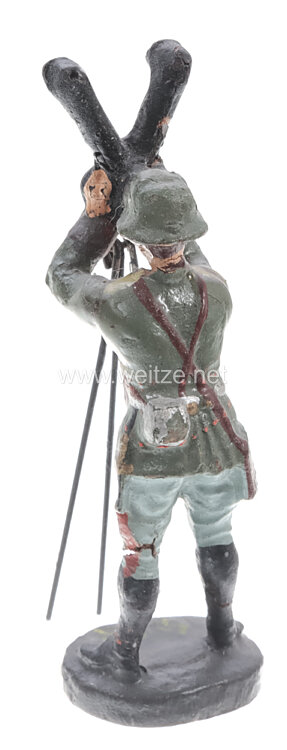
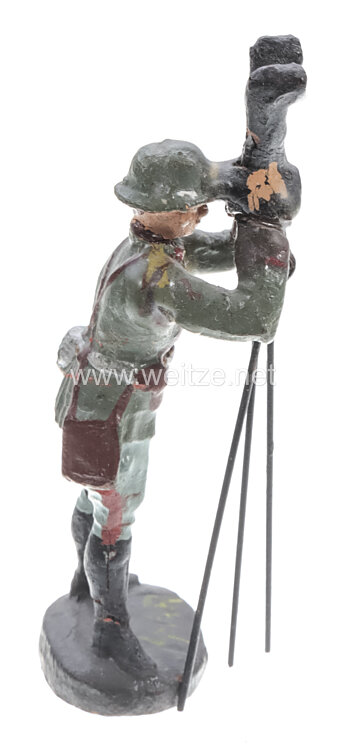
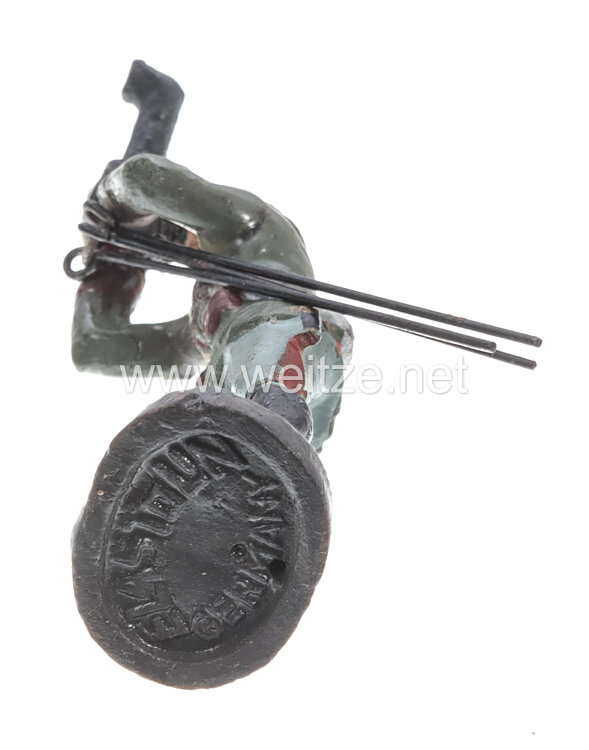
Elastolin - Army Soldier at Rangefinder, Standing
The Elastolin figure of an Army soldier at a rangefinder represents an important aspect of military training and equipment of the German Wehrmacht during the 1930s and 1940s. This toy figure in 7.5 cm scale was manufactured by the renowned firm O. & M. Hausser in Ludwigsburg, which became world-famous under the brand name Elastolin.
The representation shows a soldier in standing position at a rangefinder with tripod, an essential optical instrument for artillery and other service branches. Rangefinders were indispensable for precise determination of distance to enemy targets and played a crucial role in modern warfare of the 20th century.
Historical Context of Rangefinders: The development of optical rangefinders began in the late 19th century. The German military employed various types, including stereoscopic rangefinders and coincidence rangefinders. These devices worked on the principle of triangulation and enabled trained observers to determine distances of several kilometers with remarkable accuracy. The smaller models mounted on tripods, as depicted in this Elastolin figure, were typically used by infantry units, artillery observers, and pioneer troops.
The Elastolin Company: The Hausser brothers founded their company in 1904 and developed a revolutionary compound made from casein, chalk, linseed oil, and other materials, which they named Elastolin. This material was lighter and more break-resistant than traditional materials like tin or lead casting. From the 1920s onwards, the company produced military figures in various scales, with the 7.5 cm figures (approximately 1:24 scale) being among the most popular.
During the Nazi era, the production of military toy figures experienced an enormous boom. The figures served not only for entertainment but also for ideological education of youth. Elastolin produced detailed representations of all Wehrmacht service branches, from infantrymen to artillerymen to special units. The figures were distinguished by their realistic painting and precise depiction of uniforms, equipment, and weapons.
Technical Details of the Representation: The depicted soldier typically wears the field-gray uniform of the Army with characteristic details such as the M35 or M40 steel helmet, belt equipment, and appropriate field clothing. The tripod stand enabled stable setup of the rangefinder in the field. In military practice, such devices were operated by specially trained soldiers, often in cooperation with cartographers and artillery officers.
Collector Value and Condition: The condition rating “2” according to common collector classification (which typically ranges from 1 for mint condition to 5 for heavily damaged) indicates a well-preserved figure with minimal signs of use. Elastolin figures from the pre-war and wartime period are today sought-after collector's items, whose value depends on condition, rarity, and historical significance.
Post-War Development: After World War II, the company was initially not permitted to produce military figures. Only later, under changed conditions and with historical focus, were military-historical figures produced again. However, pre-war and wartime production remains most sought after by collectors.
This Elastolin figure is thus not merely a toy object but also a historical document that provides insight into military equipment, toy production, and social conditions of that era. It represents a tangible connection to a complex period of history and serves as a reminder of how military culture permeated even children's play during this time.