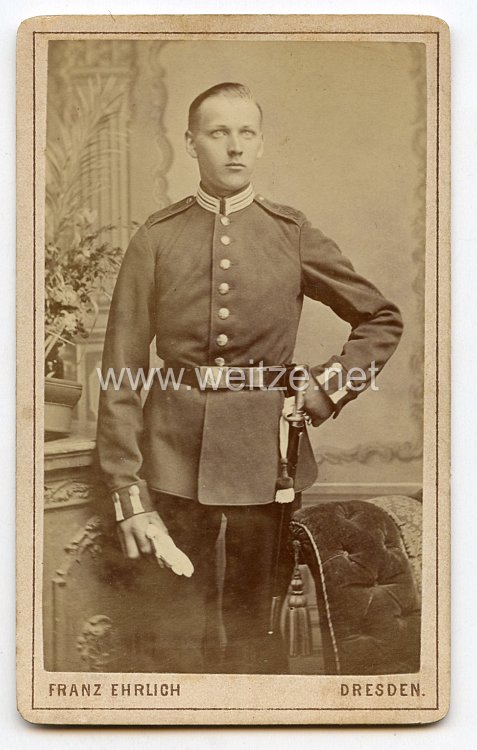
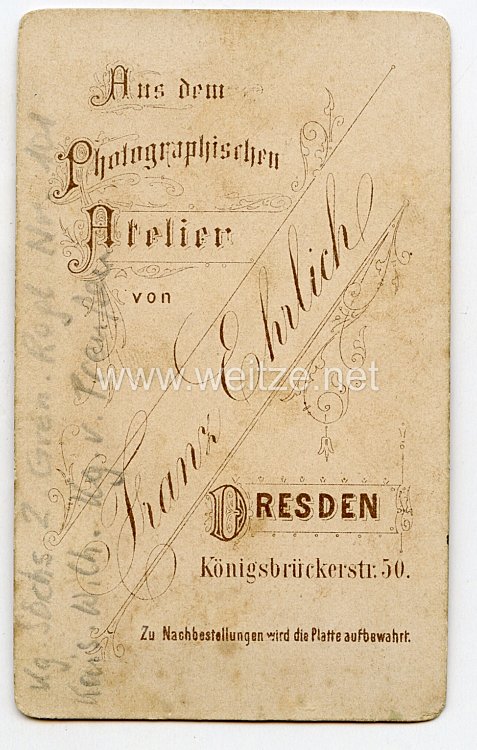
Saxony Cabinet Card Photograph Soldier of the 2nd Grenadier Regiment No. 101 Kaiser Wilhelm, King of Prussia

Location Dresden, circa 1900. 6.4 x 10.5 cm. Condition 2.
427524
25,00

Saxony Cabinet Card Photograph Soldier of the 2nd Grenadier Regiment No. 101 Kaiser Wilhelm, King of Prussia

This cabinet photograph depicts a soldier of the 2nd Grenadier Regiment Nr. 101 “Kaiser Wilhelm, King of Prussia”, taken around 1900 in Dresden. This type of photographic documentation represents an important testimony to military culture in the Kingdom of Saxony during the Wilhelmine era.

The 2nd Grenadier Regiment Nr. 101 belonged to the Saxon army, which existed as an independent contingent within the German Empire until 1918. The regiment bore the honorary name “Kaiser Wilhelm, King of Prussia” and was stationed in Dresden, the capital of the Kingdom of Saxony. This naming reflected the complex federal structures of the Empire, where individual federal states maintained their own army corps, which were nevertheless subordinate to the Prussian King as German Emperor.

Cabinet photography established itself in the 1860s as the standard format for portrait photographs, gradually replacing the smaller carte-de-visite format. With dimensions typically measuring 10 x 15 cm mounted on cardboard, cabinet photos offered a larger image area and better detail reproduction. By 1900, such photographs were an integral part of military and civilian memorial culture. Soldiers had themselves photographed in uniform to send these images to family and friends or to preserve them as personal mementos.

Grenadier regiments enjoyed particular prestige within the German armies. Historically, the term “grenadier” originally designated soldiers armed with hand grenades, but by 1900 this had long become a purely honorary title for selected infantry units. The Saxon grenadier regiments recruited their troops mainly from their own kingdom and maintained strong regional traditions.

The uniform of the Saxon grenadiers around 1900 largely corresponded to Prussian patterns but displayed characteristic Saxon peculiarities. The peacetime uniform consisted of dark blue tunics with regiment-specific facings, Pickelhauben (spiked helmets) with the Saxon coat of arms, and the typical shoulder straps with regimental numbers. The 2nd Grenadier Regiment Nr. 101 wore white shoulder straps and collars with the number “101”. The precise execution of uniform and equipment followed detailed dress regulations that governed wearing down to the smallest detail.

Dresden had several established studio photographers around 1900 who specialized in military portraits. These photographers maintained professionally equipped studios with elaborate backgrounds, props, and optimal lighting. The photographs served not only private purposes but also documented the military hierarchy and self-image of the imperial army. Often standardized poses were used that emphasized the military drill and bearing of the soldier.

The period around 1900 marked the peak of German militarism in peacetime. The military enjoyed the highest social prestige, and service in a traditional regiment like the 2nd Grenadier Regiment was considered an honor. Universal conscription, practiced in Saxony as throughout the German Empire, meant that most young men served several years of military service. This experience shaped an entire generation and manifested itself in countless photographic documents.

The Saxon army corps comprised two corps, the XII and XIX Army Corps. The 2nd Grenadier Regiment Nr. 101 belonged to the 1st Division of the XII Army Corps. Garrisoned in Dresden during peacetime, the regiment would have been mobilized as part of the Saxon troops in the event of war. Indeed, the regiment marched to the front with the outbreak of World War I in 1914, where it suffered considerable losses.

Such cabinet photographs possess high documentary and collectible value today. They enable detailed studies of uniforms, equipment, and military iconography. For military historians, uniform specialists, and collectors, they offer invaluable primary sources for researching the military everyday culture of the Empire. The condition of such photographs varies considerably, depending on storage conditions and material quality.

Photographic technology around 1900 was still based on wet collodion or gelatin dry plates, which already allowed relatively short exposure times. This enabled sharper, more detailed images than in earlier decades. The prints were made on albumen paper or later on silver gelatin paper and mounted on stable cardboard, which frequently bore the studio imprint.

This photograph thus represents a significant piece of German military history at the threshold of the 20th century, when the Empire stood at the height of its power, a few years before World War I, which would fundamentally change this world.