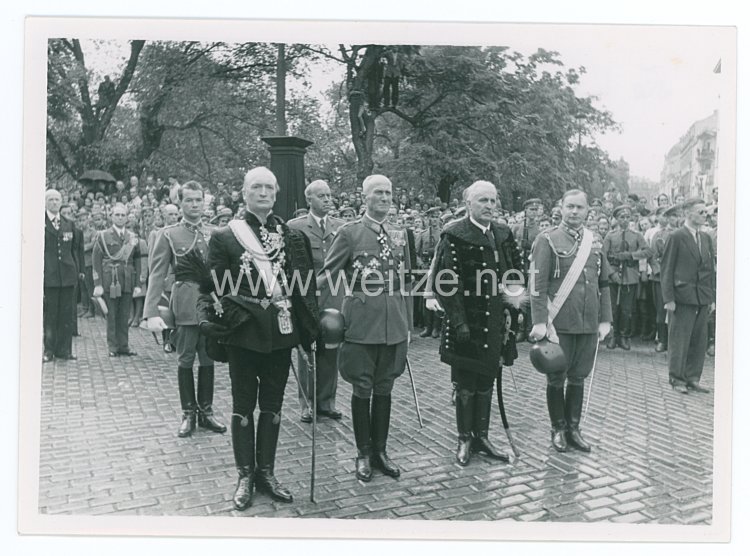
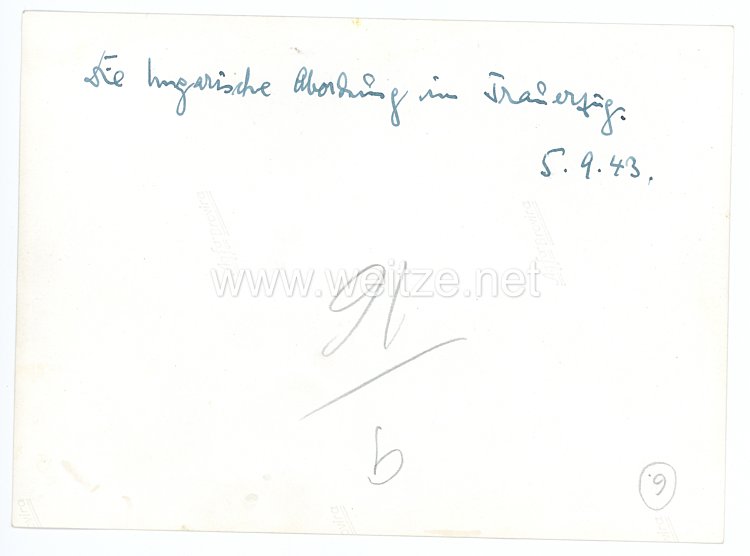
Photograph of Hungarian Delegation at the Funeral Procession of Bulgarian King Boris III
This photograph documents a significant moment in European history during World War II: the Hungarian delegation at the funeral procession of King Boris III of Bulgaria in August 1943. The image, measuring approximately 13 x 18 cm, belongs to those contemporary historical documents that capture the complex diplomatic and military relationships between the Axis powers.
King Boris III (1894-1943) ruled Bulgaria from 1918 and died under mysterious circumstances on August 28, 1943, just days after meeting with Adolf Hitler at his Wolfsschanze headquarters. The monarch's sudden death, officially attributed to a heart attack, triggered numerous speculations and became one of the great mysteries of World War II. His funeral procession and burial in Sofia attracted high-ranking delegations from all allied nations.
Hungarian-Bulgarian relations during World War II were characterized by their shared role as allies of the German Reich. Both countries had suffered territorial losses in World War I and hoped for revisions through their Axis affiliation. Hungary under Regent Miklós Horthy and Bulgaria under King Boris III pursued similar foreign policy strategies, though both attempted to preserve their sovereignty vis-à-vis Germany and particularly to avoid full participation in the Holocaust.
The Hungarian delegation at Boris's funeral represented the official mourning of the Kingdom of Hungary and demonstrated diplomatic solidarity between the two nations. Such state occasions were of the highest importance in protocol terms and were documented through photographs for posterity. The presence of Hungarian military and government representatives underscored the importance of bilateral relations.
Photographs like this served multiple purposes: they were official documentation of state events, propaganda material to display Axis unity, and historical sources for future generations. The format of approximately 13 x 18 cm corresponds to the standard dimensions for official press photographs and military documentation of the era. Such images were produced by accredited photographers and distributed to press agencies, archives, and involved government offices.
The historical context of 1943 was marked by the turning tide of war. After the defeat at Stalingrad in February 1943 and the Allied landing in Italy, the smaller Axis powers began seeking exits from the war. Boris III had endeavored to keep Bulgarian troops away from the Eastern Front and had refused to hand over Bulgarian Jews to Germany. His death removed one of the more cautious voices within the Axis alliance.
The funeral itself took place at Alexander Nevsky Cathedral in Sofia, with subsequent burial at Rila Monastery. Besides the Hungarian delegation, representatives from Germany, Italy, Romania, Croatia, and other allied states were present. The ceremony was one of the last major diplomatic gatherings of the Axis powers in Southeastern Europe.
For collectors and historians, such contemporary photographs are of inestimable value. They offer visual primary sources that complement official documents and written reports. The authenticity of such images can be confirmed through comparisons with other documented pictures of the event, through analysis of period photographic techniques, and through examination of provenance and context.
The year 1943 marked a turning point for Hungary and Bulgaria. Both countries would attempt to break away from Germany in the following years, leading to different outcomes. Bulgaria switched sides in 1944 and declared war on Germany, while Hungary was occupied by Germany after Horthy attempted to conclude an armistice with the Allies.
This photograph is thus not merely an image of a funeral ceremony, but a contemporary document of the Axis powers at a critical moment of World War II, documenting the diplomatic relations, military alliances, and personalities that decided the fate of millions of people.