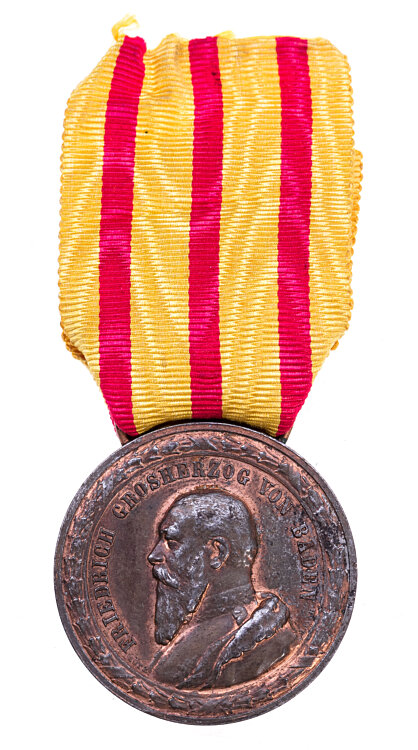
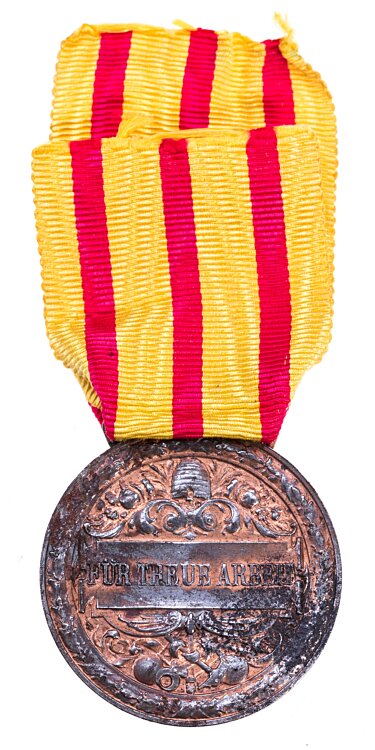
Baden Honor Badge for Workers and Male Servants 1916-1918 - Variant

Medal iron copper-plated, “Grosherzog”, “Für treue Arbeit”, die engraver: Götz Mayer, on ribbon, some fly rust, condition 2
55124
65,00

Baden Honor Badge for Workers and Male Servants 1916-1918 - Variant

The Baden Honor Decoration for Workers and Male Servants represents a fascinating example of social policy developments in the Grand Duchy of Baden during World War I. This award was created at a time when the home front played an increasingly important role in the war effort, and the recognition of faithful labor was considered vital to the war.

The Grand Duchy of Baden, one of the most significant medium-sized states of the German Empire, had a long tradition of honoring deserving citizens. Under Grand Duke Friedrich II (1907-1918), the award system was expanded to also recognize the merits of the working class and service personnel. This development reflected social changes and the growing importance of the labor movement in the early 20th century.

The specimen described here was created by the renowned engraver Götz Mayer, known for his precise and artistically high-quality work. The medal is made of copper-plated iron, which was characteristic of awards from the war years 1916-1918, when precious metals were needed for the armaments industry. The use of iron instead of bronze or silver was a direct result of war-related material shortages.

The inscriptions “Grosherzog” (in contemporary spelling, meaning Grand Duke) and “Für treue Arbeit” (For Faithful Work) illustrate the character of this decoration. It was awarded to honor long-term faithful service in crafts, industry, and domestic service. The award criteria typically included a service period of at least 25 or 40 years with the same employer, combined with impeccable behavior and special dedication to duty.

During World War I, this decoration gained an additional dimension. The home front became the second theater of war, and maintaining production as well as public order were of crucial importance. Workers in war-essential industries, railway workers, agricultural laborers, and servants who kept households running while men fought at the front made an indispensable contribution to the war effort.

The ribbon from which the medal was worn typically followed Baden's heraldic colors: red and yellow. The variant described here indicates differences in manufacture or award practices that could occur during the war years due to material shortages and various manufacturers.

The condition of the object with “some surface rust” is typical for iron decorations of this period. Iron is susceptible to corrosion, and the copper plating provided only limited protection. This condition underscores the authenticity and age of the piece.

After the end of World War I and the abdication of Grand Duke Friedrich II in November 1918, the awarding of this decoration also ended. The transformation of Baden into a free state within the framework of the Weimar Republic marked the end of the grand ducal award practice. These medals were thus awarded only for a relatively short period of about two to three years, making them sought-after collectibles.

Today, these decorations are important historical testimonies of an era of social upheaval. They document not only the award practices of a German medium-sized state but also the recognition of the working class at a time when the social question was gaining increasing importance. The Revolution of 1918/19 would ultimately fundamentally change social conditions, but awards like these show that approaches to recognizing workers' achievements already existed during the Empire.

For collectors and historians, such pieces offer valuable insights into the social and military history of the Grand Duchy of Baden and the German Empire during World War I.

r