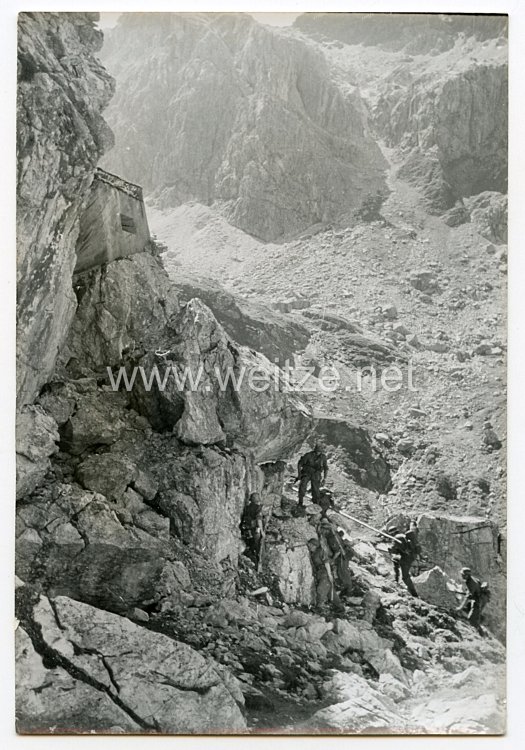
Wehrmacht Heer Press Photo: Pioneer Assault Team Attacks Rock Bunker with Concentrated Charge
This Wehrmacht press photograph documents a typical pioneer assault troop of the German Army (Heer) during an attack on an enemy rock bunker position using a concentrated charge (geballte Ladung). Such images were systematically produced by the Wehrmacht's Propaganda Companies (Propagandakompanien or PK) system and distributed to German and international press through the High Command of the Wehrmacht (OKW) and the High Command of the Army (OKH).
The concentrated charge was an improvised explosive device created by bundling multiple stick grenades (Model 24) together. Typically, a central stick grenade was surrounded by four to six additional grenades whose pull cords had been removed. Only the central grenade retained its detonator, so that when triggered, all bundled explosives detonated simultaneously. This method produced significantly greater explosive force than a single hand grenade and was particularly effective against bunkers, fortifications, and armored targets.
The Wehrmacht's pioneer troops (Pioniere) played a crucial role in all campaigns of World War II. Their tasks included overcoming obstacles, constructing fortifications, mine clearance, bridge building, and particularly combat against enemy bunker installations. The assault troop (Stoßtrupp) as a tactical formation had its roots in World War I experiences, where specialized units were developed to break through trench warfare stalemates.
In the context of World War II, such attacks on rock bunkers were particularly relevant during the Western Campaign of 1940 against the Maginot Line and Belgian fortresses, during the war against the Soviet Union from 1941 onward where numerous fortified positions had to be overcome, and during various operations in the Mediterranean theater. The Wehrmacht developed special tactics for bunker warfare that were documented in service regulations and training materials.
The Propaganda Companies were established in 1938 and consisted of specially trained soldiers who were simultaneously journalists, photographers, or cameramen. Their task was to document military operations and produce material for the home front and international press. These photographers were often present at the front lines and produced both authentic combat photographs and staged scenes for propaganda purposes.
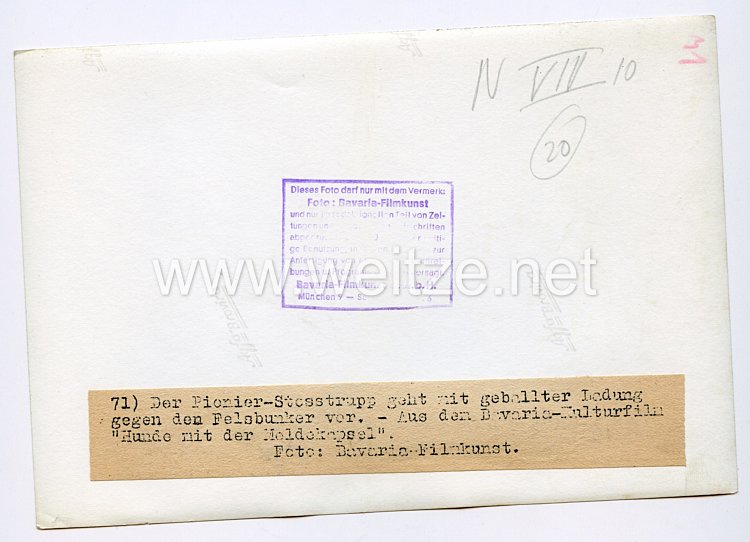
Press photographs like this one were typically marked on the reverse with stamps, censorship numbers, and captions. The inscriptions often contained information about location, date, units involved, and a description of the depicted scene. These photos were then distributed through the Press and Propaganda Office to German and foreign newspapers, magazines, and newsreels.
The equipment of a pioneer assault troop included, in addition to concentrated charges, flamethrowers, smoke grenades, explosives, submachine guns, and special pioneer tools. The soldiers often wore additional protection and were trained for close combat under extremely dangerous conditions. Attacking a bunker required careful coordination, often supported by artillery fire, smoke screens, and infantry support.
From a military-historical perspective, such photographs document important aspects of Wehrmacht warfare and tactics. They show the technical solutions developed for specific military problems, as well as the conditions under which soldiers operated. At the same time, they are documents of war propaganda that shaped the public image of military events.
Today, such press photographs are important historical sources for World War II research. They are found in archives, museums, and private collections worldwide. When evaluating them historically, it must always be considered that these images were created in the context of Nazi propaganda and often offered an idealized or staged representation of military operations. Nevertheless, they provide valuable information about equipment, tactics, uniforms, and the visual documentation of the war.