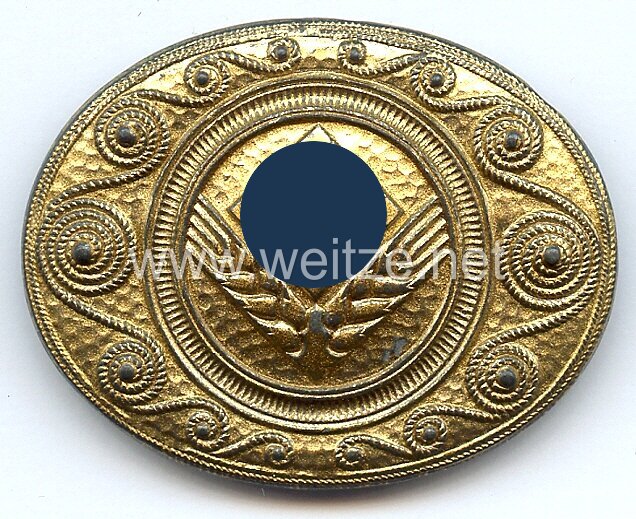
Reich Labor Service for Female Youth (RAD/wJ) - Commemorative Brooch in Gold
The Reichsarbeitsdienst der weiblichen Jugend (RAD/wJ) Gold Commemorative Brooch represents a significant chapter in German history between 1933 and 1945. This award was presented to female members of the Reich Labor Service and symbolizes their service and commitment to this National Socialist organization.
The Reichsarbeitsdienst (RAD) was officially established as compulsory service for all young Germans in 1935, although its predecessors date back to the Weimar Republic. Originally conceived as a voluntary labor service, the RAD became a mandatory institution through the Reich Labor Service Law of June 26, 1935. The female division, the Reichsarbeitsdienst der weiblichen Jugend, was developed in parallel and accepted young women between the ages of 17 and 25.
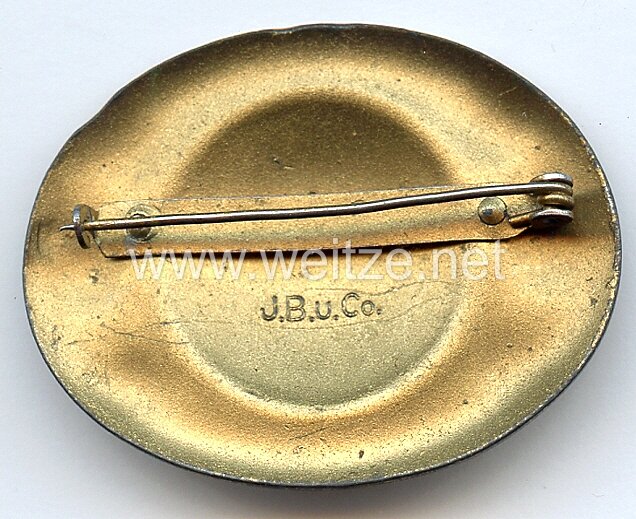
The present brooch made of fine zinc was manufactured by J.B.u.Co., one of the authorized producers of Nazi badges and awards. The use of fine zinc was common during the war years, as more valuable metals were reserved for armaments production. The gold version of the commemorative brooch represented special recognition, presumably awarded for long-term or particularly meritorious service.
The RAD/wJ had specific tasks that differed from those of the male division. While male labor service members were mainly employed in infrastructure projects, land reclamation, and later in military-related tasks, the female labor service focused on agricultural assistance, domestic duties, and social services. Young women were housed in camps and had to complete six months of service, which became mandatory from 1939 onwards.
The organizational structure of the RAD/wJ was strictly hierarchical. Members wore specific uniforms consisting of brown skirts, white blouses, and characteristic headscarves. The camps were led by Arbeitsführerinnen (work leaders) who were responsible for the ideological training and practical education of the young women. An important aspect of the service period was National Socialist indoctrination, which was considered an integral part of the program.
Commemorative brooches like this one served multiple purposes. On the one hand, they were recognition for services rendered; on the other hand, they were means of promoting identification with the organization and the regime. The wearers could continue to wear the brooch after their service, thereby demonstrating their belonging to the “Volksgemeinschaft” (people's community). The gold version indicates a higher level of recognition, possibly for multi-year service or special achievements.
The manufacture by J.B.u.Co. indicates the industrial production of such awards. Various manufacturers were authorized to produce official RAD insignia but had to comply with strict quality and design standards. The manufacturer's mark on the pin was common practice and today enables the attribution and authentication of such pieces.
The historical context of this commemorative brooch is inextricably linked to National Socialist ideology. The RAD/wJ was part of a comprehensive system for mobilizing and controlling youth. The organization served to prepare young women for their designated role in Nazi society, which was primarily seen in motherhood, domestic economy, and support of the “Volksgemeinschaft.” At the same time, the service also offered some young women opportunities to leave their familiar social environment and gain new experiences.
As World War II progressed, the role of the RAD/wJ also changed. Labor service women were increasingly deployed in war-essential areas, supported agriculture to compensate for conscripted male workers, and assisted in social institutions. Toward the end of the war, some units were even employed in anti-aircraft defense and other military-related areas.
After 1945, the Reich Labor Service was dissolved as a National Socialist organization. Awards and badges such as this commemorative brooch became historical witnesses to a dark epoch of German history. Today, such objects serve in museums and collections as illustrative material for researching and teaching about the Nazi era, always emphasizing the critical historical context.
The preservation in Condition 2 suggests that this specimen is well preserved, which is remarkable for an object made of fine zinc that is over 75 years old. Such pieces are today important sources for militaria research and the study of propaganda and recognition systems of totalitarian regimes.