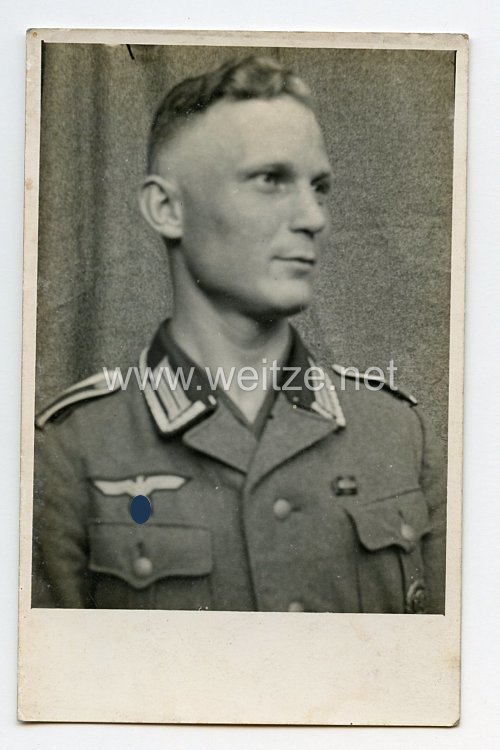
Wehrmacht Heer, Non-Commissioned Officer with Reich Sports Badge

Postcard size, condition 2.
402721
8,00

Wehrmacht Heer, Non-Commissioned Officer with Reich Sports Badge

This postcard in standard postcard format depicts a Wehrmacht Heer Unteroffizier (German Army Non-Commissioned Officer) wearing the Reichssportabzeichen (Reich Sports Badge). Such photographs were widespread during World War II and served both private and propagandistic purposes.

The Unteroffizier rank represented the first level of non-commissioned officers without portepee in the Wehrmacht Heer. Unteroffiziere formed the backbone of the military organization and carried significant responsibility for training and leading enlisted men. They were identified by distinctive rank insignia consisting of silver-colored braiding on the collar patches and later also on shoulder straps. Promotion to Unteroffizier typically occurred after appropriate service time and successful completion of NCO training.

The Reichssportabzeichen was originally introduced in 1913 as the German Imperial Badge for Physical Exercise by the German Imperial Committee for the Olympic Games. After the Nazi seizure of power in 1933, it was reorganized and re-established on December 19, 1933, under the name Reichssportabzeichen. It was considered an important decoration for physical fitness and was available in three grades: Bronze, Silver, and Gold, depending on the bearer's age and athletic performance.

To receive the Reichssportabzeichen, candidates had to achieve minimum performances in various disciplines. These typically included track and field events (running, jumping, throwing), swimming, and sometimes shooting. Requirements were graded according to age classes and had to be fulfilled within one calendar year. Particularly in the Wehrmacht, great emphasis was placed on physical fitness, and achieving the Reichssportabzeichen was encouraged and recognized.

The badge itself was worn as a pin on the left breast side of the uniform. It featured a stylized eagle above an oak wreath with swastika, surrounded by the inscription “Reichssportabzeichen.” The different metal versions (Bronze, Silver, Gold) indicated the performance level achieved. Multiple recipients received additional recognition in the form of numerical designations.

Photographs like this postcard served several functions in the Third Reich. On one hand, they served as personal mementos that soldiers sent to their families or kept themselves. On the other hand, they were part of military documentation and propaganda. Wearing decorations such as the Reichssportabzeichen in such photographs demonstrated not only personal achievement but also the regime's values: physical fitness, discipline, and military preparedness.

The production of such postcards was a significant industry during the war. Professional photographers operated both in garrisons and at the front. The photographs were often taken in photo studios where standardized backgrounds and optimal lighting conditions ensured representative portraits. The images were then developed on postcard paper, enabling direct mailing via field post.

The condition grade 2 (according to the standard collector's system from 1 for mint to 6 for heavily damaged) indicates a well-preserved postcard that may show slight signs of use but no significant damage. This is remarkable for a paper document over 75 years old and indicates careful preservation.

From a historical perspective, such documents are important testimonies today. They convey not only information about Wehrmacht uniforms and rank insignia but also about the self-presentation and self-perception of German soldiers during World War II. The combination of military rank and athletic decoration reflects National Socialist ideology, which propagated physical fitness as a central value.

For collectors and historians, such postcards offer valuable insights into the material culture of the Wehrmacht and the everyday reality of German soldiers. They complement official documents and help paint a more complete picture of this historical epoch.

These artifacts serve as reminders of a complex and dark period in history, providing tangible connections to the individuals who lived through those times while helping modern researchers understand the social and military structures of Nazi Germany.

r