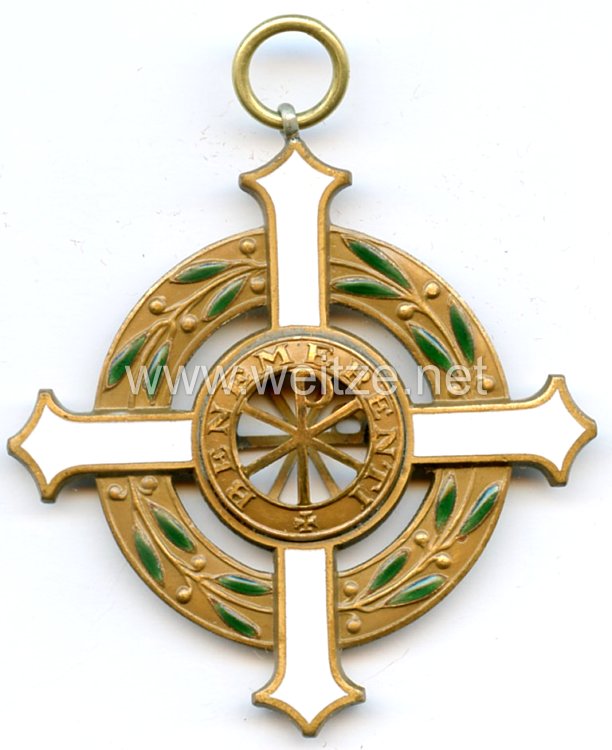
Vatican, Jubilee Cross 1950 in Bronze

Non-ferrous metal, without ribbon, pendant with the keys missing. Condition 2.
399921
70,00

Vatican, Jubilee Cross 1950 in Bronze

The Vatican Jubilee Cross 1950 (also known as the Holy Year Cross 1950) represents a significant papal commemorative decoration instituted on the occasion of the Holy Year 1950 under Pope Pius XII (1939-1958). This award belongs to the category of papal commemorative and jubilee medals, which have been an integral part of Vatican decorative traditions for centuries.

The Holy Year 1950 was an extraordinary jubilee year proclaimed by Pope Pius XII on December 24, 1949, lasting from December 24, 1949, to December 24, 1950. It was the first Holy Year following the devastating Second World War and therefore held particular symbolic significance for the renewal and reconstruction of Europe. The proclamation of the Holy Year was made through the bull “Jubilaeum Maximum,” in which Pius XII called for worldwide reconciliation and peace.

The present specimen is executed in bronze (base metal). Vatican jubilee crosses were traditionally awarded in different metal grades: gold for high-ranking dignitaries and significant benefactors, silver for clergy and meritorious laypeople of middle rank, and bronze for the broad mass of pilgrims and Holy Year participants. The bronze version was thus the most frequently awarded variant and was distributed to thousands of pilgrims and faithful who came to Rome during the Holy Year 1950.

The cross typically displays the characteristic design of papal decorations from this era. The obverse usually features the Christogram or a cross surrounded by religious symbols. The reverse frequently bears the date “1950” and references to the Holy Year. The missing attachment with the crossed keys is particularly noteworthy, as the Keys of Saint Peter – the crossed gold and silver keys – represent the central sovereign emblem of the Holy See and normally served as the suspension device.

The significance of the Holy Year 1950 cannot be overestimated. Approximately four million pilgrims flocked to Rome to participate in the celebrations. This was an impressive demonstration of Catholic faith at a time when Europe was still suffering from the consequences of war. Pope Pius XII used this jubilee to make important dogmatic declarations, including the proclamation on November 1, 1950, of the dogma of the Assumption of Mary into Heaven (Assumptio Beatae Mariae Virginis) through the Apostolic Constitution “Munificentissimus Deus.”

The jubilee cross was awarded not only to pilgrims but also to members of the clergy, religious orders, and laypeople who had made special contributions to organizing and conducting the Holy Year. The award criteria were relatively generous to provide as many faithful as possible with a lasting memento of this significant ecclesiastical event.

Vatican decorations differ fundamentally from military awards of secular states. They are not conferred for military service but for religious, charitable, and ecclesiastical services. Nevertheless, they are frequently included in collections of military and civil orders, as they are part of the European system of honors and possess historical and cultural significance.

The present piece is in condition 2, indicating good preservation with minor signs of wear. The absence of the ribbon and the attachment with the keys is not unusual for specimens from this period, as these parts were often lost or stored separately. The original ribbons were typically in the papal colors white and yellow (gold).

For collectors and historians, the Jubilee Cross 1950 represents an important testament to the immediate post-war period. It documents the central role of the Catholic Church in the reconstruction process of Europe and the efforts toward spiritual renewal after the horrors of war. The bronze variant is relatively common due to its wide distribution but nevertheless possesses historical and collectible character.

The Holy Year 1950 also marked important developments in Vatican diplomacy and the Church's position in the emerging Cold War. Pope Pius XII used the jubilee as a platform to emphasize Christian values against both communist atheism and excessive materialism in the West. The millions of pilgrims who received these crosses carried home not just a physical memento but also a renewed commitment to faith and peace in a divided world.