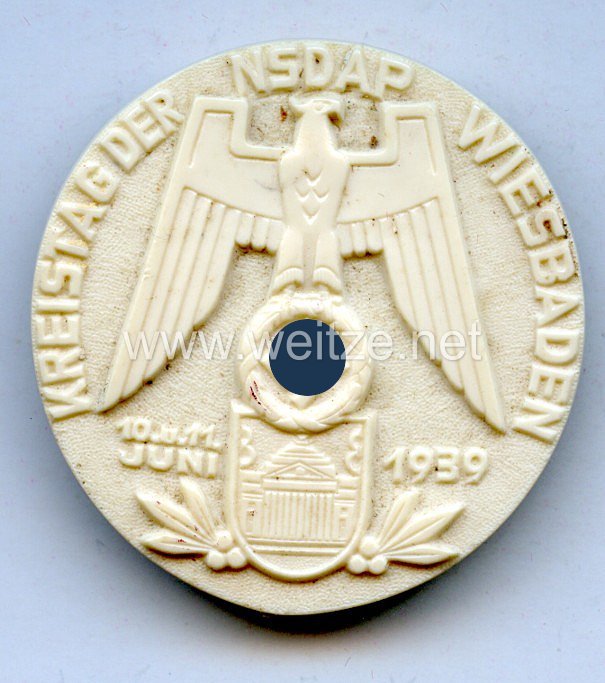
NSDAP - District Convention of the NSDAP Wiesbaden June 10 and 11, 1939
This badge documents a significant event in the history of the NSDAP (National Socialist German Workers' Party) shortly before the outbreak of World War II. The District Convention of the NSDAP Wiesbaden, held on June 10-11, 1939, was part of a systematic series of events through which the party demonstrated its power and mobilized the population.
Such district conventions were important components of the National Socialist organizational structure. They served ideological training, coordination of regional party activities, and public demonstrations of power. In the summer of 1939, only months before the invasion of Poland on September 1st, the German Reich was in the final preparation phase for war. Events like the Wiesbaden District Convention therefore also served to prepare the population for coming developments.
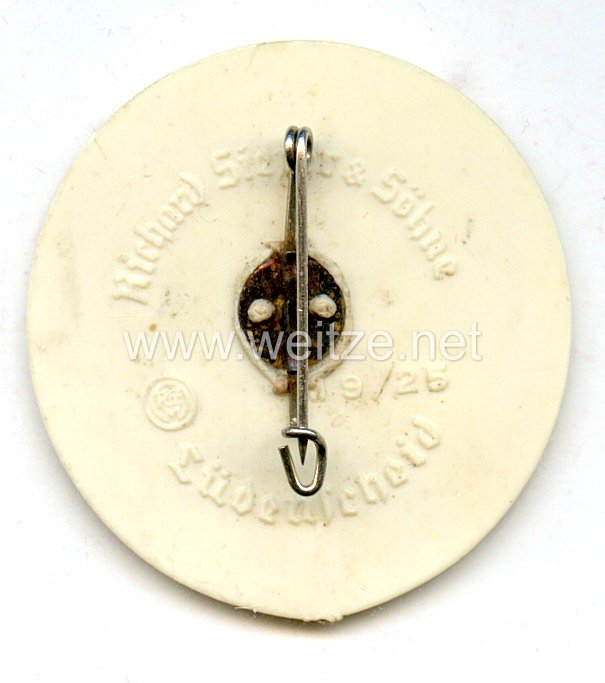
The badge itself is made of plastic, which was typical for the late 1930s. German armaments industry increasingly required metals for military purposes, so substitute materials were increasingly used for civilian and party purposes. The manufacturer Richard Sieper & Söhne from Lüdenscheid was an established producer of badges and awards. The company bore the RZM number M9/25, where RZM stood for Reichszeugmeisterei (Reich Quartermaster's Office).
The Reichszeugmeisterei was founded in 1929 and served as the central procurement and inspection office of the NSDAP. It controlled the manufacture and distribution of all party badges, uniforms, and equipment. Only manufacturers licensed by the RZM were permitted to produce official NSDAP insignia. Each approved manufacturer received a unique identification number that had to be affixed to products. The “M” stood for metal and plastic goods, the “9” designated regional allocation, and “25” was the specific manufacturer number of Richard Sieper & Söhne.
The Sieper company was among the most significant manufacturers of NS badges. The enterprise from Lüdenscheid, a traditional center of German metalware industry, produced a variety of party badges, event pins, and awards. The quality of Sieper products was generally high, and the company employed numerous workers during the NS period.
Wiesbaden as the venue for the district convention was of particular importance as the capital of the Prussian administrative district of Wiesbaden and as a spa town. The city was an important administrative and cultural center in the Rhine-Main area. The NSDAP had gained a foothold in Wiesbaden early on, and the city played an important role in the Gau leadership of Hesse-Nassau.
Event badges like this were issued to participants, organizers, and deserving party members. They served simultaneously as souvenirs and distinctions. Wearing such badges demonstrated solidarity with the party and participation in its activities. Collectors of NS badges were already active during the NS period, and collecting such devotional items was actually encouraged by the party, as it strengthened members' loyalty.
The pin attachment enabled fastening to civilian clothing or party uniforms. Unlike military decorations, such event badges had no official rank character, but were nevertheless worn proudly and regarded as signs of political commitment.
From today's perspective, such objects are important historical sources. They document the comprehensive penetration of everyday life by NS ideology and show how the party consolidated its rule through events, symbolism, and material culture. The condition grade 2 (very good) of this specimen indicates that it was carefully preserved over the decades. For collectors and historians, such well-preserved pieces are of particular value as they offer authentic insights into the material culture of the Third Reich.
Academic engagement with such objects always requires a critical and contextualized approach. They are testimonies of a criminal regime that plunged Europe into the most devastating war in its history and perpetrated the Holocaust. Their preservation and research serve historical understanding and serve as a warning.