Tailcoat Buckle of a Lippian Official and Soldier in World War I

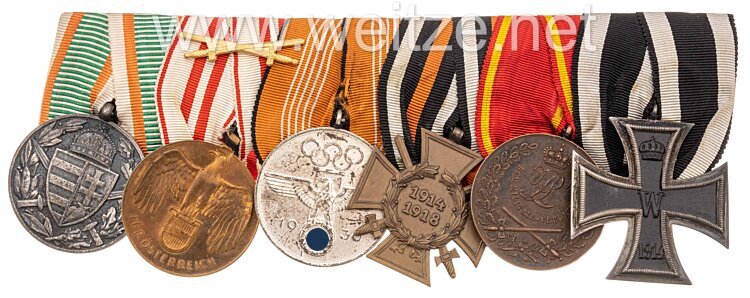
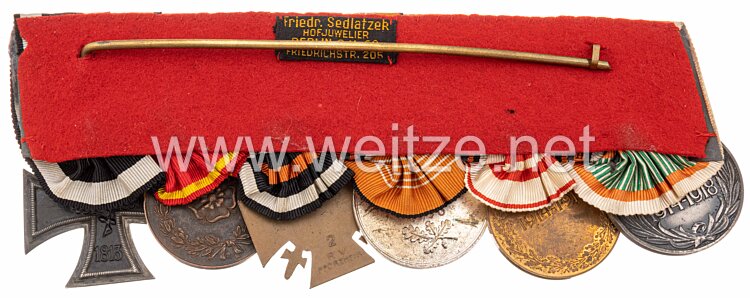
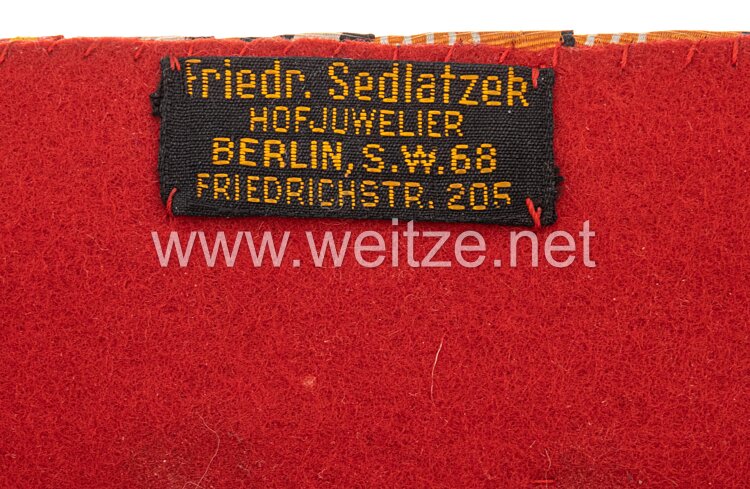
5 decorations: Iron Cross 2nd Class 1914, Schaumburg-Lippe Military Merit Medal with Swords, Honor Cross for Front Fighters 1934, Olympic Commemorative Medal 1936, Austria War Commemorative Medal 1914-1918, Hungary Commemorative Medal 1914-1918. Label of Friedrich Sedlatzek Berlin on reverse.
460521
600,00

Tailcoat Buckle of a Lippian Official and Soldier in World War I

This dress coat clasp (also known as a medal bar or ribbon bar) represents the military and civil career of an official and soldier from Lippe during World War I and the subsequent interwar period. The combination of five decorations on this bar tells the story of a man who served in war and experienced the turbulent political upheavals of the Weimar Republic and early Third Reich.

The Iron Cross 2nd Class of 1914 was the most famous and widely distributed German valor decoration of World War I. King Friedrich Wilhelm III of Prussia originally instituted this award in 1813 during the Wars of Liberation, and it was renewed in 1870 and 1914. Approximately 5.2 million Iron Crosses 2nd Class were awarded during World War I. Initially worn on a ribbon, it was later displayed as a ribbon bar on the uniform or as part of a medal bar.

The Schaumburg-Lippe Military Merit Medal with Swords points to the complex federal structure of the German Empire. The Principality of Schaumburg-Lippe, one of the smallest German federal states, had its own military decorations. This medal was awarded for military merit, with the swords indicating bestowal during wartime. The connection to Lippe is particularly interesting: the two principalities of Lippe and Schaumburg-Lippe were closely connected, and their soldiers often served in joint units within the Prussian army.

The Honor Cross for Frontline Combatants of 1934, also known as the Hindenburg Cross, was instituted by Reich President Paul von Hindenburg on July 13, 1934. This decoration was awarded to all participants in World War I who had taken part in combat operations. There were three variants: for frontline combatants (with swords), for war participants (without swords), and for bereaved families. The institution occurred in the early phase of the Nazi regime and was intended to honor World War I veterans and bind them to the regime. Approximately 6.2 million Honor Crosses for Frontline Combatants were issued.

The Olympic Commemorative Medal 1936 marks a remarkable transition from military to civil decorations. This medal was awarded on the occasion of the XI Olympic Summer Games in Berlin, which were instrumentalized by the Nazi regime as a propaganda event. It was given to organizers, helpers, and certain participants. The presence of this medal on the bar shows that the bearer remained active in public service during the interwar period, possibly as an official involved in organizing or conducting the Olympic Games.

The Austrian War Commemorative Medal 1914-1918 (also called the Karl Troop Cross) was instituted by Emperor Karl I of Austria on December 13, 1916. It was awarded to all Austro-Hungarian soldiers and their allies who participated in the war. The presence of this decoration indicates that the bearer likely fought on the Eastern Front or other theaters where German and Austro-Hungarian troops operated together.

The Hungarian Commemorative Medal 1914-1918 completes the group of war decorations. The Kingdom of Hungary, as part of the Dual Monarchy of Austria-Hungary, awarded its own decorations. This medal was issued to all participants in World War I who served in Hungarian or allied units with Hungary.

The label on the reverse from Friedrich Sedlatzek Berlin is of particular significance. Sedlatzek was one of the most renowned medal manufacturers and jewelers in Berlin, specializing in military decorations. His business was located in the Reich capital, and he produced both official awards and private medal bars. The use of such an established manufacturer underscores the value veterans placed on the presentation of their decorations.

The compilation of these specific decorations on a dress coat clasp was typical of the interwar period and the Third Reich. Veterans wore such bars at formal occasions, veteran meetings, and official ceremonies on civilian clothing. The bar represents not only personal valor and service but also the complex history of Germany and Central Europe in the early 20th century – from the Empire through defeat in World War I, the Weimar Republic, to the beginning of Nazi rule.