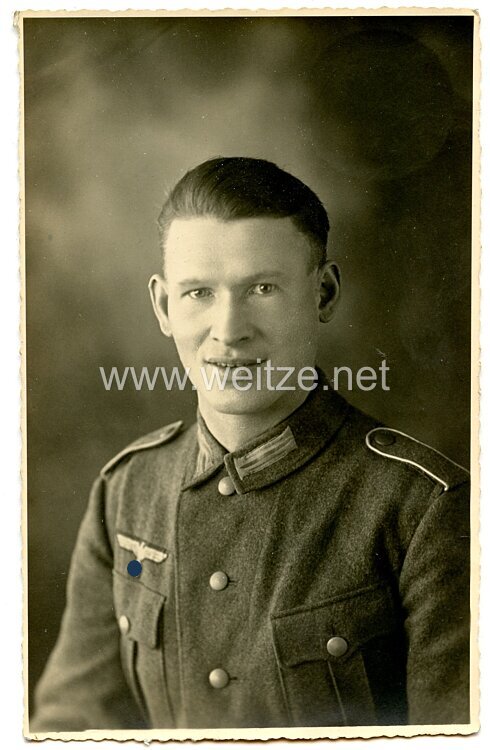
Wehrmacht Heer Portrait Photograph, Infantry Member
This portrait photograph in postcard format depicts a member of the Wehrmacht Heer Infantry and represents a significant category of military memorabilia from the period of World War II (1939-1945). Such photographs held immense personal and social significance during the war years and today constitute important historical documents.
The Wehrmacht, as the designation for the unified armed forces of the German Reich from 1935 to 1945, was divided into three service branches: the Heer (Army), the Kriegsmarine (Navy), and the Luftwaffe (Air Force). The Heer, with several million soldiers, formed the largest branch. The Infantry as a combat arm constituted the core of ground forces and bore the main burden of combat operations on all fronts.
Portrait photographs in postcard format were extremely common during the Nazi era. The standard size corresponded to the then-usual dimensions of approximately 9 x 14 cm or 10 x 15 cm, matching postcard format. This dimension was not chosen arbitrarily: it enabled cost-effective postal delivery and fit into the standardized photo albums of the time. Soldiers frequently had themselves photographed in photo studios near their barracks or during home leave, wearing their uniforms.
The tradition of military portrait photography dates back to the 19th century but experienced a particular flowering during World War II. For many young men, the military uniform symbolized masculinity, duty fulfillment, and national pride—values massively promoted by Nazi propaganda. The photographs served multiple purposes: they were keepsakes for families, gifts to fiancées or wives, and documented a significant life chapter.
Wehrmacht uniforming followed strict regulations established in the dress codes and clothing regulations. Infantrymen typically wore the field-gray uniform with characteristic insignia: shoulder straps with branch color (white for infantry), collar patches, and rank insignia appropriate to their grade. In such studio photographs, soldiers usually presented themselves in their best walking-out uniform, often with decorations and badges of honor.
Photographic practice during the war years was remarkably developed despite material shortages. Professional military photographers and civilian photo studios in garrison towns specialized in soldier portraits. The images were usually developed on high-quality photographic paper and often mounted on cardboard, which increased their durability. Many studios used elaborate backgrounds or props to lend the photographs special dignity.
From today's perspective, such photographs possess complex historical value. On one hand, they are personal documents of individual fates—each image shows a person with their own story, hopes, and often a tragic end. On the other hand, they document the visual culture and self-representation of an army involved in wars of aggression and war crimes. Academic engagement with such objects therefore requires sensitivity and historical contextualization.
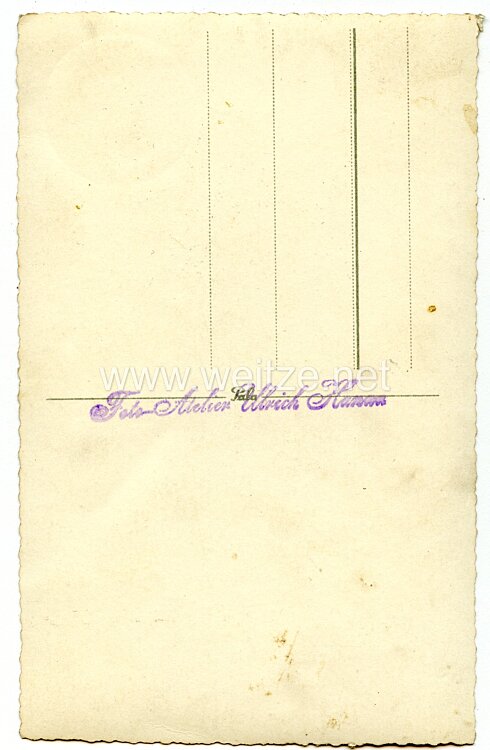
For collectors and historians, portrait photographs offer valuable information about uniformology, rank structures, and the everyday history of the Wehrmacht. Based on insignia, decorations, and uniform details, conclusions can often be drawn about the unit, rank, and deployment locations of the person depicted. Some photos bear handwritten dedications, dates, or photo studio stamps on the reverse, providing additional contextual information.
The condition of such historical photographs varies greatly. The designation “Condition 2” in the collector's world usually denotes good to very good condition with possibly minor signs of use. Factors such as storage, humidity, and light exposure significantly influence the longevity of these documents.
In today's culture of remembrance, such photographs play an ambivalent role. They commemorate the millions of young men who fought in a criminal war—some as convinced National Socialists, others as conscripts. Historical research strives neither to heroize nor demonize, but to capture the complex reality of that time and make it documentable for subsequent generations.