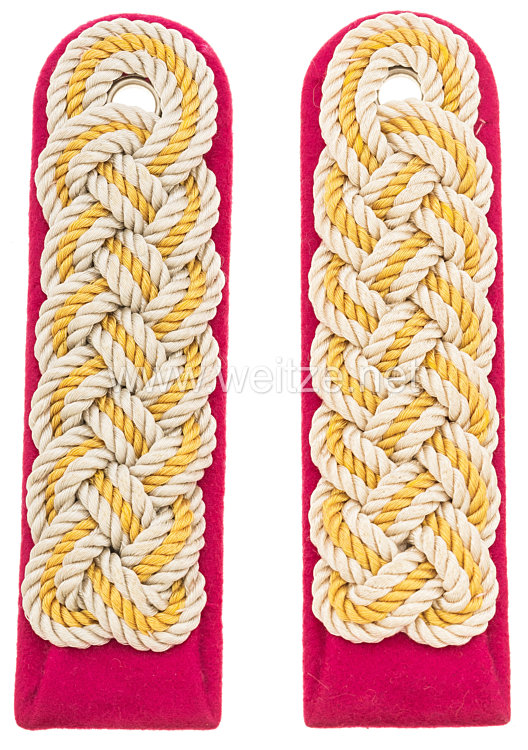
SA Pair of Shoulder Boards for an SA-Brigadeführer to SA-Obergruppenführer in the Supreme SA Leadership

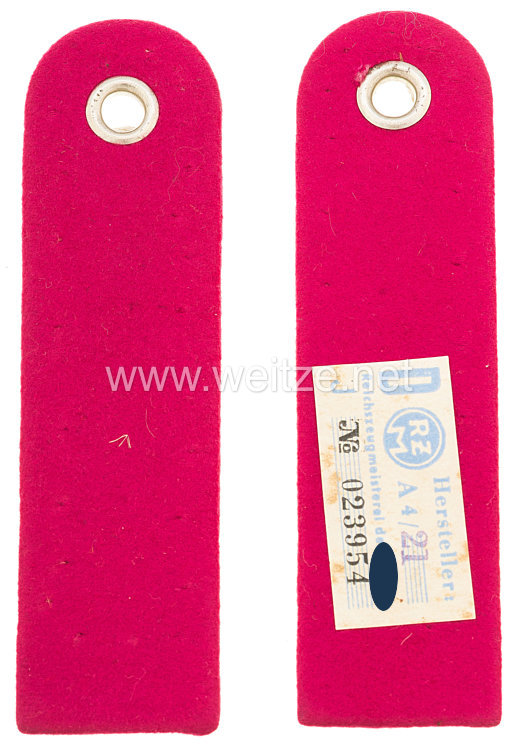
Pattern from 1939 onwards. Celleon/gold braid on crimson cloth backing. Sew-in version, reverse with RZM paper label “D”. Unworn, condition 2+. Very rare.
444020
850,00

SA Pair of Shoulder Boards for an SA-Brigadeführer to SA-Obergruppenführer in the Supreme SA Leadership

These shoulder boards represent a significant aspect of the hierarchical structure within the Sturmabteilung (SA) during the National Socialist regime in Germany. This specific design for high-ranking leaders from SA-Brigadeführer to SA-Obergruppenführer in the Supreme SA Leadership (Oberste SA-Führung) illustrates the complex rank system and elaborate distinction markings of this paramilitary organization.

The SA, originally founded in 1920/21, developed into a mass organization with several million members. Following the so-called Röhm Affair of June 30, 1934, when the SA leadership was eliminated, the organization lost much of its political significance. Nevertheless, the SA continued to exist until 1945 and maintained its elaborate uniform regulations and rank structure.

The shoulder boards described here date from the 1939 pattern onwards, which provides an important chronological reference. Following uniform reforms in the late 1930s, SA leadership insignia were repeatedly modified and standardized. The use of celleon/gold braid on crimson cloth backing was characteristic of the highest leadership ranks within the Supreme SA Leadership, which reported directly to the Chief of Staff of the SA.

The crimson base color had been the identifying mark of the SA leadership since the early 1930s, distinguishing it from the simple brown uniforms of ordinary SA men. The use of gold braid signified status within the SA's generalship. The rank of SA-Brigadeführer was roughly equivalent to a major general, while SA-Obergruppenführer corresponded to a full general.

The Supreme SA Leadership (OSAF) formed the command staff of the entire SA organization. It concentrated the highest functionaries and staff officers who administered and directed the organization. Members of the OSAF wore special insignia to mark their elevated position. The present shoulder boards were reserved exclusively for this elite.

The technical execution of these shoulder boards followed the regulations of the Reichszeugmeisterei (RZM) system. The RZM was responsible for standardization and quality control of all uniform parts and equipment items for the NSDAP and its formations. The reverse RZM paper label marked “D” indicates a certified manufacturer authorized to produce these special insignia. The RZM identification letters enabled complete traceability of production.

The sewn-in design was common for high-quality shoulder boards and represented permanent attachment to the uniform, as opposed to slip-on variants for daily changes. This suggests these insignia were intended for dress uniforms or special service uniforms.

The stated unworn condition of these shoulder boards is remarkable. Many such rank insignia were either worn and damaged during the war years or deliberately destroyed after 1945. The survival of these pieces in original condition makes them important historical documents for military historical research.

The rarity of these specific shoulder boards is explained by several factors: First, the number of officers in these high ranks within the OSAF was limited. Second, political developments after 1934 led to stagnation in the SA, resulting in fewer new appointments. Third, many uniform parts were melted down during the war or destroyed after its end.

For military historical research, such objects are of great value as they document the material culture and hierarchical structures of the SA. They allow conclusions about production methods, wearing regulations, and the self-presentation of this organization. At the same time, they serve as memorials to a time when paramilitary organizations played a central role in the exercise of power by a criminal regime.

The preservation of such artifacts in museums and research collections ensures that future generations can study the material manifestations of this dark period in history. They serve not to glorify but to educate, providing tangible evidence of the organizational structures that enabled totalitarian control.