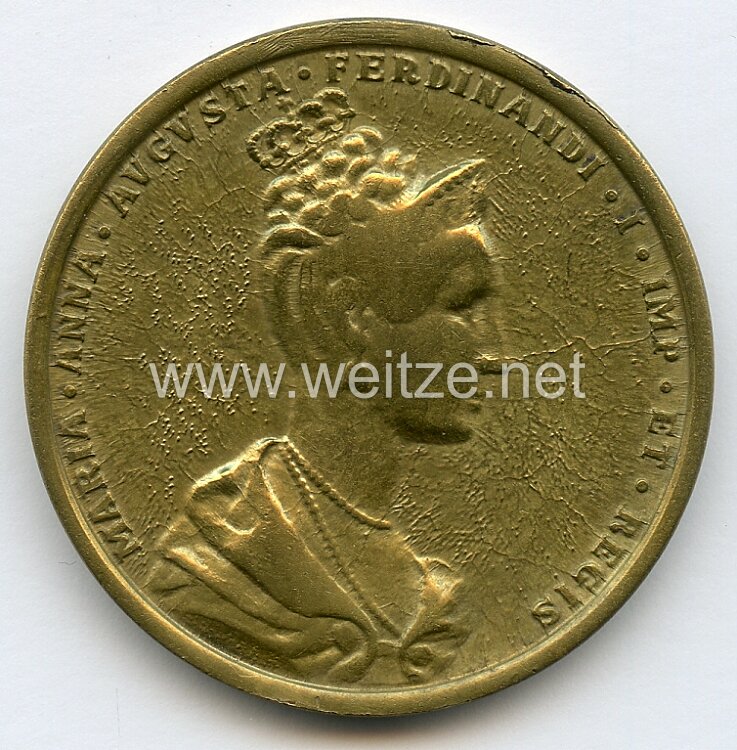
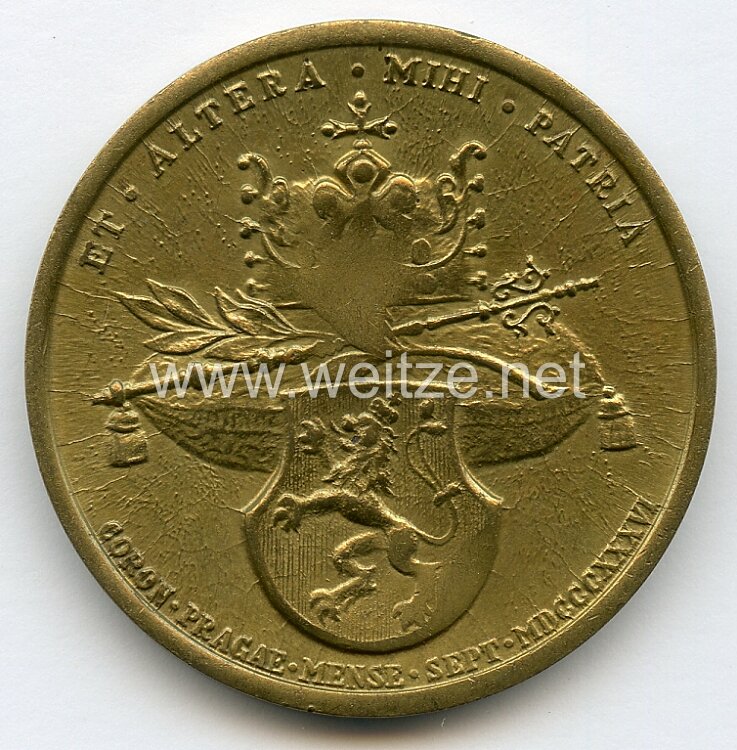
Austria / Imperial and Royal Monarchy Non-Portable Medal Commemorating the Coronation of Maria Anna of Savoy as Queen of Bohemia in Prague 1836
This medal was struck to commemorate the coronation of Maria Anna of Savoy as Queen of Bohemia on September 12, 1836 in Prague. It represents a significant testament to the ceremonial traditions of the Habsburg Monarchy and documents an important dynastic moment in the history of the Austro-Hungarian Monarchy.
Maria Anna of Savoy (1803-1884) was the daughter of King Victor Emmanuel I of Sardinia and Maria Theresa of Austria-Este. Her marriage to Ferdinand I of Austria in 1831 united two significant European royal houses. Ferdinand, who succeeded his father Francis I to the throne in 1835, was both Emperor of Austria and King of Bohemia and Hungary - in accordance with the centuries-old Habsburg tradition of ruling over a multi-ethnic empire.
The Bohemian coronation was an essential component of Habsburg legitimacy. Since the Middle Ages, Habsburg rulers had worn the Crown of Saint Wenceslas, and the coronation ceremony at St. Vitus Cathedral in Prague underscored their position as Kings of Bohemia. The 1836 ceremony was particularly significant as it represented the first royal coronation under Ferdinand I and demonstrated the continuity of Habsburg rule in Bohemia.
The medal's obverse displays the Latin inscription “Maria Anna Augusta Ferdinandi I Imp et Regis”, which translates to “Maria Anna Augusta, [consort] of Ferdinand I, Emperor and King.” This titulature emphasizes the complex power structure of the monarchy. The reverse bears the inscription “Et altera mihi Patria” (“And the other [is] my fatherland”) along with “Coron Pragae Sept MDCCCXXXVI” (Coronation Prague September 1836).
The phrase “Et altera mihi Patria” is particularly significant, as it expresses Maria Anna's connection to her new kingdom. As a native of Savoy, she symbolically adopted Bohemia as her second homeland, illustrating the integrative function of the monarchy in a multilingual and multicultural empire.
Such non-portable medals, also called commemorative medals or table medals, were popular means of dynastic representation in the 19th century. Unlike military decorations or wearable medals, they served as mementos and collectibles. They were often issued in various metals and sizes - from precious gold and silver specimens for high-ranking individuals to more affordable base metal versions for a broader audience.
The production of such medals typically fell to the imperial minting facilities, particularly the Vienna Mint, known for its high craftsmanship. Medallists such as Josef Daniel Böhm and Karl Radnitzky created numerous strikings for the Imperial House during this era.
The historical context of the 1836 coronation is closely linked to the political situation of the time. Ferdinand I, who due to health limitations could not always govern himself, stood at the center of a complex system of advisors and regents. His reign from 1835 to 1848 ended with the Revolution of 1848, which shook the entire European political structure. The 1836 medal thus documents a period of relative stability before the great upheavals of the 1848 Revolution.
Bohemian coronations became rarer after 1836. The last Habsburg coronation as King of Bohemia took place in 1836 - later rulers dispensed with this elaborate ceremony, reflecting the declining symbolic value of traditional legitimation rituals in a modernizing world.
Today, such medals are important historical sources for researching Habsburg representational culture, numismatics, and the political iconography of the 19th century. They document not only dynastic events but also artistic styles, propaganda techniques, and the monarchy's self-representation to its subjects.