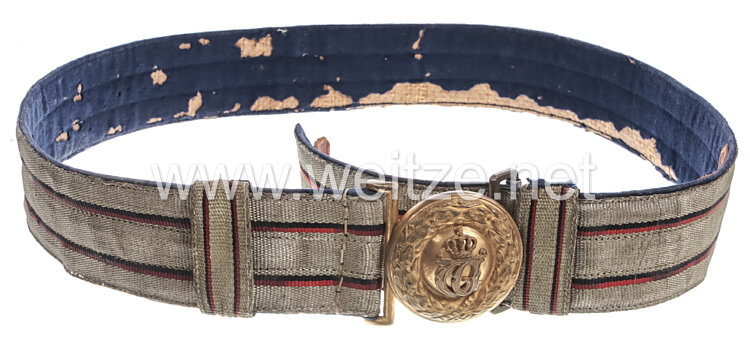
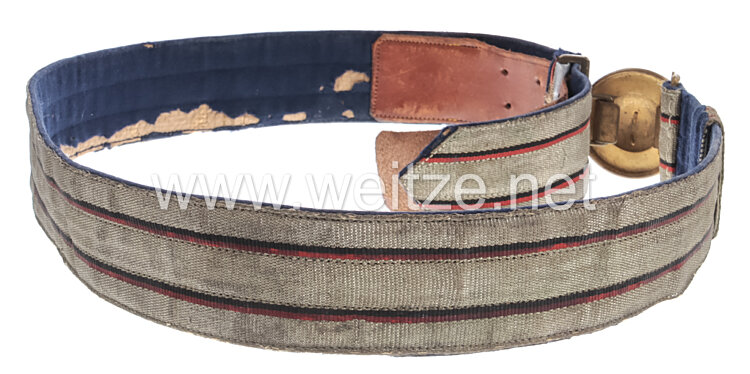
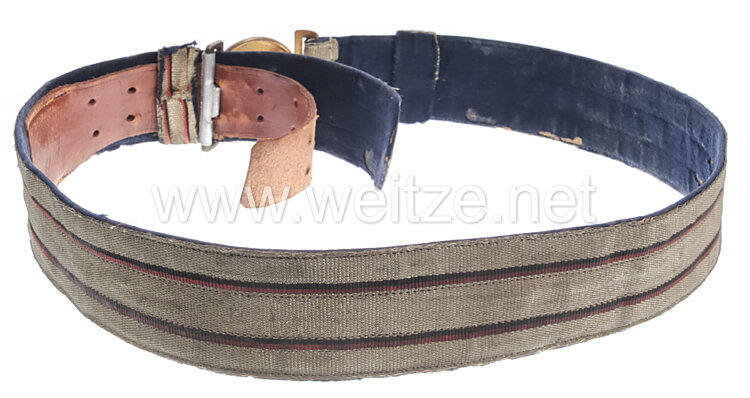
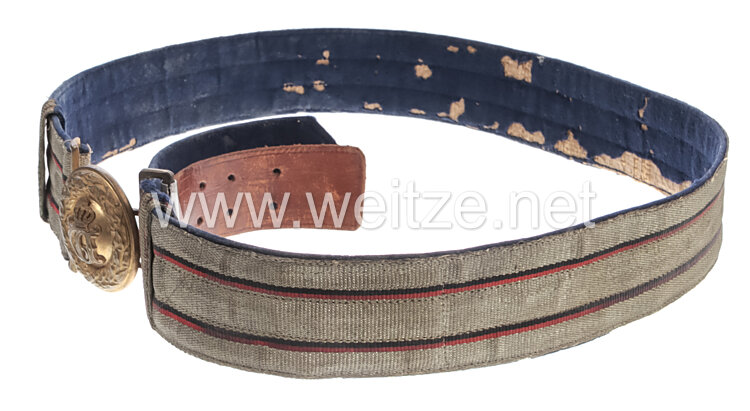
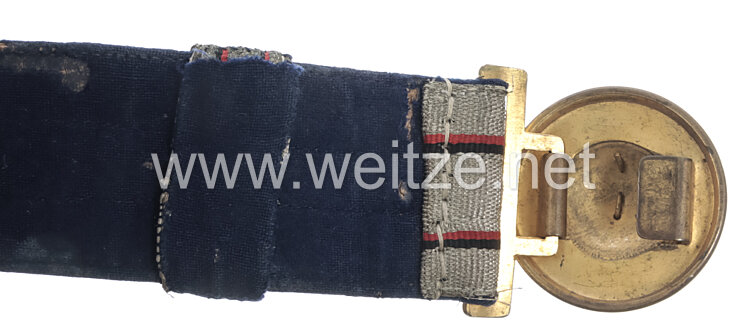
Kingdom of Württemberg Officer's Field Sash

Circa 1900. Silver bullion sash with two black and red stripes, royal blue felt lining, 2 slides, the buckle gilt with the cipher “WR”, length without buckle approximately 90 cm. The cloth lining with significant moth damage. Condition 2-3.


464120
300,00

Kingdom of Württemberg Officer's Field Sash

The officer's field sash from the Kingdom of Württemberg represents a significant testament to the military tradition and uniform culture of the German southwestern state in the late 19th and early 20th centuries. As an essential component of the officer's uniform, the field sash embodied not only functional aspects but above all the rank, dignity, and affiliation with the officer corps of one of the four kingdoms within the German Empire.

The Kingdom of Württemberg in the German Empire

After the foundation of the Reich in 1871, the Kingdom of Württemberg retained extensive autonomy in military matters as a federal state. The Württemberg contingent of the German Army comprised its own military units with specific uniform regulations that differed from those of Prussia and other German states. King Wilhelm II of Württemberg (reign 1891-1918), whose cipher "WR" (Wilhelm Rex) appears on the clasp of this field sash, was the last king of the land and shaped military development until the end of the monarchy in 1918.

Construction and Composition of the Field Sash

This field sash from around 1900 displays the characteristic features of Württemberg officer sashes. The silver brocade - finely woven material interwoven with silver threads - was reserved for officers and clearly distinguished them from non-commissioned officers and enlisted men. The two black-red stripes refer to the Württemberg state colors, which had been black and red since the 19th century. This color combination appears in numerous Württemberg insignia and decorations.

The royal blue felt lining served not only to stabilize the sash but also for wearing comfort. The two sliders enabled individual adjustment of the length to the wearer. The gilt clasp with the royal cipher formed the representative conclusion and clearly identified the sash as a Württemberg product from the reign of Wilhelm II.

Wearing and Usage

The field sash was worn diagonally over the right shoulder and ran to the left hip, where it was fastened with the clasp. It belonged to the accoutrements (uniform equipment) on various occasions: at parades, official receptions, in field service, and at ceremonial military events. The officer's sword could be attached to the field sash, giving it a practical function as well.

Manufacturing and Procurement

Such high-quality field sashes were manufactured by specialized military effects manufacturers, who were often royal court suppliers. In Stuttgart and other Württemberg cities, renowned firms existed that produced uniform parts and equipment items for officers. Officers had to procure and finance their uniform equipment themselves, which explains the high quality of materials and workmanship.

Uniform Regulations and Guidelines

The precise execution of field sashes was stipulated in the Württemberg dress regulations and uniform guidelines. These regulations were regularly updated and specified details such as width, length, material quality, and the correct placement of state colors. The Württemberg regulations differed in details from those of other German federal states, reflecting the federal structure of the Empire.

Historical Context around 1900

The period of origin of this field sash around 1900 falls into a phase of relative peace and military modernization. The German Empire under Kaiser Wilhelm II expanded its armed forces, and the Württemberg contingent was also enlarged and modernized. At the same time, traditional elements of the uniform were retained, emphasizing historical continuity and regional identity.

Condition and Material Damage

The mentioned moth damage to the cloth lining is typical for textile objects from this period. Moths preferentially attack natural materials such as wool and felt, especially when stored unprotected for extended periods. Such damage is frequently encountered in military textiles from the Imperial era and, while diminishing the state of preservation, does not reduce the historical or collectible value of such objects.

Collector Value and Museum Significance

Württemberg officer sashes are today sought-after collectibles that provide important insights into the military history of southwestern Germany. They document not only uniform traditions but also craft skills, material culture, and social hierarchies in the Imperial officer corps. For military history museums and collections, they represent indispensable evidence of the epoch between 1871 and 1918.

The End of the Monarchy

With the abdication of King Wilhelm II of Württemberg in November 1918 and the proclamation of the Republic, the use of such royal insignia ended. Field sashes bearing the cipher "WR" became obsolete and thus mark a vanished epoch of German and Württemberg history. Today they remind us of the military tradition of a kingdom that existed for over a millennium and came to its end in 1918.

r