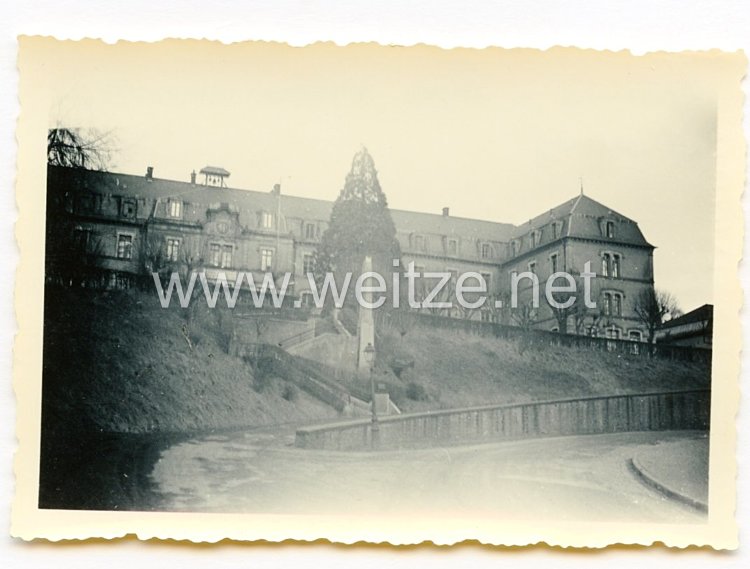
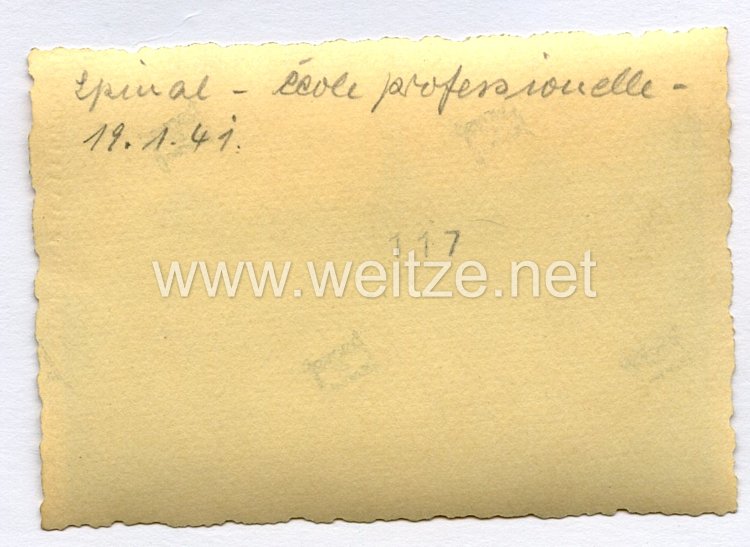
Wehrmacht Photograph, France “Epinal Ecole Professinelle”

approx. 6 x 8.9 cm, condition 2.
400019
10,00

Wehrmacht Photograph, France “Epinal Ecole Professinelle”

This object is a Wehrmacht photograph from occupied France, showing the École Professionnelle in Épinal. Measuring approximately 6 x 8.9 cm, the photograph conforms to the typical format of contemporary amateur snapshots from the 1940s, taken by German soldiers during World War II.

Historical Context of the German Occupation

The city of Épinal, capital of the Vosges department in the Lorraine region, was occupied in June 1940 following the German Western Campaign. After the Armistice of Compiègne on June 22, 1940, France was divided into an occupied zone in the north and west, and the unoccupied zone under the Vichy government. Épinal was located in the occupied zone and remained under German control until its liberation by American and French forces in autumn 1944.

Military Photography in World War II

Photography was part of daily life for German soldiers during the war. While the Wehrmacht had official propaganda companies (PK-Einheiten), private photography by ordinary soldiers was widespread. Despite occasional restrictions for military security reasons, many Wehrmacht members owned cameras and documented their wartime experiences, visited locations, and encounters with local populations.

The compact format of approximately 6 x 9 cm suggests the use of a roll film camera, which was popular in the 1930s and 1940s. Manufacturers such as Zeiss Ikon, Agfa, and Voigtländer produced compact cameras ideally suited for military use.

The École Professionnelle

An École Professionnelle was a French vocational school offering technical and craft training. During the occupation, such institutions were frequently requisitioned or utilized by the German administration for their own purposes. School buildings served as quarters, administrative buildings, field hospitals, or storage facilities. The fact that a German soldier photographed this specific school might indicate a personal connection – perhaps he was quartered there or the building served a military purpose.

Épinal During the Occupation

Épinal held strategic importance due to its location near the German border and its role as a transportation hub. The city possessed significant fortifications and was traditionally a French garrison town. During the occupation, the population experienced typical hardships: rationing, forced labor, requisitions, and the constant presence of German troops.

The region of Lorraine held particular significance for the German occupiers, as it had been German territory between 1871 and 1918. This historical connection influenced occupation policies, with some Nazi officials viewing the area as historically German and implementing particularly stringent Germanization measures.

Documentary Value

Such private photographs possess considerable historical value today. They supplement official war documentation and provide insights into everyday life during the occupation from the occupiers' perspective. For local historians and archives, they are often important sources for reconstructing architectural changes, military presence, and everyday history. The French departmental archives of Vosges and local historical societies systematically collect such material for processing this period.

Condition and Collector Value

The indicated condition 2 according to standard collector scales means the photograph is well-preserved with only slight signs of wear. This is remarkable for a document over 80 years old that likely survived field post conditions, transport, and storage.

Historical Significance

Photographs like this one serve multiple historical purposes. They document the German military presence in specific locations, provide visual evidence of requisitioned buildings, and offer glimpses into how soldiers perceived and recorded occupied territories. For researchers studying the occupation period, such images contribute to understanding the daily reality of military occupation beyond official records and propaganda.

Ethical Considerations

Handling Wehrmacht material requires historical sensitivity. Such objects are testimonies to criminal warfare and occupation rule, but possess legitimate historical and educational value as source material. Their preservation serves documentation and education, not glorification.

r