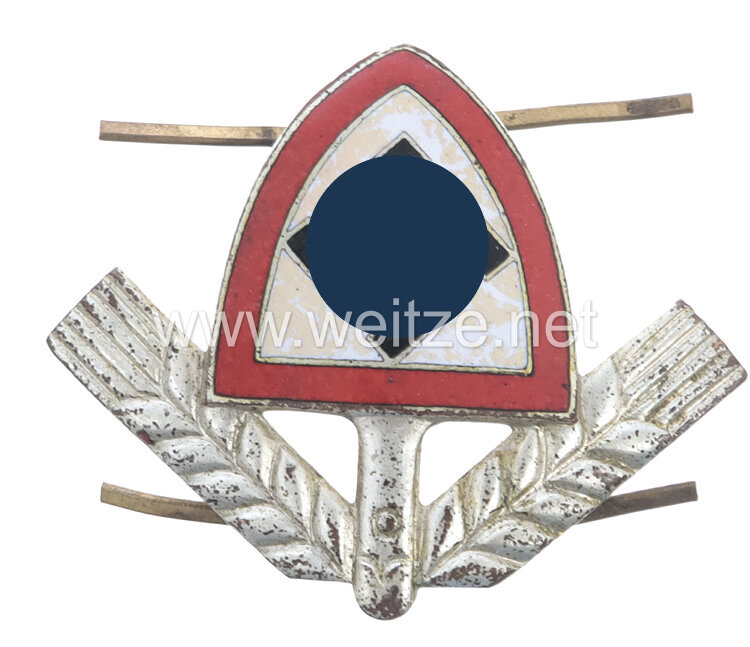
RAD Cap Badge for Leader

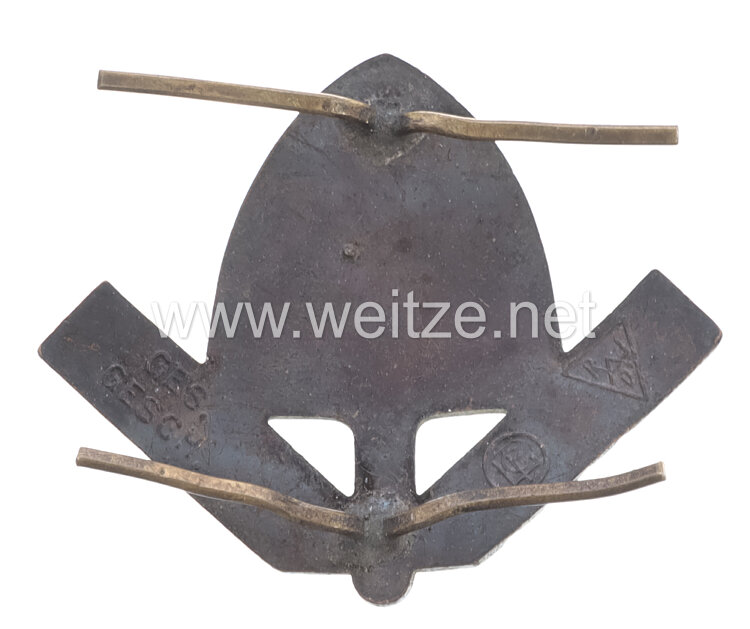
Non-ferrous metal enameled, manufacturer marked on reverse, condition 2.
463919
150,00

RAD Cap Badge for Leader

The cap badge for leaders of the Reich Labor Service (RAD) represents a significant rank insignia from the National Socialist era, reflecting the hierarchical structure of one of the Third Reich's most important paramilitary organizations.

The Reichsarbeitsdienst (Reich Labor Service) was officially established on June 26, 1935, through the Reich Labor Service Law, having evolved from the Voluntary Labor Service (FAD) instituted in 1931. Under the leadership of Konstantin Hierl, who held the title of Reichsarbeitsführer, the RAD developed into a mandatory institution for all young Germans. From 1935, all male youth between 18 and 25 years of age were required to perform six months of labor service; from 1939, this obligation was extended to female youth as well.

The rank structure of the RAD was modeled on military precedents but used its own terminology. Leader ranks began with Truppführer and ascended through Obertruppführer, Feldmeister, Oberfeldsmeister to the highest ranks such as Arbeitsführer, Oberarbeitsführer, and finally the Reichsarbeitsführer. This hierarchy was made visible through specific uniform components and badges.

The enameled non-ferrous metal cap badge described here represents the typical manufacturing method of these insignia. The use of enamel gave the badges their characteristic coloring and durability. The central motif typically consisted of the RAD symbol: a wreath of wheat ears facing right with a crossed spade, surrounded by an oak leaf wreath. For leader ranks, these badges were often manufactured in higher quality than the versions for ordinary labor servicemen.

The manufacturer's mark on the reverse is of particular interest to collectors and historians. Numerous companies were commissioned to produce RAD effects, including well-known manufacturers such as Assmann & Söhne in Lüdenscheid, Friedrich Linden in Lüdenscheid, RZM-approved companies, and many others. The Reichszeugmeisterei (RZM) supervised the production and quality of party and organizational insignia and assigned manufacturer numbers. These markings enable more precise dating and authentication of pieces today.

The wearers of these badges belonged to the leadership cadres of the RAD, who were responsible for organizing, training, and directing those performing compulsory labor service. The RAD was active in various areas: from agricultural land reclamation to road construction and fortifications such as the Westwall. During World War II, RAD units were increasingly deployed for war-essential tasks and sometimes involved in combat operations.

The RAD uniform resembled military uniforms but was recognizable by its characteristic earth-brown color. The cap badge was worn on the peaked cap, which was part of the service dress. For leaders, there were additional distinguishing features such as special collar patches, shoulder boards, and sleeve insignia indicating respective rank.

After the end of World War II, the Reich Labor Service was dissolved and banned along with all other National Socialist organizations by Control Council Law No. 2 of October 10, 1945. Its symbols and badges became historical relics of a vanished era.

Today, such cap badges are objects of military-historical collections and serve the academic study of this period. The indicated condition 2 corresponds in collector nomenclature to a well-preserved piece with slight signs of wear, which for an object over 75 years old is considered very good. The enameling should be largely intact, with possibly minimal chipping or signs of aging.

For historians and collectors, such badges are important sources for research into the organizational structures of the Third Reich, uniform studies, and the material culture of this time. They document the permeation of society with hierarchical, militarily organized structures and the mobilization of youth for state purposes.

r