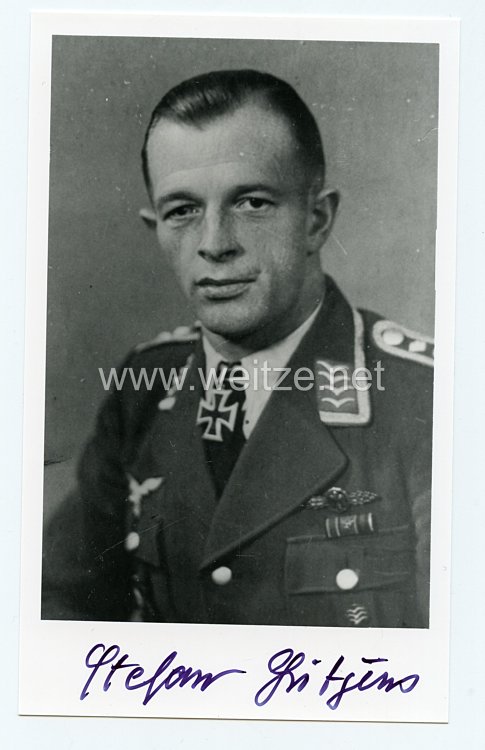
Luftwaffe - Post-War Signature of Knight's Cross Recipient Litjens, Stefan "Steff"
Post-War Autograph of Stefan "Steff" Litjens - Luftwaffe Knight's Cross Recipient
The present object represents a signed photograph of Stefan "Steff" Litjens, a German fighter pilot of the Luftwaffe during World War II and recipient of the Knight's Cross of the Iron Cross. Such post-war autographs from Knight's Cross recipients form a special category of military-historical collectibles, documenting both the personal history of the protagonists and the complex culture of remembrance in the post-war period.
Stefan Litjens - Biographical Background
Stefan Litjens, born on August 23, 1918, in Krefeld, joined the Luftwaffe in 1937 and completed the typical training to become a fighter pilot. During World War II, he served in various fighter wing units and achieved documented aerial victories as a fighter pilot. The Knight's Cross of the Iron Cross was awarded to him for exceptional merit in aerial combat, a decoration that was only given to particularly successful and courageous soldiers.
Throughout his military career, Litjens flew missions primarily on the Eastern and Western Fronts. Like many fighter pilots of his generation, he experienced the transition from initial German air superiority to increasing Allied dominance in the skies. After the war's end, Litjens survived and returned to civilian life.
The Knight's Cross of the Iron Cross
The Knight's Cross of the Iron Cross was instituted on September 1, 1939, by Adolf Hitler as a renewal of the Iron Cross from previous German conflicts. It represented the highest grade of the Iron Cross and was awarded for extraordinary bravery or outstanding leadership in combat. During World War II, approximately 7,300 individuals received this decoration.
Fighter pilots were among the most frequently decorated soldiers with the Knight's Cross, as their achievements could be quantified through confirmed victories. The award criteria evolved during the course of the war, with the required number of aerial victories increasing over time.
Post-War Autographs of Knight's Cross Recipients
After 1945, a special collecting field developed around autographs and signed photographs of Knight's Cross recipients. These post-war signatures differ fundamentally from contemporary wartime documents. They often originated decades after the events, typically from the 1970s and 1980s onwards, when veterans' associations formed and collectors began systematically acquiring autographs.
Many former Knight's Cross recipients were willing to sign photographs sent to them by collectors. This often occurred on portrait photographs from the war period or on more recent photographs. The practice of collecting autographs from military personnel was particularly widespread in the Anglo-Saxon and German spheres.
Format and Design
The described object with dimensions of 9.0 x 14.7 cm approximately corresponds to postcard format, which was frequently used for such signed photographs. The signature was applied retroactively to a photograph, presumably in the decades following the war. The stated condition 1 indicates very good preservation, without significant damage, discoloration, or creases.
Collector Value and Historical Significance
Post-war autographs of Knight's Cross recipients have both collector and documentary value. They are testimonies of the post-war period and the manner in which former soldiers dealt with their past. At the same time, they document the interest of collectors and historians in the military history of World War II.
The value of such autographs varies greatly depending on the fame of the signatory, rarity of the signature, condition, and authenticity. Autographs from fighter pilots are particularly sought after by aviation historians. Authentication is conducted through handwriting comparisons with other known signatures and through provenance research.
Historical Context
When scientifically evaluating such objects, a differentiated consideration is required. They are documents of military history but must not be viewed in isolation from the historical context of National Socialism and World War II. Modern military historians emphasize the necessity of distinguishing between the military performance of individual soldiers and the criminal nature of the regime they served.
Post-war autographs represent a distinct source category that provides insights into the culture of remembrance and dealing with the past. They document how former soldiers viewed their role in history and how they were perceived by collectors and the public.