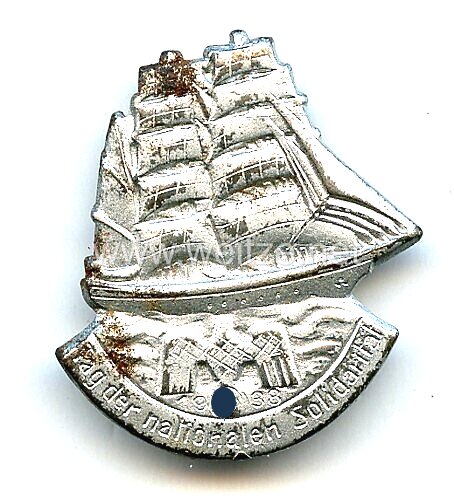
Third Reich - Day of National Solidarity 1938

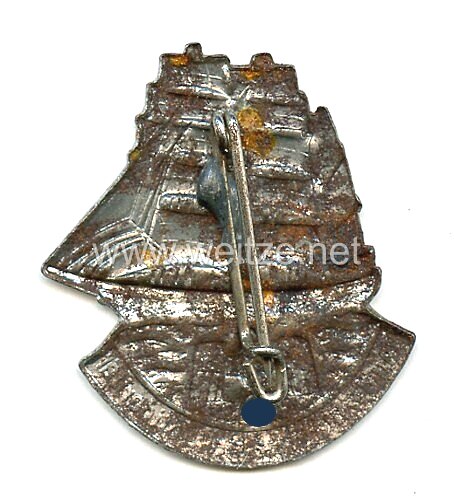
Pressed iron sheet badge, with pin fastener, condition 2.
456819
20,00

Third Reich - Day of National Solidarity 1938

The Badge of the Day of National Solidarity 1938 represents a remarkable testimony to National Socialist propaganda activities in the German Reich. This tinplate badge belongs to a category of collection tin badges that were issued during the NS era for charitable purposes and propagandistic collections.

The Day of National Solidarity was held on October 2, 1938, immediately after the Sudeten Crisis and in direct connection with the Munich Agreement of September 29, 1938. This event was part of the comprehensive propaganda machinery of the NS regime and was intended to demonstrate the supposed unity of the German people while raising funds for the Winter Relief Organization (Winterhilfswerk - WHW) and other National Socialist welfare organizations.

The Winter Relief Organization of the German People was founded in 1933 and was one of the largest donation organizations in the Third Reich. It organized annual collections in which badges were issued in exchange for donations. The special occasion in October 1938 was marked by the foreign policy successes of the regime and the imminent incorporation of the Sudetenland into the German Reich.

The production of such badges was carried out using various materials, with tinplate representing an inexpensive and widely used material. This enabled mass production at low costs, which was of great importance for collection campaigns. The badges were typically equipped with a simple pin construction that allowed wearers to attach them to clothing and thus publicly demonstrate their willingness to donate.

The organization of these collections was strictly hierarchical. The NS-Volkswohlfahrt (NSV - National Socialist People's Welfare) coordinated the distribution of badges and the implementation of collections in cooperation with local party organizations. Street collections were mandatory, and there was considerable social pressure to participate. Wearing such a badge signaled not only willingness to donate but also political conformity with the regime.

The historical context of 1938 is crucial for understanding this object. After the Anschluss of Austria in March 1938 and the escalating Sudeten Crisis in the summer and autumn of that year, National Socialist Germany was in a phase of aggressive expansion. The Day of National Solidarity was intended to demonstrate the supposed cohesion of the “Volksgemeinschaft” (people's community) and to secure the regime's foreign policy ambitions domestically.

Such badges were produced in various variants and designs, often with symbols such as swastikas, German coats of arms, or specific motifs representing the respective occasion. Production numbers were considerable, as the collections were carried out throughout the Reich and millions of citizens were called upon to participate.

From a collector's perspective, these badges are today important historical documents that provide insight into the everyday propaganda of the NS regime. The condition of such objects is evaluated according to numismatic criteria, with “condition 2” indicating a well-preserved specimen with slight signs of use.

The legal situation regarding the collecting and trading of NS memorabilia is regulated in Germany by the Criminal Code (§ 86a StGB), with historical and educational purposes explicitly exempted. Such objects now serve as illustrative material for historical research and education about the mechanisms of totalitarian propaganda.

The Badge of the Day of National Solidarity 1938 thus represents more than just a piece of metal: it is testimony to the perfidious connection between apparent charity, political propaganda, and social conformity pressure in National Socialist Germany, whose critical examination is essential for the historical understanding of this dark era.

r