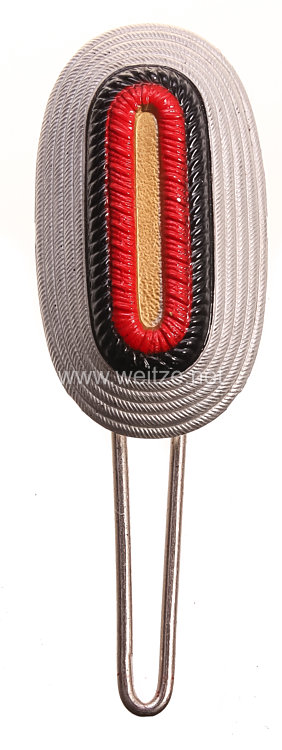
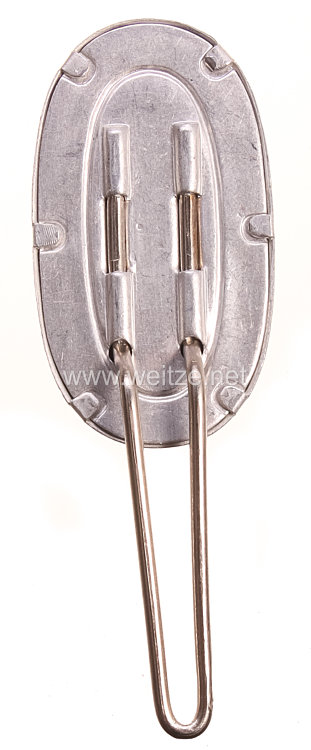
Federal Republic of Germany (FRG) Insignia Badge for Police Shako

circa 1957, aluminum, condition 2.
436119
25,00

Federal Republic of Germany (FRG) Insignia Badge for Police Shako

The field insignia for the police shako of the early Federal Republic of Germany represents a significant testament to police uniform history in the post-war period. This badge, manufactured from aluminum and dating to around 1957, represents a transitional phase in the development of German police uniforms after World War II.

Following the establishment of the Federal Republic of Germany in 1949, the young democracy faced the challenge of building new state institutions while creating a clear demarcation from the National Socialist regime. This also affected the police, whose uniforms and symbolism required fundamental redesign. According to federal principles, police authority rested with the individual federal states (Länder), which led to various uniform variations, although there were efforts toward certain uniform standards.

The shako itself is a traditional headgear with a cylindrical or slightly conical shape, originating in the 18th century and particularly widespread in European armies and police forces during the 19th century. In Germany, the shako had been used since Prussian times for various military and police units. After 1945, some police forces of the federal states returned to this traditional headgear, with the design deliberately emphasizing democratic and civilian character.

The field insignia, also known as a cockade or emblem, was prominently mounted on the front of the shako and served as a sovereign symbol. The use of aluminum as material was characteristic of the 1950s, as this light metal was cost-effective, corrosion-resistant, and easy to process. In contrast to the more elaborate metalwork of earlier epochs, aluminum enabled efficient series production, which was of great importance in the economically strained post-war period.

The period around 1957 marks an important phase in the consolidation of Federal Republic police structures. During this time, various police laws were modernized at the state level and equipment was standardized. The Federal Republic sought to establish a democratic police tradition that clearly distinguished itself from the militarized police of the Nazi era. Nevertheless, traditional elements like the shako were selectively adopted, albeit in modified form and with new symbolism.

The design of such field insignia was generally based on the coats of arms or symbols of the respective federal states. Typical elements included stylized eagles, state coats of arms, or other heraldic symbols representing state authority, but deliberately avoiding aggressive military symbolism. The coloring was usually restrained, often in silver or natural aluminum finish.

In the context of German police history, these shako field insignia are of particular collecting interest because they were used only for a relatively short period. As early as the 1960s, many federal states began modernizing their police uniforms and transitioning from traditional headgear like the shako to more practical peaked caps or other headgear. This development was part of a general tendency toward modernization and functionalization of police equipment.

The production of such field insignia was usually carried out by specialized companies for military and police accoutrements, which possessed the necessary expertise in metalworking and heraldry. Attachment to the shako was typically accomplished through rear split pins or screw connections that ensured secure fixation.

From a museological and collector's perspective, these objects document an important segment of German post-war history. They demonstrate the young Federal Republic's attempt to establish continuity with democratic traditions while simultaneously marking a clear break from the immediate past. The relatively short period of use and the subsequent transition to more modern uniforming makes these field insignia sought-after collector's items that capture a specific historical moment.

The condition and preservation of such pieces vary considerably depending on storage and use. The aluminum material, while resistant to rust, can develop oxidation or patina over time, which collectors often value as evidence of authenticity and age. Understanding the historical context and proper identification of these insignia requires knowledge of heraldry, police history, and the specific regulations of different federal states during this transitional period.