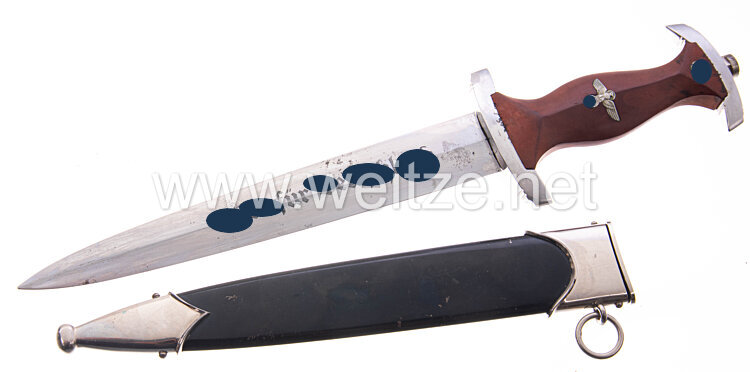
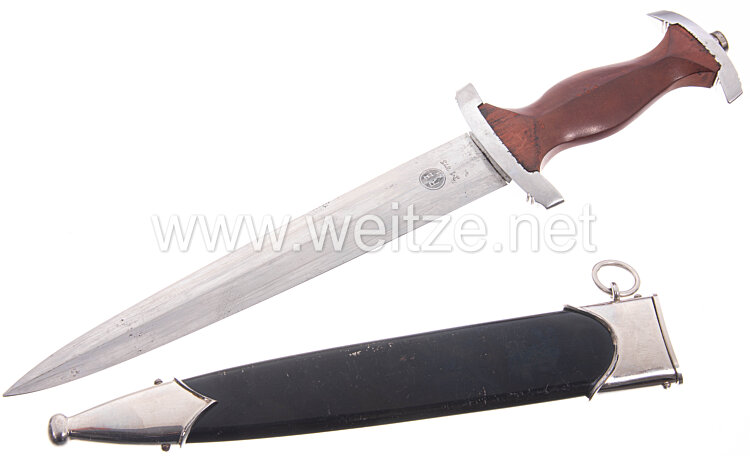
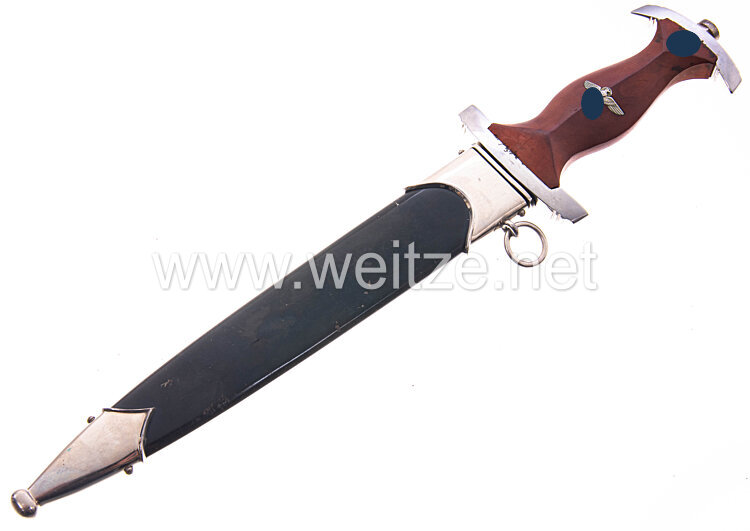
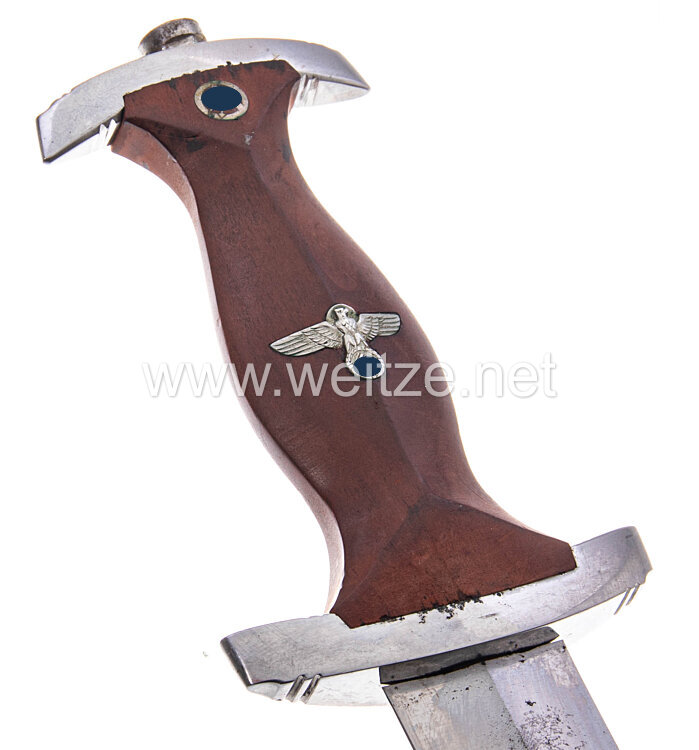
National Socialist Motor Corps (NSKK) Service Dagger M 33 - Rare Variant by Helbing, Steinbach
The NSKK Service Dagger Model 1933 represents a significant chapter in the history of National Socialist organizations in the Third Reich. The Nationalsozialistisches Kraftfahrkorps (NSKK), or National Socialist Motor Corps, was established on April 1, 1931, as a branch of the NSDAP and developed into a paramilitary organization with over 500,000 members by 1945.
The introduction of the service dagger occurred in 1933, shortly after the National Socialists came to power. It served as a symbol of membership in the NSKK and was manufactured according to the guidelines of the Reichszeugmeisterei (RZM), the central procurement agency for equipment of the NSDAP and its affiliated organizations. The RZM not only supervised quality but also assigned specific manufacturer codes to control and standardize production.
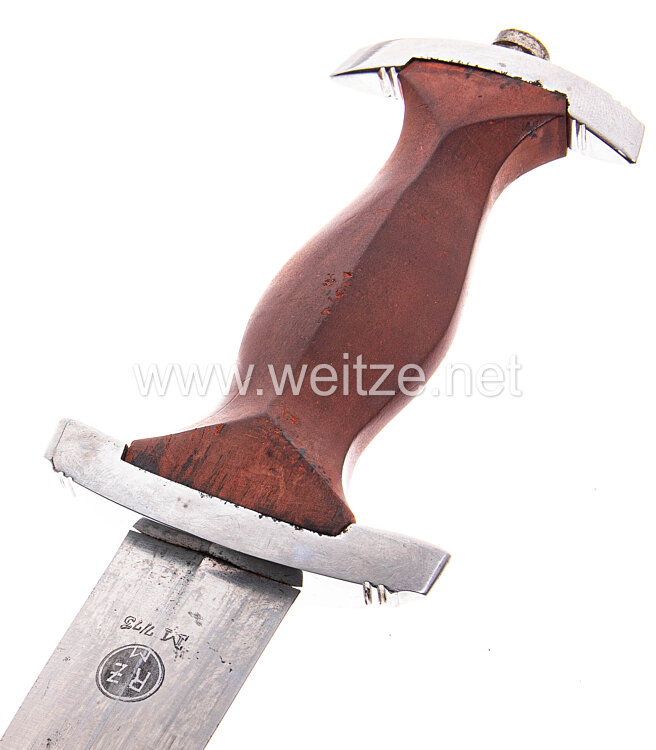
This particular example bears the manufacturer code M7/73, which identifies the firm F. u. A. Helbing of Steinbach. This company was among the authorized manufacturers of NSKK daggers and was characterized by certain production-specific features. Particularly characteristic of Helbing daggers are the typically weaker or shallower etchings of the motto and RZM code on the blade, a feature that helps collectors and historians with authentication.
The blade of the NSKK dagger traditionally bore the inscription “Alles für Deutschland” (All for Germany), which was etched on both sides. This motto was intended to symbolize unconditional loyalty to the National Socialist state. The technical design included a straight, double-edged blade approximately 25 cm in length.
A distinctive feature of this specimen is the crossguard in an unusually “thick” design made of iron, which was nickel-plated. This represents a deviation from standard production, where different materials or proportions were frequently used. Such variations arose from different manufacturing processes of various suppliers or from material shortages during the war. In later productions, to which this piece belongs, increasingly cost-effective materials and simplified production methods were employed.
The grip of the NSKK dagger was characteristically fitted with a black-lacquered wooden handle into which the NSKK emblems were set. These emblems typically displayed the swastika and the NSKK symbol. The original emblems of this specimen remain intact, which is of great significance for historical authenticity.
The scabbard was also manufactured in black-lacquered finish with nickel-plated fittings that complemented the characteristic appearance. The fittings typically included an upper throat, a center band, and a chape. The NSKK logo was frequently applied to the fittings.
Production of NSKK daggers was carried out by numerous manufacturers throughout Germany, including well-known firms such as Eickhorn, Alcoso, Carl Wüsthof, and indeed F. u. A. Helbing. The RZM awarded contracts and supervised compliance with specifications. After 1936, control became even stricter, and all daggers had to be marked with the RZM code.
The NSKK itself had diverse responsibilities, ranging from motorized training and organization of motorsport events to military transport support during World War II. Members wore their service daggers as part of their uniform at official events and ceremonies.
After 1945, the NSKK, along with all other Nazi organizations, was banned and dissolved by the Allies. The possession, manufacture, and distribution of Nazi memorabilia were strictly regulated in Germany. Today, such objects have exclusively historical and museum value and serve the scholarly examination of this dark period of German history.
For military historical research, NSKK daggers are important material witnesses that provide insights into material culture, production standards, and the symbolic self-representation of National Socialist organizations. The study of manufacturer variants, materials, and manufacturing techniques contributes to understanding the economic and industrial aspects of the Nazi regime.