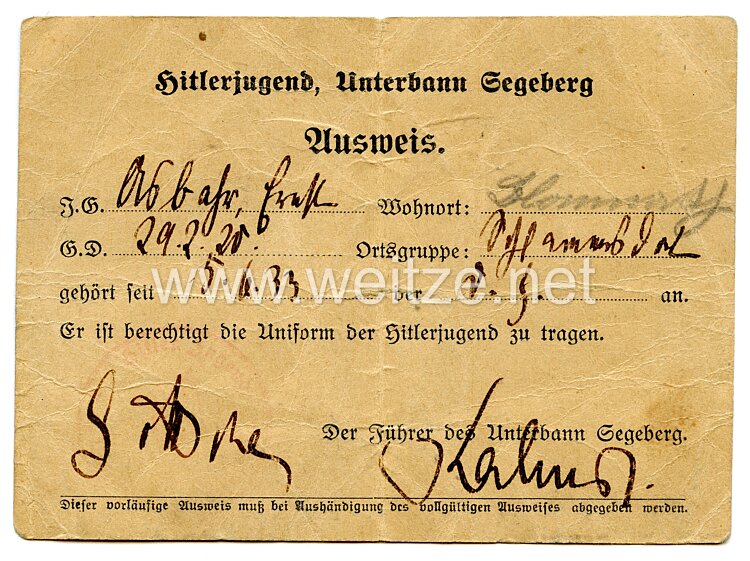
HJ - Hitler Youth Membership Card of a Boy from Unterbann Segeberg
This Hitler Youth membership card documents the enrollment of a boy in Unterbann Segeberg beginning on June 5, 1933, a significant date during the early consolidation phase of the Nazi regime. This document represents not merely a personal identification paper, but also testimony to the systematic registration and indoctrination of German youth under the Third Reich.
The Hitler Youth (Hitlerjugend, HJ) was established in 1926 as the youth organization of the NSDAP, but only achieved its dominant position after the Nazi seizure of power in 1933. The date of June 5, 1933, falls within the immediate period following the Nazi takeover, when the coordination (Gleichschaltung) of all youth organizations was systematically pursued. In April 1933, Baldur von Schirach was appointed Youth Leader of the German Reich, marking the beginning of the monopolization of youth work.
The Unterbann Segeberg was an administrative unit within the hierarchical structure of the HJ. The organization was divided into various levels: the Reich Youth Leadership stood at the top, followed by Obergebiete (upper regions), Gebiete (regions), Banne (divisions), and Unterbanne (subdivisions). An Unterbann typically comprised several troops and corresponded roughly to a district. Segeberg, located in present-day Schleswig-Holstein, was part of the HJ Region Nordmark, which encompassed the northern areas of the German Reich.
The HJ membership card itself was an official document confirming membership and containing various personal data. Typically recorded were: name, date of birth, date of entry, membership number, physical characteristics such as height and hair color, and a photograph. The card also served to document promotions, awards, and participation in training courses or camps. Carrying such a card was mandatory for all HJ members and was regularly inspected.
The early membership beginning in June 1933 is noteworthy because at that time HJ membership was not yet legally mandatory. Compulsory membership was only fully enforced through the Law concerning the Hitler Youth of December 1, 1936 and the subsequent Second Implementation Ordinance of March 25, 1939. Boys who joined in 1933 often did so due to family pressure, social conformity pressure, or genuine enthusiasm for the National Socialist movement, which was still perceived by many as a hopeful renewal.
Activities in the HJ were diverse and aimed at comprehensive ideological, physical, and pre-military education. These included field exercises, sporting events, marches, camps, and ideological training. Boys were organized into Kameradschaften (comradeships) of about 15 members, which were in turn combined into Scharen (troops), Gefolgschaften (followings), and higher units. Military drill and emphasis on obedience, discipline, and willingness to sacrifice characterized the educational program.
The used condition of this card indicates actual use over an extended period. Such documents were regularly presented and stamped, carried to events, and served as proof of membership. Signs of wear, entries, and stamps tell the individual story of their bearer and document his participation in HJ life.
From a historical perspective, HJ membership cards are important primary sources for researching Nazi youth policy and everyday history in the Third Reich. They enable conclusions about recruitment patterns, regional organizational structures, and the biographical trajectories of individuals. At the same time, they serve as memorials to the systematic instrumentalization and indoctrination of an entire generation.
Today, such documents are of military-historical and contemporary historical interest. They are preserved in museums, archives, and private collections and serve historical research and education. Handling such objects requires historical sensitivity and clear contextualization to clarify their significance as testimonies of a criminal regime.