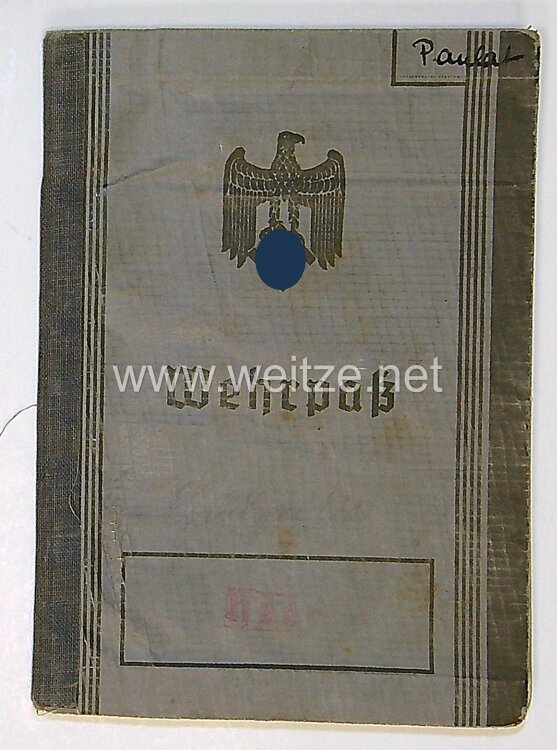
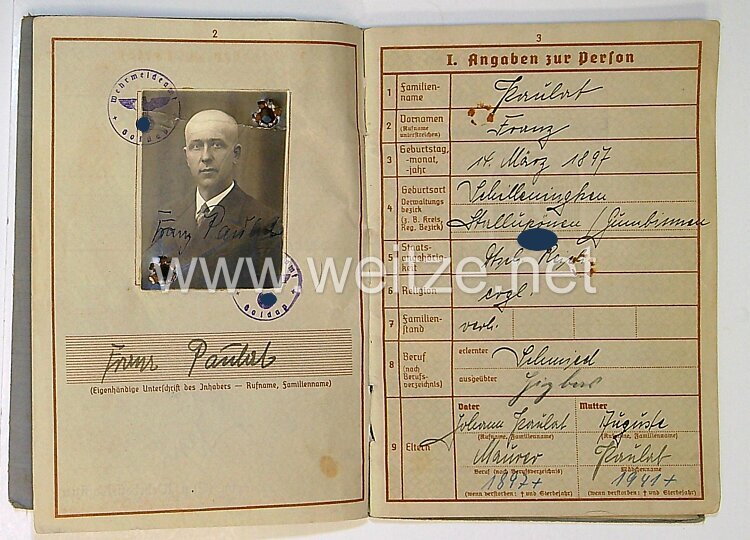
Wehrpass for a World War I Veteran of the 1st Guards Aviation Regiment
This Wehrpass (military service book) documents the military career of a First World War veteran who served with the prestigious 1st Guards Airship Regiment (1. Garde-Luftschiffer-Regiment). Issued on August 3, 1937, in Gumbinnen (East Prussia), this document represents not only an individual soldier's military history but also the comprehensive administrative systems of the German Wehrmacht during the interwar period.
The Wehrpass was an essential military identity document in the German military system, used since the 19th century. Following the Nazi seizure of power in 1933 and the official reintroduction of universal conscription on March 16, 1935, all men liable for military service were registered. The issuance of this pass in 1937 occurred as part of the systematic registration of all former soldiers and men fit for military service for the new Wehrmacht.
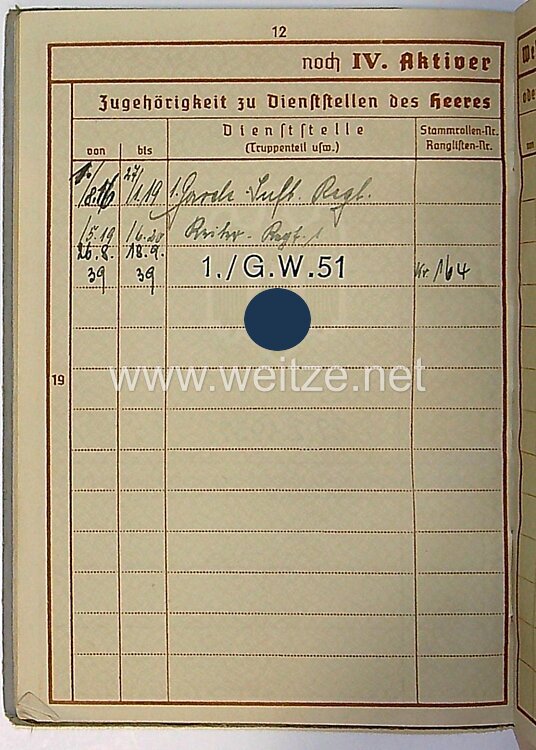
The 1st Guards Airship Regiment was an elite unit of the Prussian Army engaged in military aviation. During World War I, airship regiments played a crucial role in reconnaissance, artillery observation, and early aerial combat. These units operated with observation balloons and airships that were essential for observing enemy positions. The military status as a Guards Regiment indicates the special significance and elite character of this formation, which was often directly subordinate to the monarch.
The soldier's service from 1916 until January 27, 1919 encompasses the most critical years of the First World War and the turbulent post-war period. Entry in 1916 coincided with a phase when Germany was desperately trying to break the stalemate of trench warfare and massively expanding new military technologies, including aerial reconnaissance. The fact that his service lasted until January 1919, beyond the official war's end on November 11, 1918, reflects the chaotic circumstances during demobilization and revolutionary unrest.
After the war's end, the veteran was assigned to Cavalry Regiment 1 (Reiter-Regiment 1), which was not unusual. The drastic reduction of German armed forces by the Treaty of Versailles of 1919 to a maximum of 100,000 men led to the dissolution of many specialized units, including air forces, which were completely prohibited for Germany. Former airship personnel were frequently transferred to traditional infantry or cavalry units or simply administratively assigned to such units.
Particularly noteworthy is the notation "Without Decorations" (Ohne Auszeichnungen). This was by no means uncommon, as the awarding of medals and honors in the German military followed strict criteria. Many soldiers who conscientiously fulfilled their duties received no formal decorations, especially if they were not directly deployed in frontline service or particularly dangerous situations. Although airship units were often in dangerous positions, as their balloons were popular targets for enemy artillery and aircraft, not every service resulted in decorations.
The issuance in Gumbinnen, a significant city in East Prussia (today Gusev, Russia), points to the veteran's geographic origin from the eastern regions of the German Reich. Gumbinnen was the seat of a military district and had the necessary military administrative structures for issuing such documents.
The document's Condition 2 rating indicates good preservation, which is quite remarkable for papers over 80 years old. The included photograph enables personal identification and makes the document an authentic testimony of individual wartime experience.
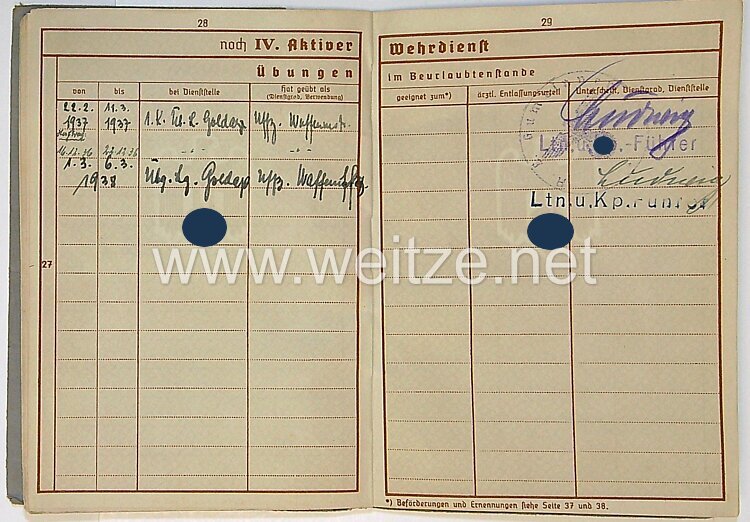
Such Wehrpässe are today important historical sources for military and social history. They document not only military careers but also the comprehensive control mechanisms of the modern state over its citizens. The re-registration of former soldiers in 1937 was part of the systematic preparation for a new war that would begin only two years later.
For collectors and historians, such documents offer valuable insights into individual biographies, administrative practices, and the military organization of the time. They connect personal history with major historical events and make abstract war history tangible and human.