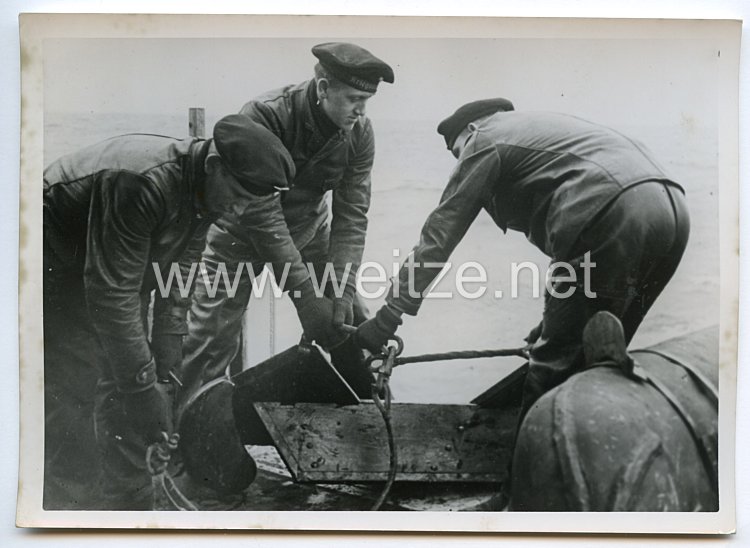
Kriegsmarine Press Photograph: On Minesweeping Operations in the North Sea February 21, 1940

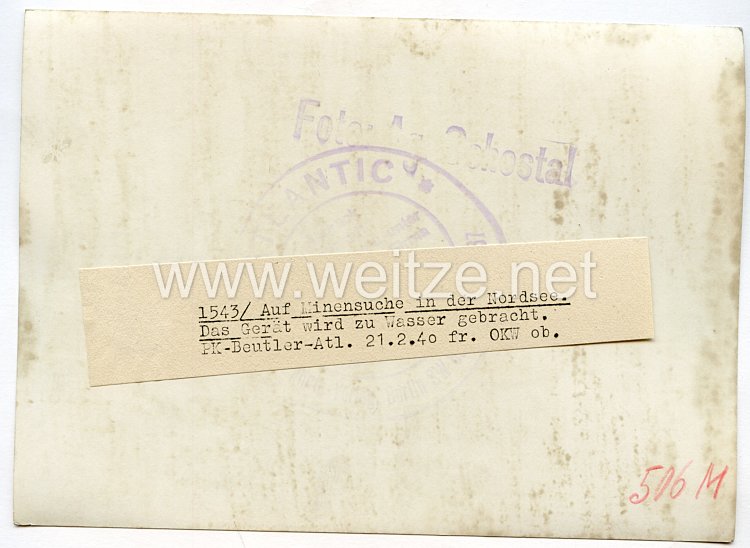
Dimensions approximately 13 x 18 cm, inscribed on reverse. Used condition.
345816
20,00

Kriegsmarine Press Photograph: On Minesweeping Operations in the North Sea February 21, 1940

The object in question is a Kriegsmarine press photograph from the early period of World War II, dated February 21, 1940. Measuring approximately 13 x 18 cm, it corresponds to the standard format for press photographs of that era. The inscription on the reverse identifies it as official propaganda material documenting minesweeping operations in the North Sea.

The Kriegsmarine, the official designation of the German naval forces between 1935 and 1945, maintained an extensive propaganda department that worked closely with the Reich Ministry of Public Enlightenment and Propaganda under Joseph Goebbels. Press photographs were a central instrument of Nazi war propaganda, intended to convey a specific image of German warfare both domestically and in neutral foreign countries.

February 1940 falls within the phase of the so-called “Phoney War” or “Sitzkrieg,” that relatively quiet period between September 1939 and April 1940 when there was little major combat on the Western Front. At sea, however, the situation was different: the North Sea was already an active theater of operations where both Germany and Britain intensively laid naval mines to obstruct each other's trade routes and military movements.

The minesweeping mission was one of the most dangerous yet essential tasks of the Kriegsmarine. The German Navy operated specialized minesweepers of various classes, including the smaller R-boats (Räumboote) and larger M-class minesweepers. These units were equipped with special gear to detect and neutralize mines. The crews of these vessels carried out their perilous work often under adverse weather conditions and under constant threat from enemy air and naval attacks.

The North Sea was of paramount strategic importance. It not only formed the connection between German ports and the Atlantic but was also the operational area for the British Royal Navy, which attempted to establish a naval blockade against Germany. Both sides deployed extensive minefields: Germany to threaten British shipping lanes, and Britain to prevent German warships and merchant vessels from sailing.

Press photographs such as this were produced by so-called war correspondents or PK-men (Propagandakompanie). These photographers and journalists were militarily organized and assigned to combat units. Their task was to document the events of war and provide material for the home front as well as international media. The images underwent strict censorship and were deliberately selected to support specific narratives.

The 13 x 18 cm format was a standard size for press photos and allowed for easy reproduction in newspapers and magazines. The reverse inscription typically contained information about location, date, a brief image description, and often censorship stamps or release markings. Such photographs were distributed to German and foreign editorial offices and appeared in publications such as the “Illustrierter Beobachter,” the “Berliner Illustrierte Zeitung,” or the navy-specific magazine “Die Wehrmacht.”

The depiction of minesweeping activities served several propaganda objectives: it was meant to demonstrate the professionalism and operational readiness of the Kriegsmarine, denounce the dangers of British mine warfare, and simultaneously highlight the bravery of German sailors. Such images were part of a broader strategy to present the Navy as a modern and effective military branch, despite being numerically inferior to the British Royal Navy.

From today's perspective, such press photographs are important historical documents. They offer insights into the propaganda machinery of the Nazi regime while also documenting actual military operations and the daily life of soldiers. Collectors and historians value these materials as primary sources that, when critically analyzed, can provide valuable information about naval warfare, technical developments, and propaganda structures.

The condition described as “used” is typical for such historical photographs that circulated through editorial offices and archives. These images often bear handling marks, stamps, and annotations that themselves constitute part of the historical record, documenting the photograph's journey through the Nazi propaganda apparatus and subsequent archival preservation.