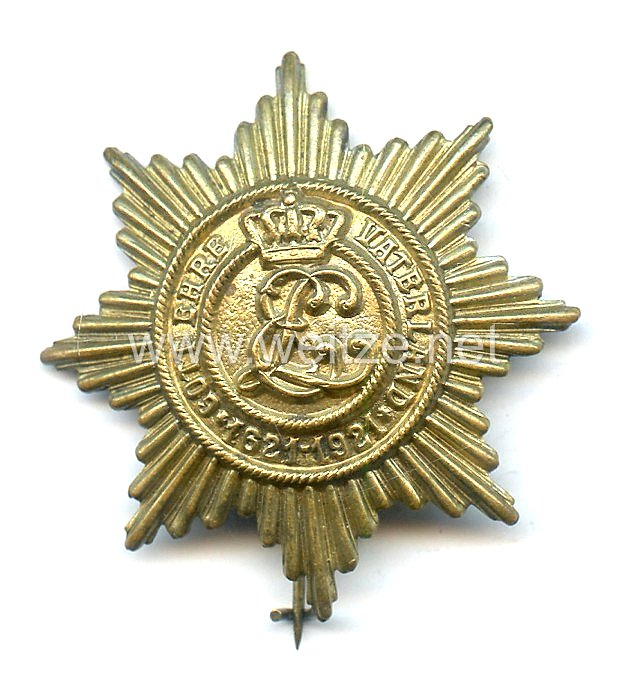
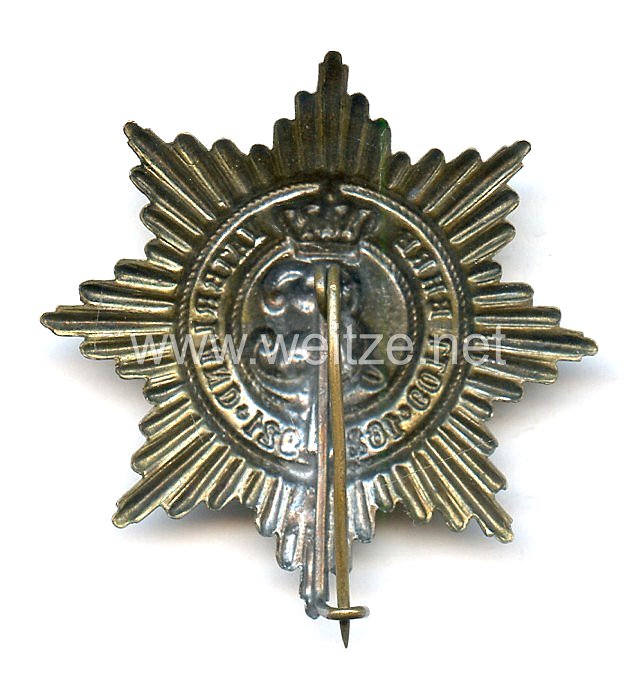
Hessen Commemorative Badge of Former Members of Leibgarde-Infanterie-Regt. Nr. 115, 1921
The Jubilee Badge of Former Members of the Leibgarde-Infanterie-Regiment Nr. 115 from 1921 represents a significant testament to German military history and the tradition of veterans' associations during the Weimar Republic. This pin badge was created to commemorate the regiment's 300th anniversary and combines dynastic loyalty with military comradeship during a period of profound political upheaval.
The Leibgarde-Infanterie-Regiment Nr. 115 belonged to the Grand Ducal Hessian Army and was stationed in Darmstadt. Its roots traced back to 1621, when a lifeguard unit was established under Landgrave Ludwig V of Hesse-Darmstadt. Over three centuries, the regiment served the Hessian rulers and participated in numerous conflicts, including the Thirty Years' War, the Napoleonic Wars, and finally World War I.
The design of the badge is highly symbolic. It takes the form of the Hessian Star, a traditional heraldic element closely associated with Hessian identity. At its center is the crowned regimental cipher “EL,” standing for Ernst Ludwig, the last Grand Duke of Hesse and by Rhine (reigned 1892-1918). Ernst Ludwig was not only the territorial ruler but also the regiment's chief, embodying the close connection between dynasty and military that characterized the German states of the Empire.
The inscription “Gott Ehre Vaterland 1621 . 1921” (God Honor Fatherland) references the regiment's three-hundred-year history while articulating the traditional value system of Prussian-German militarism. This triad – God, Honor, and Fatherland – formed the ideological core of the Imperial Army and continued to be upheld by veterans' associations even after its dissolution.
The historical context of its creation in 1921 is remarkable. At this time, the regiment no longer existed. With the November Revolution of 1918 and the abdication of the German princes, including Grand Duke Ernst Ludwig, not only the Empire ended but also the existence of traditional regimental units. The Treaty of Versailles of 1919 severely restricted the German Army to 100,000 men and prohibited the retention of old regimental names and traditions in the new Reichswehr.
In this situation, numerous veterans' associations and tradition organizations of former regiments emerged. These organizations maintained the memory of the military past, organized meetings and commemorative events, and created badges like the one described. The year 1921 was particularly significant for such jubilee celebrations, as many regiments could look back on round anniversaries and used these as occasions to reaffirm their comradeship.
The production and wearing of such badges served multiple functions. On one hand, they served for identification and community building among former comrades. In a time when many veterans suffered from the consequences of the lost war, economic crisis, and political instability of the early Weimar Republic, these associations offered social support and the cultivation of shared memories. On the other hand, they also had a political dimension. Many veterans' organizations viewed the new republican order with skepticism or rejection and maintained monarchist or nationalist attitudes.
The craftsmanship of such badges followed the traditions of German military insignia. They were typically manufactured by specialized metalware factories that focused on military decorations and badges. Quality varied depending on the execution – there were simpler variants for general use and more elaborate pieces for officers or special occasions.
The Leibgarde-Infanterie-Regiment Nr. 115 had suffered heavy losses during World War I. Many of its members had been killed or wounded. The jubilee badge of 1921 therefore also served memorial purposes and honored the memory of fallen comrades. This commemorative function was a central element of interwar veterans' culture.
Today, such badges are important military-historical collectibles and sources for researching German military history and memorial culture. They document not only the history of individual units but also the social and political dynamics of the Weimar Republic. They testify to the difficulty many veterans faced in adapting to the new democratic order and to the persistence of monarchist and militaristic traditions in German society during the 1920s.