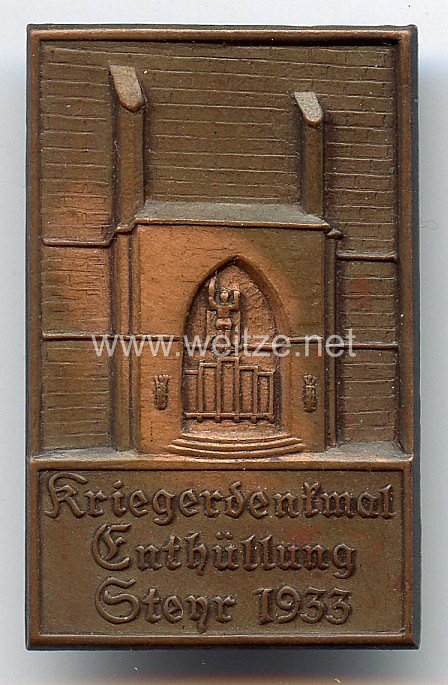
Third Reich - War Memorial Unveiling Steyr 1933 (Austria)

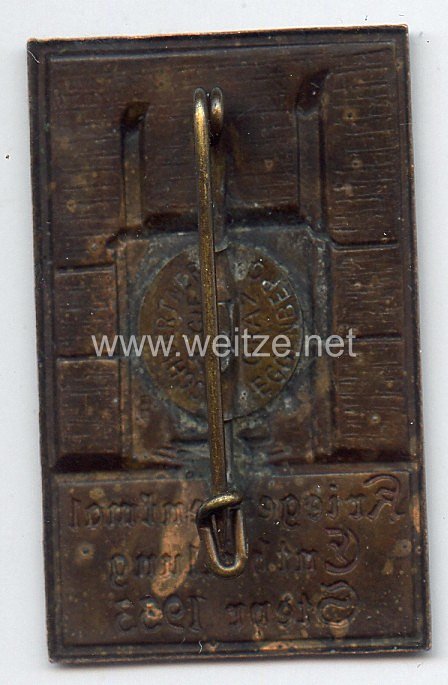
Tinnie badge, pinback, with maker: Schwertner & Cie Graz Eggenberg, condition 2.
336015
25,00

Third Reich - War Memorial Unveiling Steyr 1933 (Austria)

This tin badge commemorates the unveiling of the war memorial in Steyr in 1933, a significant event in the interwar period of Austrian history. The badge was manufactured by Schwertner & Cie of Graz-Eggenberg, an established producer of decorations and badges in Styria.

The years between 1918 and 1938 represented a phase of intense political and social upheaval for Austria. Following the collapse of the Habsburg Monarchy and the devastating losses of the First World War, commemorating fallen soldiers became a central concern for many Austrian communities. War memorials were erected in nearly every town and village to honor the dead while simultaneously establishing national identity.

The year 1933 marks a decisive turning point in Austrian history. It was the year when Chancellor Engelbert Dollfuß dissolved parliament and paved the way for the Austrofascist corporate state. In this politically charged environment, memorial unveilings and patriotic events acquired particular significance, as they were instrumentalized to legitimize the new order and mobilize national sentiments.

Steyr, an important industrial city in Upper Austria, was a center of arms production and heavy industry in the early 20th century. The Steyr Works produced not only automobiles and bicycles but also military equipment. The city had suffered numerous casualties during World War I, making the erection of a dignified memorial an important civic concern.

Such commemorative badges were typically distributed to participants in the unveiling ceremony – to veterans, relatives of the fallen, local dignitaries, and members of veterans' associations. They served as material reminders of the event and reinforced collective memory. The badges were often worn on clothing and documented participation in this significant occasion.

The manufacturing company Schwertner & Cie in Graz-Eggenberg was among numerous enterprises that specialized in producing badges, medals, and decorations during the interwar period. The Styrian metal industry had a long tradition in manufacturing such objects, and Graz firms supplied not only local but also regional clients throughout Austria.

The designation "III. Reich" (Third Reich) in the title is historically problematic and requires clarification: The German Reich under National Socialist rule referred to itself as the "Third Reich," but in 1933 Austria was still an independent state. The Anschluss of Austria to the German Reich did not occur until March 1938. The use of this designation might refer to later categorizations or reflect the complex political circumstances of the time, when pan-German movements were already strongly represented in Austria.

War memorials of the interwar period generally followed traditional design patterns: they often depicted mourning soldiers, victory goddesses, eagles, or Christian symbols such as crosses. The inscriptions praised the heroism and sacrifice of the fallen while idealizing the traumatic experiences of war. These memorials were sites of remembrance but also of political instrumentalization, especially during a time of growing authoritarian tendencies.

Veterans' associations played a central role in organizing such unveiling ceremonies. They cultivated the memory of the fallen, organized commemorative events, and contributed to maintaining military traditions. In the politically polarized 1930s, these associations were often arenas for ideological confrontations between Social Democrats, Christian Socials, and National Socialists.

This badge is thus more than a mere souvenir – it is a historical witness to a complex historical period in which mourning for war dead, the search for national identity, and political radicalization were intertwined. Such objects enable contemporary observers to understand the commemorative culture of the interwar period and comprehend the prehistory of the events that led to the end of Austrian independence in 1938.