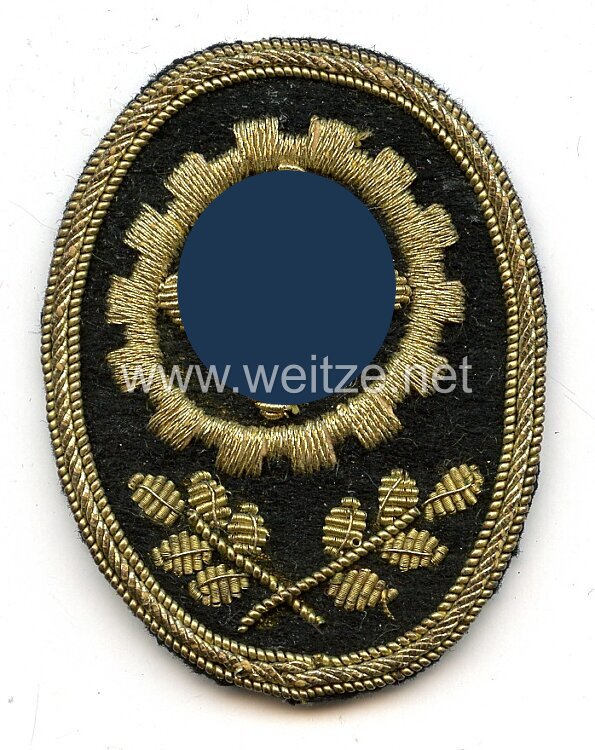
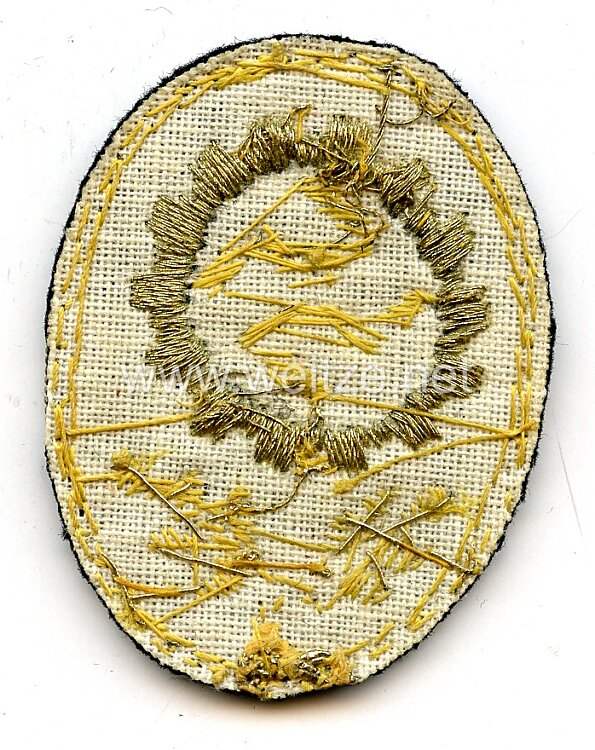
Deutsche Arbeitsfront (DAF) Visor Cap Badge
The Deutsche Arbeitsfront (DAF) cap badge represents a significant example of uniform insignia from National Socialist mass organizations. This version in hand-embroidered metal thread represents the highest quality level of such badges and was primarily worn by leadership personnel and functionaries.
The Deutsche Arbeitsfront (German Labor Front) was founded on May 10, 1933, under the leadership of Robert Ley and developed into the largest mass organization in the Third Reich. After the Nazis crushed the free trade unions on May 2, 1933, the DAF was intended to serve as a unified organization encompassing all German employees and employers. By 1939, the DAF had over 23 million members, making it the largest membership organization in Nazi Germany.
The DAF cap badge typically displayed the DAF symbol, consisting of a cogwheel representing industry, surrounded by wheat ears symbolizing agriculture, with a swastika at its center. This emblem symbolized the National Socialist claim to unite all strata of the working population under the regime's ideology.
The hand-embroidered metal thread execution described here belongs to the category of so-called deluxe versions. These were not industrially manufactured but produced by specialized craft workshops using elaborate handwork. The embroidery was created with metal wires, usually aluminum or silver-plated copper wire, applied to a base of felt or cloth. This technique required considerable craft skill and was time-intensive, explaining the higher costs of these versions.
Various quality levels existed for DAF badges: The simplest variants were machine-woven or stamped and made from less expensive materials. The middle quality level consisted of machine-made embroideries. The highest category consisted of hand-embroidered versions with metal threads, as in the present case. Leaders and higher functionaries of the DAF preferentially wore these more elaborate variants to demonstrate their status within the organization.
The production of such deluxe badges was concentrated in Germany in several traditional centers of passementerie art and metal thread embroidery. Particularly renowned were firms in Wuppertal, Lüdenscheid, and other cities in the Bergisches Land region, which had a long tradition in manufacturing military and paramilitary insignia. Many of these companies existed before the Nazi era and made their expertise available for producing the new uniform badges.
The peaked cap itself was a central element of the DAF uniform. Depending on rank and function, the caps differed in details such as color, piping, and of course the badges attached to them. The cap badge was usually attached to the front of the cap, above the cap band and below the crown.
The organizational structure of the DAF was complex and comprised numerous subdivisions. These included Kraft durch Freude (Strength Through Joy), the DAF's leisure organization, the Beauty of Labor Office, as well as various specialist offices and Reich occupational groups. Functionaries of these organizations wore corresponding uniforms with associated badges.
The stated Condition 2 indicates, according to common collector grading, a well-preserved specimen that may show signs of use but no severe damage. With hand-embroidered metal thread versions, slight oxidation traces on the metal threads or minimal detachment of the embroidery from the base are frequently observed, without substantially affecting the overall appearance of the object.
Today, such badges are objects of study for historians, museums, and collectors of military-historical items. They document the visual culture and symbolic language of National Socialism as well as the craft techniques of insignia production during this era. Scholarly engagement with such objects contributes to understanding the mechanisms of totalitarian rule, which included the symbolic penetration of all areas of life through uniform clothing and badges.
The hand-embroidered craftsmanship visible in such pieces also provides insight into the specialized industries that supported the Nazi organization's visual propaganda. The meticulous detail work required for these badges demonstrates the regime's emphasis on hierarchical distinction and the importance placed on symbolic representation within its mass organizations.