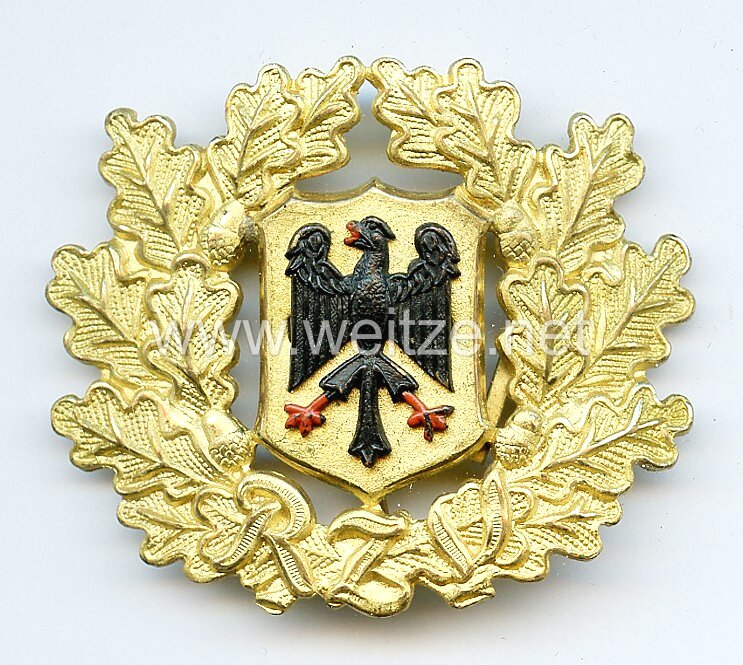
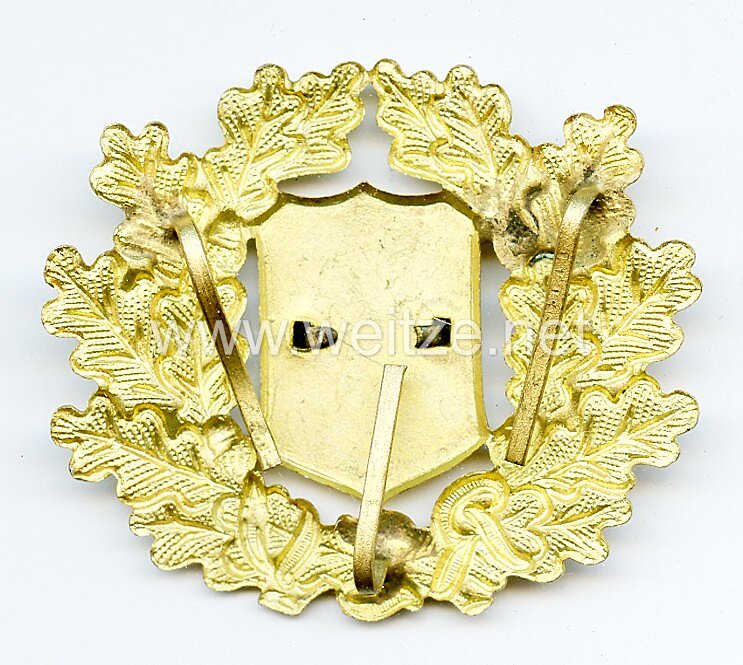
Weimar Republic Reichszollverwaltung (RZV) Oak Leaf Wreath

Gilt non-ferrous metal, condition 2.
466214
60,00

Weimar Republic Reichszollverwaltung (RZV) Oak Leaf Wreath

The Oak Leaf Wreath of the Reich Customs Administration from the Weimar Republic era (1919-1933) represents a significant chapter in the history of German customs administration and its paramilitary structures. This award made of gilt bronze embodies the complex development of German border security during the interwar period.

Following the Treaty of Versailles in 1919, Germany was subject to severe military restrictions. The Reichswehr was limited to 100,000 men, forcing the German government to develop alternative security structures. The Reich Customs Administration (Reichszollverwaltung - RZV) evolved in this context into a paramilitary organization that extended far beyond its original fiscal duties.

The RZV was officially established through the Ordinance on the Establishment of the Reich Customs Administration of October 1, 1919. Under the direction of the Reich Finance Ministry, it initially had the task of collecting duties and controlling cross-border trade. However, given the tense political situation at German borders – particularly in the east with Poland and in the west with France and Belgium – the organization increasingly assumed security policy functions.

The Border Surveillance Service (Grenzaufsichtsdienst - GAD) formed the armed wing of the Reich Customs Administration. These units were militarily organized, wore uniforms, and were armed. They were intended not only to combat smuggling but also to protect borders against irregular forces and potential invasions. In the early 1920s, during the Ruhr occupation and the conflicts in Upper Silesia, the GAD played an important role in maintaining German presence in disputed border areas.

The awarding of decorations such as the oak leaf wreath served several purposes. On one hand, it was intended to strengthen morale and discipline within the organization. On the other hand, it symbolized the importance that the Weimar state attached to border security. The oak leaf as a motif has a long history in German military tradition and symbolizes strength, permanence, and loyalty – values that the customs administration was also meant to embody.

The production of such awards typically occurred through specialized firms that also produced military orders and medals. The use of gilt bronze was standard for non-highest decorations and allowed for a dignified appearance at reasonable costs. The craftsmanship quality of these pieces varied depending on the manufacturer and time of production.

Throughout the Weimar Republic, the Reich Customs Administration remained a significant institution. At its peak, it employed tens of thousands of officials and employees. The Border Surveillance Service comprised several thousand armed men organized in quasi-military structures. This parallel structure to the regular army was an open secret and was viewed with suspicion by Allied monitoring commissions.

The political significance of the RZV increased in the late 1920s when Germany experienced a phase of relative stability. The Locarno Treaties of 1925 and the Kellogg-Briand Pact of 1928 eased the international situation, yet the customs administration remained an important component of German state power. With the Nazi seizure of power in 1933, the organization was reorganized and integrated into the new regime.

Today, awards from the Reich Customs Administration from the Weimar era are sought-after collectibles that offer insight into a little-known facet of German history. They recall an epoch in which Germany had to navigate between the demands of the Versailles Treaty and the need for security and sovereignty. The oak leaf wreath symbolically represents the Weimar Republic's attempts to maintain a functional state apparatus despite massive restrictions.