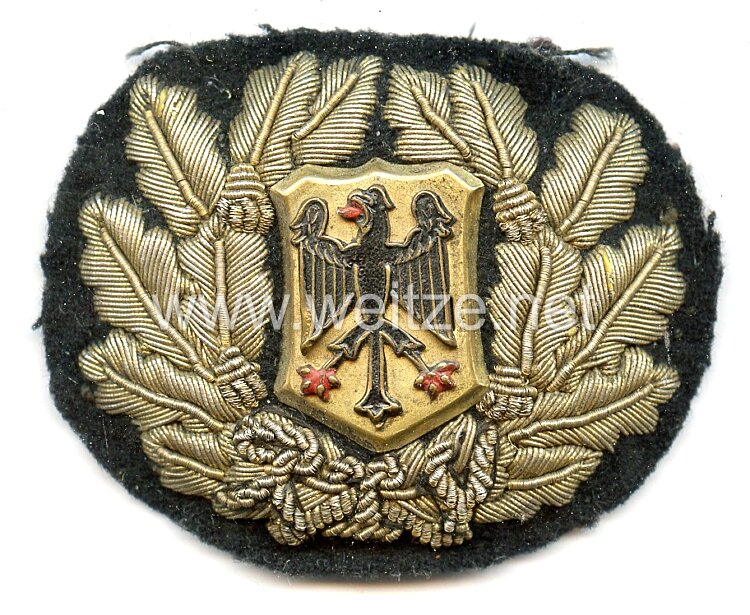
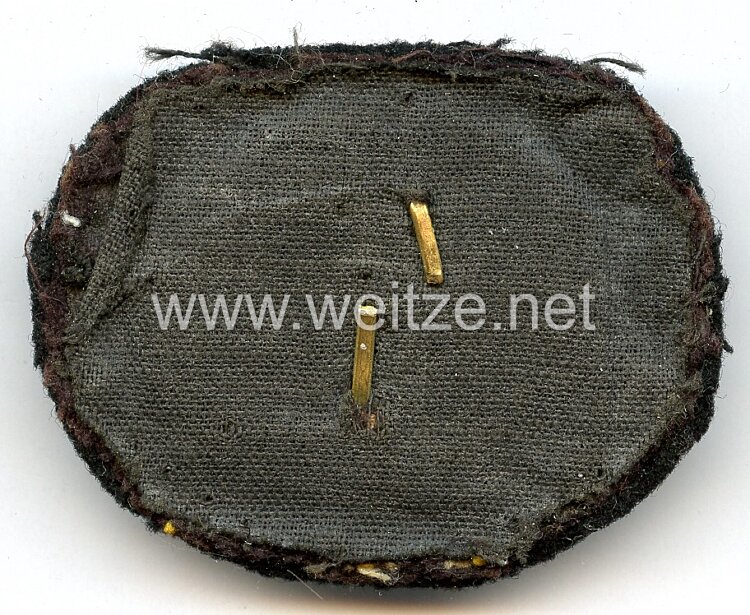
Weimar Republic Cap Cockade for an Official of the Reichszollverwaltung (Reich Customs Administration)
This hand-embroidered gilded cockade with national eagle represents a significant symbol of state authority during the Weimar Republic (1919-1933). This specimen was worn by officials of the Reich Customs Administration (Reichszollverwaltung) on their service caps and embodies the continuity of state institutions during a time of profound political upheaval in Germany.
After the end of World War I and the collapse of the monarchy in November 1918, the young German Republic faced the challenge of creating new state symbols that would both break with the imperial past and project legitimacy and authority. The Weimar National Assembly adopted the new Reich Constitution on August 11, 1919, which also provided the basis for redesigning state emblems.
The Reich Eagle was retained as a national symbol, but in modified form. Unlike the imperial eagle with crown and scepter, the republican eagle showed a simpler design facing right without monarchical attributes. This redesign was created by the graphic artist Karl-Tobias Schwab and was officially established by the Reich Coat of Arms Act of November 11, 1919.
The Reich Customs Administration played a central role in the Weimar Republic's state finances. After the war and the reparation obligations of the Treaty of Versailles, customs revenues were an important source of income for the Reich. Customs officials were directly subordinate to the Reich and not to the states, which underscored their special position in the structure of Reich administration. The Reich Financial Reform of 1919/1920 under Reich Finance Minister Matthias Erzberger centralized financial administration and significantly strengthened the position of the Reich Customs Administration.
Cockades as service badges have a long tradition in Germany dating back to the 18th century. They served for identification and indicated affiliation with a particular state institution. The cap cockade was typically attached to the front of the service cap and was mandatory for uniformed officials.
The hand-embroidered execution of this cockade indicates high-quality craftsmanship. While ordinary officials often wore cockades made of stamped metal, hand-embroidered specimens with gold threads were particularly common among higher-ranking officials. The gold embroidery was traditionally done on a base of firm fabric, using genuine or imitation gold threads. The handwork required specialized craftsmen who often worked in passementerie workshops or specialized effects factories.
The service clothing regulations of the Weimar Republic precisely regulated how and by whom certain cockades could be worn. The Reich Clothing Ordinance for officials stipulated that the cockade with the Reich eagle was reserved exclusively for Reich officials. State officials, on the other hand, wore the cockades of their respective states, often in the black-red-gold Reich colors with state-specific additions.
The national eagle depicted on the cockade followed the official guidelines for representing the Reich coat of arms. The eagle was shown with outstretched wings, facing right, and without monarchical insignia. This form differed significantly from the Prussian eagle of the imperial era and was meant to symbolize the republican form of government.
The customs uniform of the Weimar Republic followed the regulations for Reich officials and typically consisted of a dark, usually green uniform with characteristic badges. The peaked cap was an essential component of the service clothing, and the cockade formed the central identification mark on the front of the cap.
During the turbulent years of the Weimar Republic, marked by economic crises such as the hyperinflation of 1923 and political unrest, the Reich institutions and their officials remained important stabilizing factors. Customs officials at borders and in ports embodied the authority of the Reich and were charged with enforcing customs laws and combating smuggling.
With the Nazi seizure of power in 1933, the Weimar Republic ended. State symbols were changed again, and the Reich eagle received the swastika as an additional element. Official cockades from the Weimar period were replaced by new badges or had to be modified.
Today, cockades from the Weimar Republic are sought-after collectors' items that document an important chapter of German history. They testify to Germany's first democracy and its efforts to legitimize state authority through new, republican symbols. The condition grade 2 of this specimen indicates a well-preserved cockade that, despite being nearly a hundred years old, has retained its historical significance.