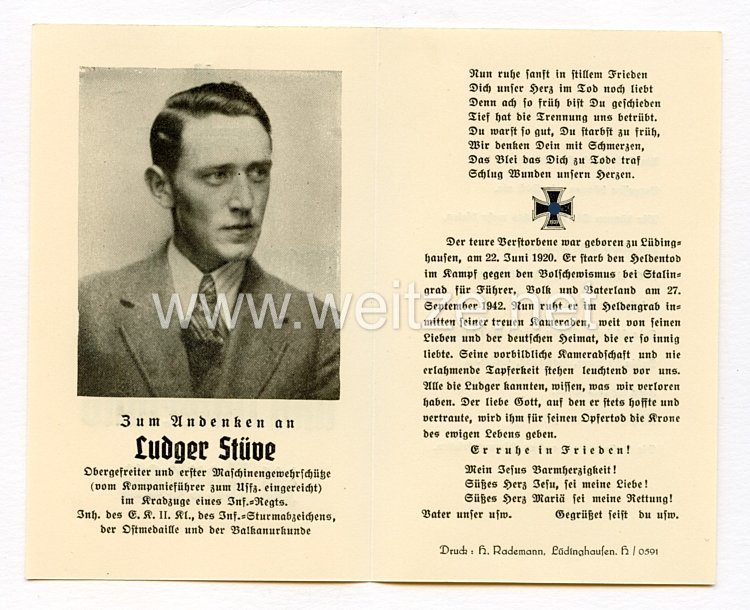
Wehrmacht Death Notice of a Machine Gunner in a Motorcycle Platoon of an Infantry Regiment, Killed in Action on September 27, 1942 at Stalingrad

Mourning card, dimensions approx. 14.5 x 11.7 cm, condition 2.
404014
35,00

Wehrmacht Death Notice of a Machine Gunner in a Motorcycle Platoon of an Infantry Regiment, Killed in Action on September 27, 1942 at Stalingrad

This death memorial card (Sterbebild) documents the fate of a German machine gunner who fell on September 27, 1942, at Stalingrad. With dimensions of approximately 14.5 x 11.7 cm, it corresponds to the typical format of such memorial cards from the Second World War period.

Death memorial cards had been a deeply rooted Catholic tradition in German-speaking regions since the 19th century, gaining particular significance during World War II. These printed devotional cards were commissioned by the relatives of deceased soldiers and distributed at funeral services, memorial masses, and burials. They served both religious remembrance and personal grief processing during a time of mass death.

The fallen soldier belonged to a motorcycle squad (Kradzug) of an Infantry Regiment. Motorcycle reconnaissance units were motorized reconnaissance formations of the Wehrmacht, equipped with motorcycles, often with sidecars. These units were known for their mobility and speed, typically deployed for reconnaissance missions, communication tasks, and rapid advances. As a machine gunner in such a unit, the fallen soldier held a particularly important role, as the firepower of the MG 34 or MG 42 often constituted the main armament of these light units.

The date of death, September 27, 1942, falls within a critical phase of the Battle of Stalingrad. At this time, German troops had already been engaged in fierce fighting for the industrial city on the Volga for weeks. By late September 1942, the fighting concentrated particularly on the city center and the industrial districts in the northern part of the city. The 6th Army under General Friedrich Paulus attempted to eliminate the last Soviet resistance pockets and completely capture the city. The fighting was characterized by unprecedented brutality, with high casualties on both sides in grinding house-to-house combat.

The deployment of motorcycle reconnaissance units at Stalingrad demonstrates the desperate situation of the Wehrmacht, as these units, originally conceived for mobile operations in open terrain, were now employed in urban rubble landscapes. The motorcycles lost their tactical advantages in this terrain, and the soldiers essentially fought as regular infantry under extremely unfavorable conditions.

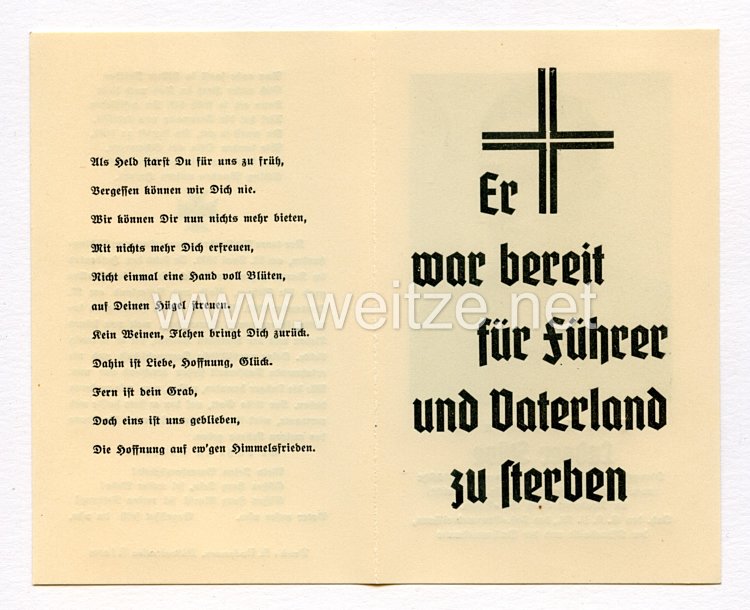
The design of death memorial cards followed certain conventions during the war. They typically displayed a photograph of the fallen in uniform, religious symbols such as crosses, and contained prayers, Bible verses, or patriotic texts. The front usually presented the portrait, while the reverse listed biographical data, information about military service, decorations, and the exact circumstances of death. Phrases such as “fallen for Führer, people, and fatherland” were often used, combining National Socialist ideology with Christian traditions.

The production of such memorial cards was carried out by specialized printing companies that offered this service despite paper shortages and wartime economy. Relatives had to finance these memorial cards themselves, which represented an additional burden during times of economic hardship. Nevertheless, great importance was attached to this form of remembrance, as it was considered an essential part of death culture in Catholic tradition.

As historical sources, death memorial cards offer extraordinary insights into several aspects of war history. They document individual fates beyond the grand strategic narratives, show the geographical and temporal distribution of losses, and illustrate how Nazi propaganda instrumentalized Christian traditions for its purposes. Simultaneously, they reveal private mourning rituals and the ways families dealt with the loss of their loved ones.

The Battle of Stalingrad developed into the turning point of the war on the Eastern Front. What appeared to be a German victory in September 1942 ended in February 1943 with the capitulation of the encircled 6th Army and approximately 91,000 German prisoners. Of the originally over 200,000 encircled soldiers, only about 6,000 survived Soviet captivity and returned to Germany.

Today, such death memorial cards are important military-historical documents preserved in archives, museums, and private collections. They commemorate the individual victims of war and serve as a sobering testament to one of the most devastating military catastrophes in German history.

r