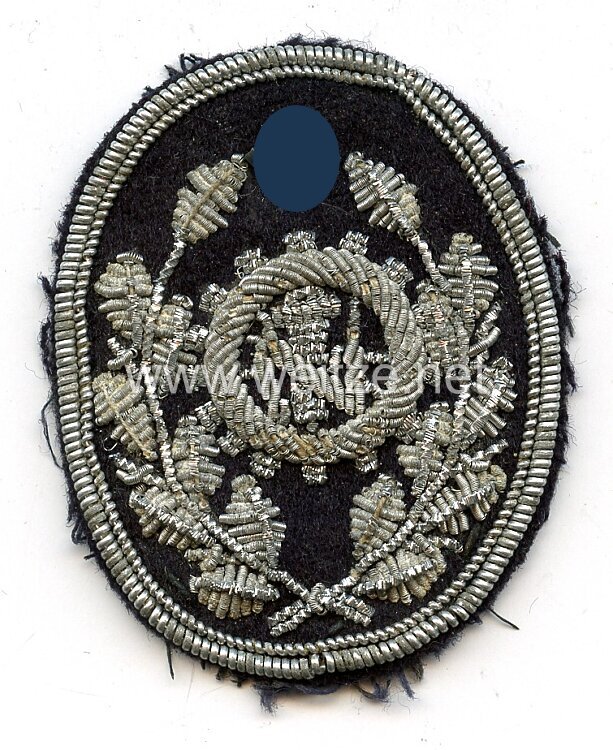
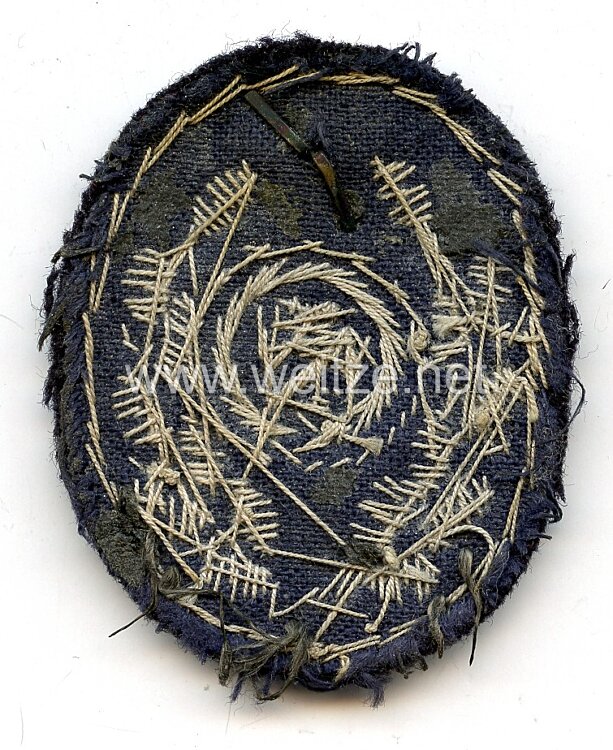
Technische Nothilfe TeNo Oak Leaf Cockade for Visor Cap “for Leaders”
The Technische Nothilfe (TeNo), or Technical Emergency Service, was founded on September 30, 1919, as a paramilitary organization designed to maintain Germany's technical infrastructure during strikes and emergencies. Originally conceived as a non-political organization, the TeNo underwent a profound transformation during the Nazi seizure of power in 1933, which was reflected in its uniforms and rank insignia.
The oak leaf cockade described here represents a significant rank insignia used around 1933 for leaders (Führer) of the Technical Emergency Service. This cockade was worn on the peaked cap (Schirmmütze) and identified wearers in leadership positions within the organization. The execution of this cockade demonstrates the high craftsmanship typical of leadership insignia from this period.
The characteristic design consists of hand-embroidered metal thread on a black background, with the oak leaves – a traditional German symbol of valor and steadfastness – artfully executed. The central element, the swastika, is worked as a metal appliqué and marks the political coordination of the organization after 1933. This transition from an originally non-partisan organization to an NS-controlled entity occurred rapidly after Adolf Hitler's seizure of power.
The Technical Emergency Service had an important function during the Weimar Republic in maintaining public order and supply. Its members were technically trained specialists deployed during natural disasters, technical accidents, and political unrest. With the Nazi seizure of power, the TeNo was gradually integrated into the system of NS organizations.
The uniforms and rank insignia of the TeNo were newly regulated in 1933 to adapt the organization to National Socialist concepts. The introduction of the swastika into the insignia was part of this coordination. For leadership personnel, particularly high-quality insignia were prescribed, which differed from simpler enlisted insignia through their elaborate manufacture.
The hand-embroidered execution of this cockade suggests early production, possibly from the transitional period of 1933/34. Later productions were often machine-made or simplified to reduce manufacturing costs. The use of metal threads was expensive and time-consuming, making these insignia valuable equipment items.
The oak leaf as a heraldic element has a long tradition in German military and organizational history. Since the 19th century, it symbolized strength, endurance, and national identity. The combination with the swastika from 1933 onward linked traditional German symbolism with National Socialist ideology.
The position of this cockade on the peaked cap was precisely prescribed. It was attached centrally to the front of the cap and was thus the most visible rank insignia. The black background color corresponded with the colors of the TeNo uniform, which was oriented toward military models.
After 1936, the Technical Emergency Service was further integrated into the NS organizational structure and worked closely with other formations such as the SA, SS, and the Reich Air Protection League. During World War II, the TeNo played an important role in cleanup work after air raids and in maintaining infrastructure within the Reich territory.
From a collecting perspective, such early leadership insignia of the TeNo are rare today. Most were destroyed during the war or in the immediate postwar period. The stated condition of 2+ indicates a worn but well-preserved example showing typical signs of use but structurally intact.
Research into such uniform components contributes to understanding the institutional development of paramilitary organizations under National Socialism. They document the gradual militarization and politicization of originally civilian aid organizations and show how ideological messages were conveyed through symbolism and uniforms.