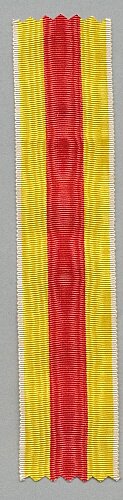
Original Ribbon for Military Karl Friedrich Order of Merit Knight's Cross 1st - 3rd Model + Merit Medal of the Military Karl Friedrich Order of Merit

Width 32 mm, length 150 mm, unworn.

Shipping as letter 1€ postage possible.
International shipping at your own risk as a letter 2.50€ postage possible.
202414
10,00

Original Ribbon for Military Karl Friedrich Order of Merit Knight's Cross 1st - 3rd Model + Merit Medal of the Military Karl Friedrich Order of Merit

The ribbon of the Military Order of Merit of Karl Friedrich represents a significant decoration of the Grand Duchy of Baden, closely connected with the military history of southwestern Germany in the 19th and early 20th centuries.

The Military Order of Merit of Karl Friedrich was established on September 24, 1807, by Grand Duke Karl Friedrich of Baden, shortly before his death on June 10, 1811. The foundation occurred during a time of profound political upheaval, when Baden had been elevated to a Grand Duchy through the Act of Confederation of the Rhine and its armed forces were being substantially modernized within the framework of the Napoleonic Wars.

The order went through several model variations, with the first three models being in use between 1807 and the 1870s. The first model (1807-1818) was characterized by special craftsmanship, with the order's cross still clearly influenced by early jewelry-making techniques. The second model was introduced under Grand Duke Ludwig I and already featured modifications in enameling and design. The third model, manufactured from approximately the 1850s onward, showed further stylistic adaptations and was used until the introduction of later variants.

The order ribbon traditionally measured 32 mm in width, thus conforming to the exact specifications of Baden's order statutes. The ribbon's colors – yellow with red borders – were Baden's national colors and symbolized the close connection between the ruling house and military valor. This color combination was unmistakable and clearly distinguished the order from other German military decorations of the period.

The order was divided into several classes, with the Knight's Cross representing a middle rank. Above the Knight's Cross were the Commander's Cross and the Grand Cross, while below it were various grades of crosses of honor and medals. The Medal of Merit of the Military Order of Merit of Karl Friedrich was frequently awarded to non-commissioned officers and enlisted men who had distinguished themselves through particular bravery or long and faithful service.

The ribbon described here could be used for both the Knight's Cross and the Medal of Merit, depending on the manner of wearing and the respective order statutes. The length of approximately 150 mm was typical for the neck order variant or for storage in order cases. Shorter ribbons were used for breast decorations or medal bars.

During the Coalition Wars against Napoleon (1813-1815), numerous such decorations were awarded to Baden soldiers who fought in the battles of Leipzig, at the Katzbach, or in France. The order also remained an important instrument for recognizing military achievements during the German Wars of Unification – the Second Schleswig War (1864), the Austro-Prussian War (1866), and the Franco-Prussian War (1870/71).

The award criteria were precisely defined in the order statutes. The Knight's Cross generally required an outstanding individual achievement or several years of meritorious service in a responsible position. The award had to be personally approved by the Grand Duke, with recommendations submitted through the military chain of command.

After the November Revolution of 1918 and the abdication of the last Grand Duke Friedrich II on November 22, 1918, the award of the order ceased. The Weimar Republic prohibited the wearing of imperial and royal orders in connection with republican uniforms, but permitted wearing them as private mementos.

From a collector's perspective, original ribbons of the Military Order of Merit of Karl Friedrich are now sought-after objects in phaleristics. Unworn specimens, such as the one described here, are particularly rare, as most ribbons were actively used and show corresponding signs of wear. Correct identification of the model variants requires knowledge of the subtle differences in weaving technique, color tone, and material composition of the various manufacturing periods.

The ribbon thus represents not only a military decoration but also an important testament to Baden's regional history, German military traditions of the 19th century, and the artisanal craft of order manufacturing in this epoch.