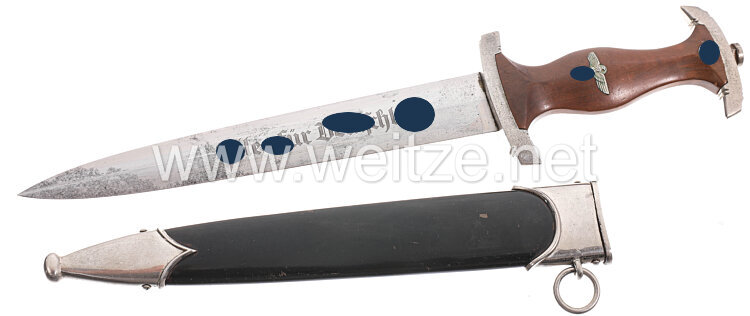
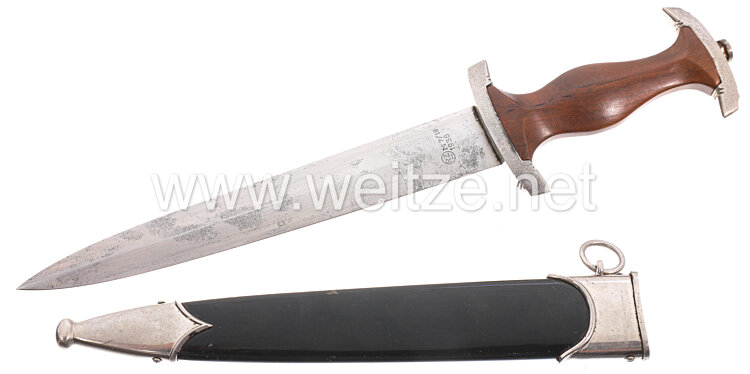
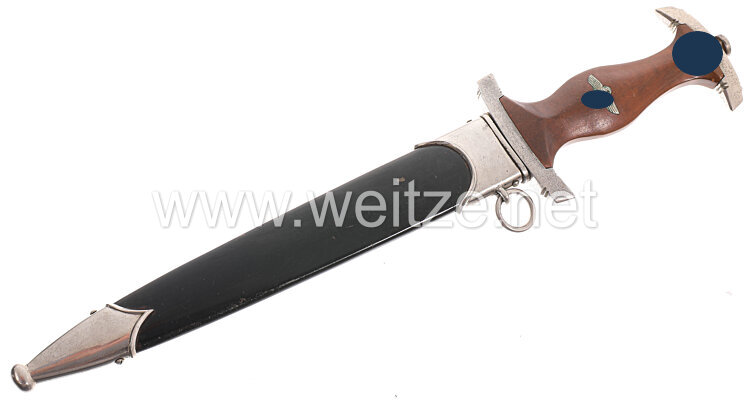
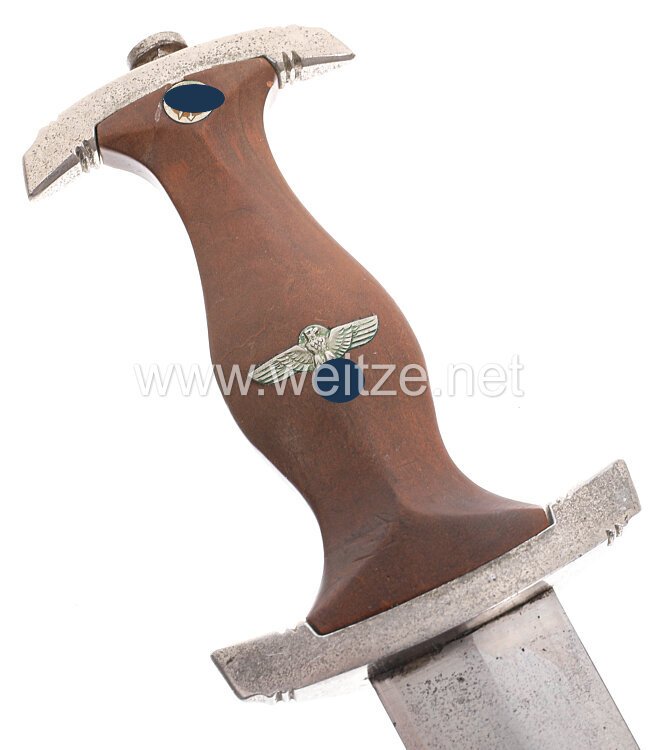
National Socialist Motor Corps (NSKK) Service Dagger M 33
The NSKK Dienstdolch M33 (Nationalsozialistisches Kraftfahrkorps Service Dagger Model 1933) represents a significant chapter in the history of paramilitary organizations of the Third Reich. This object is a ceremonial dagger carried by an organization whose development can be traced back to the early 1920s and which represents a complex connection between motorized mobility and National Socialist ideology.
The origins of the NSKK reach back to 1923, when the SA introduced a “Kraftfahr Abteilung” (Motor Section). In 1928, the SA Motor section expanded to “Kraftfahrstaffeln” (Motor Squadrons). In April 1930, the NSAK (National Socialist Automobile Corps) was formed as an NSDAP auxiliary organization subordinate to the SA. In early 1931, Adolf Hühnlein was appointed Chief and proposed a name change to NSKK, which was officially accepted in April of 1931. On July 20, 1934, weeks after the Night of the Long Knives, the NSKK was separated and promoted into an independent NSDAP organization, with Hühnlein still at its head.
Still subordinate to the SA in 1933 when the SA dagger was introduced, the NSKK also adopted the dagger shortly after. The dagger was intended as an ornamental item and its design was based on the traditional 16th century Swiss “Holbein” dagger. In May of 1936, Korpsführer Hühnlein decreed the NSKK dagger scabbards were to be finished in black to differentiate them from the SA dagger. From 1935 onward, the NSKK also provided training for Panzer crews and drivers of the Heer (German Army). The organization grew from 10,000 members in 1934 to over half a million by 1940.
The present specimen was manufactured by C. Eppenstein Söhne, Messerfabrik, a company founded in 1845 by Carl Eppenstein and registered in Solingen on October 31, 1902. C. Eppenstein Söhne made early pattern SA and NSKK daggers in limited numbers and is rated 9 out of 10 for rarity on the McSARR scale, with an estimated production of about 1000 daggers. Over 240 different manufacturers produced SA/NSKK daggers between 1933 and 1942, with each blade marked with a manufacturer's logo or RZM code after 1936.
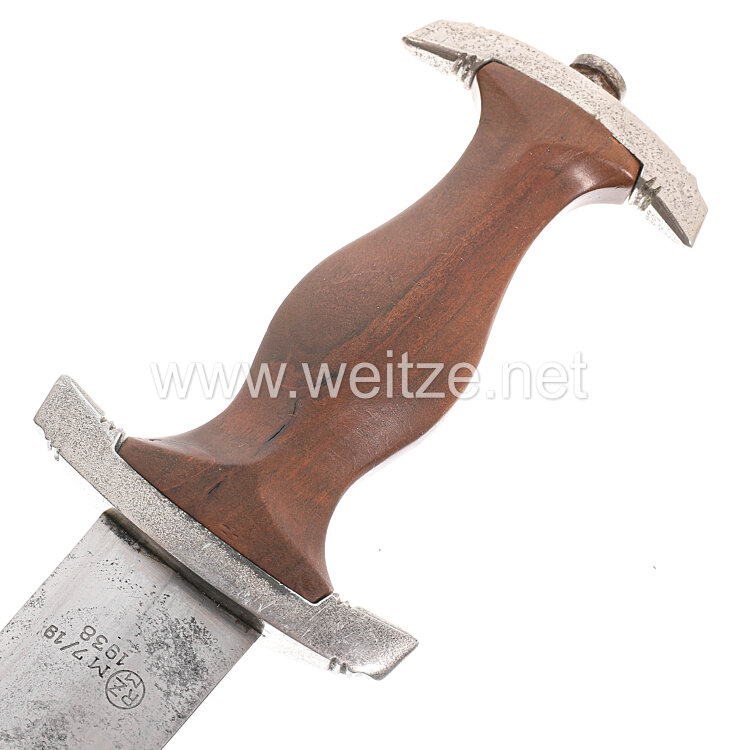
The described piece bears the RZM code “M7/19” for Eduard Wüsthof Dreizackwerk Solingen. Stamped on the crossguard is the “Ho” marking for NSKK Gruppe Hochland. Motorobergruppe Süd subdivided into Motorgruppen Ostmark, Hochland and Alpenland, with Gruppe Hochland serving Bavaria and the Hochland region.
Production variants can be divided into several periods: from 1933 to 1935, early production featured high-quality materials, hand-etched blades, and solid nickel fittings. The RZM standardization period from 1936 to 1938 saw materials shifting to cost-effective alternatives. From 1939 to 1942, wartime production experienced quality decline due to material shortages. The specimen described is an early production example (pre-1936) based on nickel fittings and manufacturer characteristics.
Physically, the dagger measures 37.5 cm in total length when inserted into the scabbard, with a blade length of 22 cm. The blade is nickel-plated, magnetic steel with sharpened tip and edges. Acid-etched onto the obverse of the blade is an inscription of “ALLES FÜR DEUTSCHLAND” (“EVERYTHING FOR GERMANY”) in Fraktur script. Inset into the obverse of the handle is a silvered German national eagle clutching a wreathed mobile swastika, measuring 25 mm in width and 15 mm in height. Inset into the obverse of the pommel is a partially-silvered SA insignia measuring 9 mm in diameter. The upper crossguard is nickel-plated alloy marked with eight notches, distributed in pairs of four at both the top and bottom. The handle grip is composed of a single piece of lacquered brown wood, carved into a curvature for a comfortable grip. The scabbard is constructed of a black-painted magnetic metal shaft with nickel-silver fixtures riveted to the scabbard at both the tip and throat.
The NSKK was disbanded in May 1945 and declared a “condemned organization” at the Nuremberg Trials (although not a criminal one). This was due in part to the NSKK's origins in the SA and the racial requirements for membership. After 1945, NSKK service daggers, like all Nazi symbols, were banned in Germany. Many examples were taken by Allied soldiers as war trophies. Today, these objects are important historical artifacts preserved in museums and private collections. Their possession and display are regulated differently in various countries and often subject to strict legal provisions.