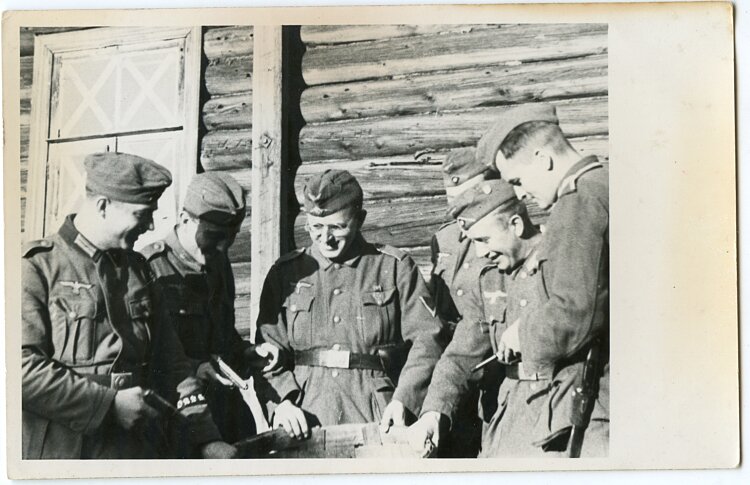
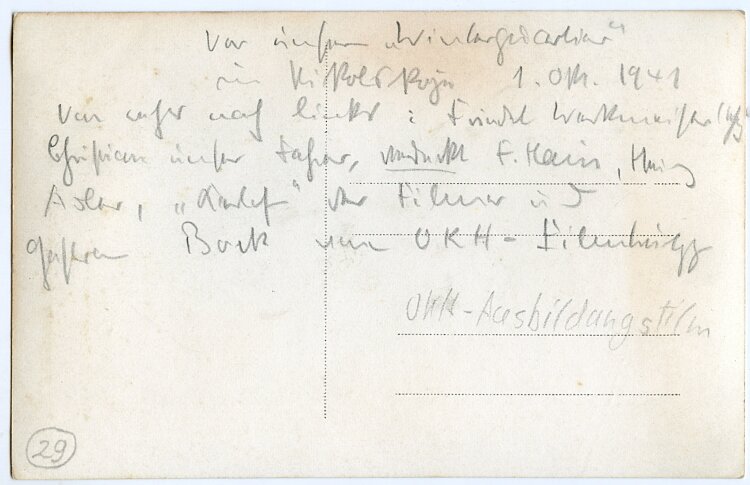
Photograph, Wehrmacht Member with Armband "OKH Ausbildungsfilm"
This photograph shows a member of the Wehrmacht wearing a distinctive armband inscribed “OKH Ausbildungsfilm” (OKH Training Film). This historical document in postcard format provides a fascinating glimpse into an often-overlooked aspect of Third Reich military organization: film documentation and training.
The Oberkommando des Heeres (OKH), or Army High Command, served as the supreme command authority of the German Army from 1935 to 1945. Under the leadership of high-ranking generals, the OKH not only coordinated military operations but was also responsible for comprehensive training and education of soldiers. As part of this mission, the Wehrmacht recognized early on the importance of modern media, particularly film, for military instruction.
The Wehrmacht's Propaganda Companies (Propagandakompanien or PK) and specialized film units played a central role in creating training materials. As early as the 1930s, during the Wehrmacht's expansion, military leadership embraced cinematography as a training tool. Film offered significant advantages over traditional methods: complex tactical maneuvers, weapons handling, technical procedures, and strategic concepts could be visually demonstrated and repeatedly shown.
Personnel equipped with the “OKH Ausbildungsfilm” armband belonged to specialized units responsible for the production, documentation, or distribution of military training films. These soldiers were frequently equipped with special gear and possessed technical expertise in areas such as camera operation, film editing, or projection. Many had previously worked in the civilian film industry and brought their expertise into military service.
The subject matter of these training films was diverse and encompassed all aspects of military life: infantry tactics, tank operation, artillery deployment, pioneer engineering, communications, medical services, and much more. Films were also produced about the handling of new weapon systems, which were shown in training units throughout the Reich and later in occupied territories. The standardization of training through films ensured uniform instruction regardless of location.
Technically, these film units worked with the most modern equipment of the era. They primarily used 35mm cameras, but also the more portable 16mm format for field deployment. Films were developed and edited in special production facilities before being duplicated and distributed to the troops. The OKH maintained its own film departments and coordinated production across various offices.
Wearing such an armband served purposes of identification and legitimation in daily military life. Armbands were a common means in the Wehrmacht for identifying members of special departments, units, or functions. They were typically worn on the left forearm and were made of woven fabric, usually with white or silver lettering on a dark background.
The postcard-sized photograph shown here corresponds to a common format of the period. Such photos, typically measuring approximately 9 x 14 cm, were frequently created as mementos and sent to family members or kept in personal albums. Professional photographers, as well as comrades with photographic skills, produced these portraits, often in studios or against neutral backgrounds.
The documentary value of such photographs is considerable. They enable historians to reconstruct the organization, uniforms, and structure of specialized Wehrmacht units. Armbands like the one shown here are of particular interest in military historical research, as they were often issued in limited numbers and document specific functions.
After the war, many of these training films were confiscated by the Allies. Some are now housed in archives such as the Bundesarchiv-Filmarchiv in Berlin, the National Archives in the United States, or the Imperial War Museum in London. Today they serve as important sources for researching Wehrmacht training, military technology, and propaganda methods.
In summary, this photograph documents a specialized aspect of Wehrmacht organization that reflects the modernity and technical sophistication of military training at the time. The use of film as a training medium was ahead of its time and demonstrates how military organizations harnessed new technologies for their purposes.