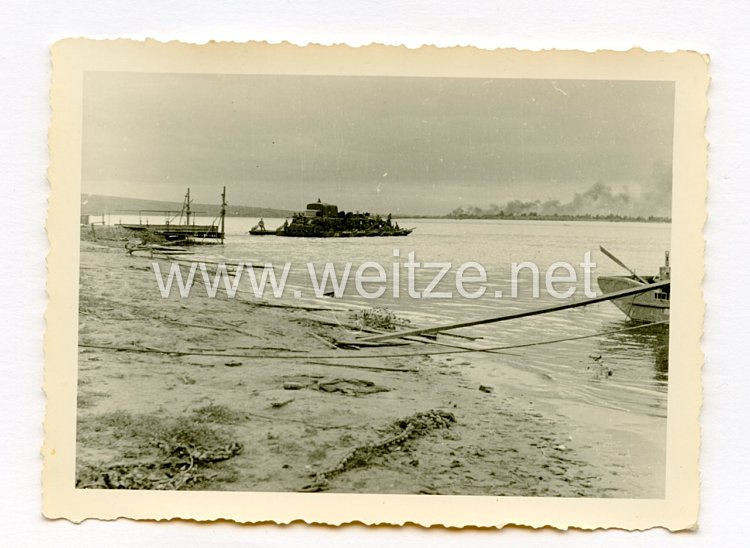
Wehrmacht Photograph, Pioneer Ferry

approx. 7 x 9 cm, condition 2.
400013
10,00

Wehrmacht Photograph, Pioneer Ferry

This photographic document depicts a Wehrmacht pioneer ferry and represents an authentic contemporary historical testimony of German military technology during the Second World War. Measuring approximately 7 x 9 cm, it corresponds to the typical format of field photographs that soldiers took during their service or kept as memorabilia.

The Pioneer troops of the Wehrmacht played a central role in operational warfare. Their tasks included the construction and destruction of bridges, the establishment of fortifications, the clearing of minefields, and particularly the creation of river crossings. Overcoming waterways represented a logistical and tactical challenge in all campaigns, which is why pioneer units were equipped with specialized equipment.

The Wehrmacht possessed various ferry systems that were deployed depending on the tactical situation and the load to be transported. The best-known system was the Bridge Equipment B, which could be used for both bridge construction and ferry connections. Additionally, there existed the lighter assault boat ferry system for rapid crossings as well as heavy pontoon equipment for transporting tanks and heavy equipment.

The Army Service Regulation 482/22 regulated in detail the deployment of ferries and crossing equipment. According to this regulation, pioneer units had to be capable of creating improvised crossing possibilities within the shortest time. The training of pioneers included theoretical instruction in statics and hydraulics as well as practical exercises on bodies of water.

Photographs like this document were taken by soldiers for various reasons: they served personal memory, documentation of technical achievements, or were used for propaganda purposes. The Wehrmacht's Propaganda Companies (PK) systematically produced visual material, but ordinary soldiers also frequently owned their own cameras and captured their daily lives.

The deployment of pioneer ferries can be traced through all theaters of war. During the Polish Campaign of 1939, numerous rivers such as the Vistula and Bug had to be crossed. In the Western Campaign of 1940, crossing the Meuse and Somme presented particular challenges. The attack on the Soviet Union from June 1941 confronted the pioneers with the massive rivers of Eastern Europe – the Dnieper, Don, and Volga required large-scale ferry operations.

The technical design of the ferries varied considerably. Light ferries consisted of coupled assault boats with wooden planks laid on top and could carry loads of up to two tons. Medium ferries made from pontoon bridge equipment enabled the transport of light tanks and artillery. Heavy tank ferries were assembled from multiple pontoons and could transport even heavy battle tanks like the Tiger.

The condition grade 2, in which the photograph is found, indicates good preservation with possibly minor signs of use. Such documents are today important sources for military-historical research and help reconstruct the technical and logistical aspects of warfare.

The collection and preservation of such photographs is of scientific value as they provide insights into military daily life that official documents cannot convey. They show the practical implementation of theoretical regulations and document the improvisation and adaptability required in combat deployment.

From today's perspective, such objects are testimonies of a dark epoch in German history. They must be viewed in the context of the criminal character of the Nazi regime and its warfare. Their historical significance lies in their source value for scholarly engagement with this period.