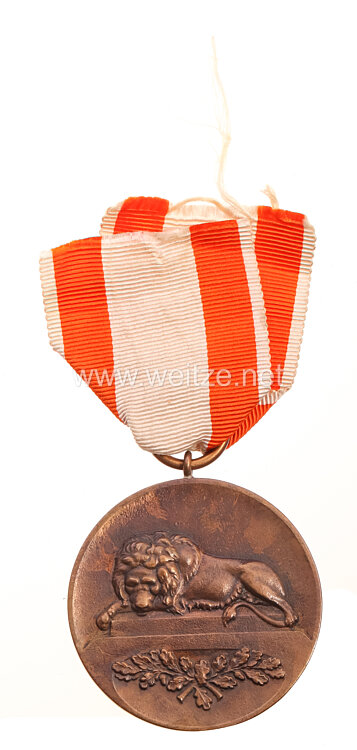
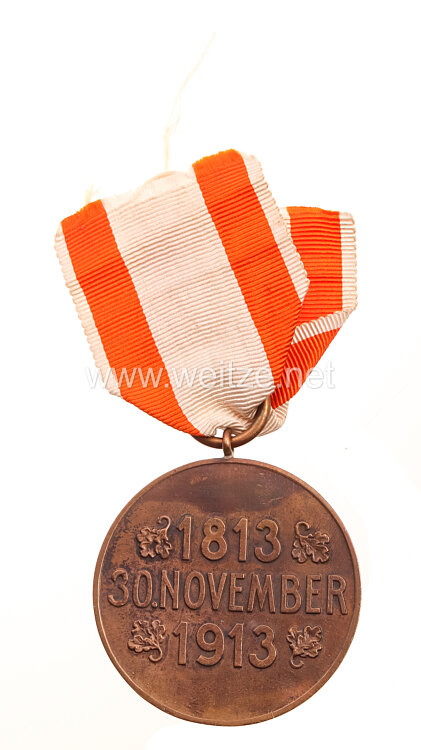
Prussia Kurhessian Jubilee Commemorative Medal "November 30, 1813-1913"

Gun bronze, on original ribbon, condition 2
Instituted by Kaiser Wilhelm II for the 100th anniversary of the 2nd Kurhessian Infantry Regiment No. 82 on November 30, 1913. Only approximately 170 awards are known.
442913
450,00

Prussia Kurhessian Jubilee Commemorative Medal "November 30, 1813-1913"

The Kurhessian Jubilee Memorial Medal commemorating the centenary of the 2nd Kurhessian Infantry Regiment No. 82 represents a particular rarity among Prussian military decorations. Instituted by Emperor Wilhelm II on November 30, 1913, this medal marked a significant milestone in the history of a regiment whose roots reached back to the turbulent years of the Wars of Liberation.

The Infantry Regiment No. 82 was originally formed during the Napoleonic Wars, at a time when the Electorate of Hesse played an important role in the anti-Napoleonic coalition. The date of November 30, 1813 noted on the medal refers to the founding or a significant historical moment of the regiment in 1813, when the Wars of Liberation against France reached their climax. After the decisive Battle of Leipzig in October 1813, French troops were in retreat, and the German states were reorganizing their military forces.

The manufacture of the medal from gun bronze followed an honored tradition particularly cultivated in Prussian military decorations. This practice symbolized the transformation of weapons of war into symbols of honor and recognition. Gun bronze, obtained from captured or decommissioned cannons, gave the decoration special historical and symbolic value. This choice of material emphasized the direct connection between military prowess and the memory of past battles.

The extraordinary rarity of this decoration is underscored by the fact that only approximately 170 awards are known. This makes the Kurhessian Jubilee Medal one of the rarest Prussian regimental decorations of the early 20th century. The limited number of awards is explained by restrictive awarding criteria: typically, such jubilee medals were only awarded to active members of the regiment as well as to selected veterans and particularly deserving individuals.

The year 1913 was marked by numerous jubilee celebrations in the German Empire. The centenary of the Wars of Liberation was commemorated throughout the empire with great ceremony. Emperor Wilhelm II used these occasions to honor the military traditions of Prussia and its allied states and to strengthen national consciousness. The institution of regimental jubilee medals was an important element of this culture of remembrance.

The 2nd Kurhessian Infantry Regiment No. 82 traditionally had its garrison in Göttingen and belonged to the XI Army Corps. The regiment's history was closely linked to that of the Electorate of Hesse-Kassel, which had been annexed by Prussia in 1866. Despite this political upheaval, Kurhessian traditions were preserved in the Prussian Army, as reflected in the designations and insignia of the regiments.

The medal was worn on its original ribbon, whose colors typically reflected the regimental colors or the colors of the former Electorate. Such decorations were worn on uniforms on ceremonial occasions and were considered a special honor for their bearers. The indicated condition 2 suggests a well-preserved decoration showing only slight signs of wear.

In historical context, this medal must also be seen against the background of the deteriorating political situation in Europe in 1913. Only months after the institution of this jubilee medal, the German Empire would enter World War I. Regiment No. 82 would soon be embroiled in the battles of the Great War, and many bearers of this medal would lose their lives on the battlefields of France and Russia.

The jubilee medal thus represents a significant moment in Prussian-German military history on the eve of the catastrophe of World War I. It embodies the cultivation of military traditions, the honoring of historical merit, and the continuity of military units over the course of a century. For collectors and historians today, it is a valuable testimony to regimental history and the decorative culture of the Prussian Empire.

r