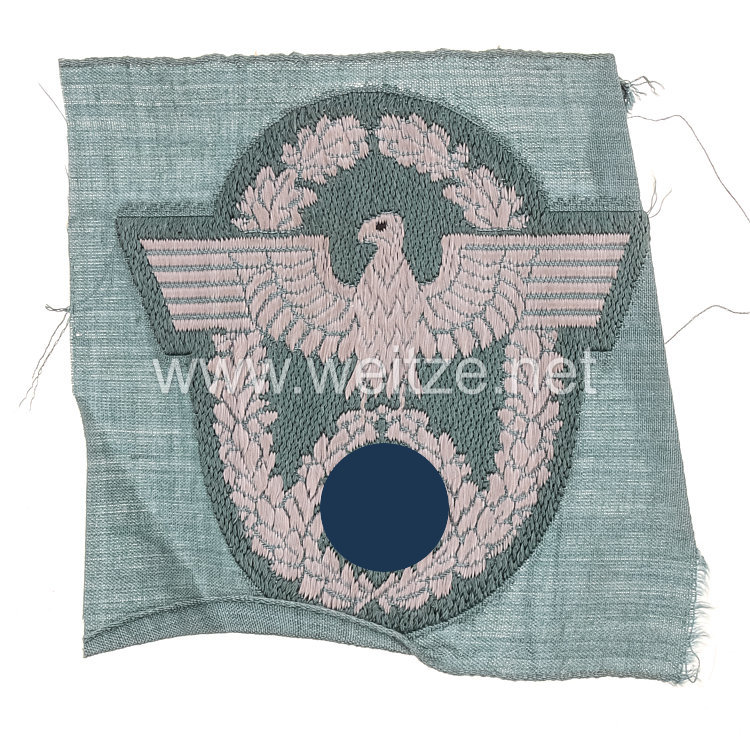
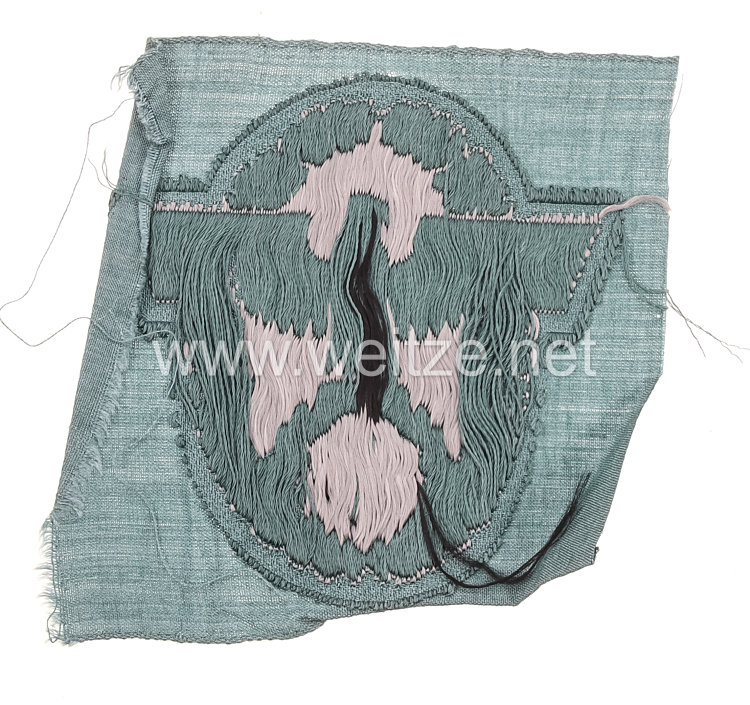
Police Sleeve Eagle for Enlisted Men Police-Felddivision
The Police Arm Eagle for enlisted men of the Police Field Division represents a significant piece of equipment from the German Ordnungspolizei (Order Police) during World War II. This insignia was worn by members of the Police Field Divisions, which occupied a unique position between military and police structures.
The Police Field Divisions were formed from members of the Ordnungspolizei beginning in 1939 and placed under military high command. The first of these divisions, the Police Division, was formed in October 1939 and participated in various campaigns, including the Western Campaign of 1940 and the invasion of the Soviet Union from June 1941. Over the course of the war, a total of four numbered Police Divisions as well as several SS Police Divisions were established.
The example described here is manufactured using Bevo weaving technique, a special weaving process developed by the company Bandfabrik Ewald Vorsteher from Wuppertal-Barmen. This technique enabled the production of detailed, woven badges that were distinguished by their durability and quality. Bevo insignia were produced throughout the war for various branches and organizations.
The execution on a field-gray background corresponds to the uniform color of the Wehrmacht and militarized police units. The field-gray background on field-gray cloth backing indicates its use on the field tunic. The eagle was worn on the left upper sleeve and identified the wearer as a member of a Police Field Division.
The dating of around 1942/43 falls into a phase of intense fighting on the Eastern Front. During this time, the Police Divisions suffered considerable losses and were repeatedly reorganized and reinforced. The 1st Police Division fought during this period in the area of Army Group North, while other Police formations were deployed on various front sectors.
The insignia was intended for enlisted men, that is, soldiers without non-commissioned officer rank. This distinguished it from insignia for non-commissioned officers and officers, who sometimes wore different versions. The lowest-ranking members formed the backbone of these divisions and were primarily assigned infantry duties.
The fact that this example is unworn makes it a rare historical document. Many insignia were worn, damaged, or lost during the war. Unworn pieces in good condition are rare today and of particular interest to collectors and historians.
The organizational structure of the Police Field Divisions was initially subordinate to the Main Office of the Order Police under SS-Obergruppenführer Kurt Daluege, while tactical command lay with the Wehrmacht. This dual structure sometimes led to jurisdictional problems but reflected the complex power structure of the Nazi state.
The armament and equipment of the Police Divisions largely corresponded to regular infantry divisions of the Wehrmacht, although supply shortages occurred especially at the beginning of the war. Uniforms followed army regulations, but special police insignia marked affiliation with the Ordnungspolizei.
After 1943, several Police Divisions were transferred to the Waffen-SS and renamed SS Police Divisions. This was part of the expansive policy of Heinrich Himmler, who sought to increase his power base by incorporating police and other formations into the SS.
Today, such insignia are important sources for military historical research. They document the complex organizational structures of the Third Reich and the merging of police and military functions during the war. Collectors and historians value such objects for their documentary value in researching uniform studies and organizational history.