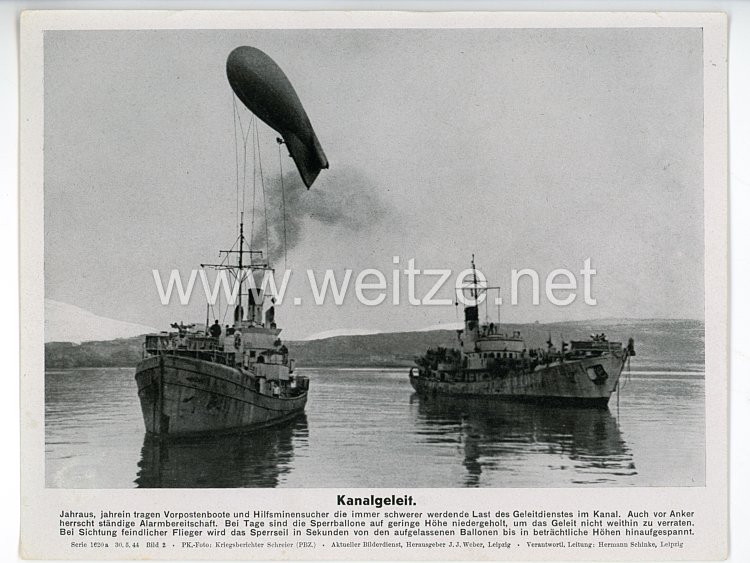
Third Reich - Printed Press Photo “Kanalgeleit” May 30, 1944
Historical Context: Press Photograph “Kanalgeleit” from May 30, 1944
This press photograph from the Aktueller Bilderdienst (Current Picture Service) documents a significant moment in the final phase of World War II. Dated May 30, 1944 – just days before the Allied invasion of Normandy – this image represents the intense propagandistic activity of the Third Reich during a critical phase of the war.
The Aktueller Bilderdienst was one of the most important institutions for distributing photographic material in Nazi Germany. This organization was subordinate to the Reich Ministry of Public Enlightenment and Propaganda under Joseph Goebbels and played a central role in controlling public opinion through visual media. The picture service supplied newspapers, magazines, and other publications with officially approved photographs that presented the National Socialist perspective on current events.
The term “Kanalgeleit” (Channel Escort) refers to military operations in the English Channel, that strategically decisive strait between England and France. In the spring of 1944, German leadership increasingly struggled with Allied attacks on their supply convoys and military units. The German Kriegsmarine was forced to conduct elaborate escort operations to ensure the supply of Atlantic Wall fortifications.
The date of the photograph – May 30, 1944 – holds particular historical significance. At this time, Allied forces stood immediately before D-Day, which would begin on June 6, 1944. German leadership suspected an imminent invasion but could not determine with certainty either the exact time or location. The propaganda machinery sought to convey an image of a defensive, well-organized defense.
Press photographs of this type were produced and distributed according to strict guidelines. The Propaganda Companies (Propagandakompanien or PK) of the Wehrmacht were specially trained units that were both fighting soldiers and war correspondents. They documented military operations with cameras and film equipment, with their work always subordinated to propagandistic objectives. The images had to convey a positive, heroic image of German forces, even as the military situation became increasingly hopeless.
The technical execution of such press photographs followed standardized formats. The format of 23.5 x 18.5 cm was typical for press prints of this era and allowed for easy use in print media. The unprinted reverse side of this specimen is unusual, as captions, censorship stamps, and publisher information were normally affixed to the back. This could indicate that it is an archive print or a print not intended for publication.
The situation in the English Channel in May 1944 was extremely precarious for the German Kriegsmarine. Through intensive air attacks and anti-submarine operations, the Allies had significantly weakened German control over this important waterway. Every convoy mission involved considerable risks. The Kriegsmarine's fast attack craft and minesweepers desperately attempted to maintain supply lines.
From today's perspective, such press photographs are important historical documents. They show not only military operations but also the way the NS regime attempted to control public perception. The propaganda photography of the Third Reich is an important research field for historians seeking to understand how images were used for manipulation and control.
Collectors and historians value such original photographs as authentic contemporary documents. They offer insights into the visual culture of National Socialism and the technical aspects of war photography. At the same time, they require critical, contextualized examination that does not disregard the propagandistic intent. These photographs are testimonies of a dark era that remain of lasting value for educational and research purposes.