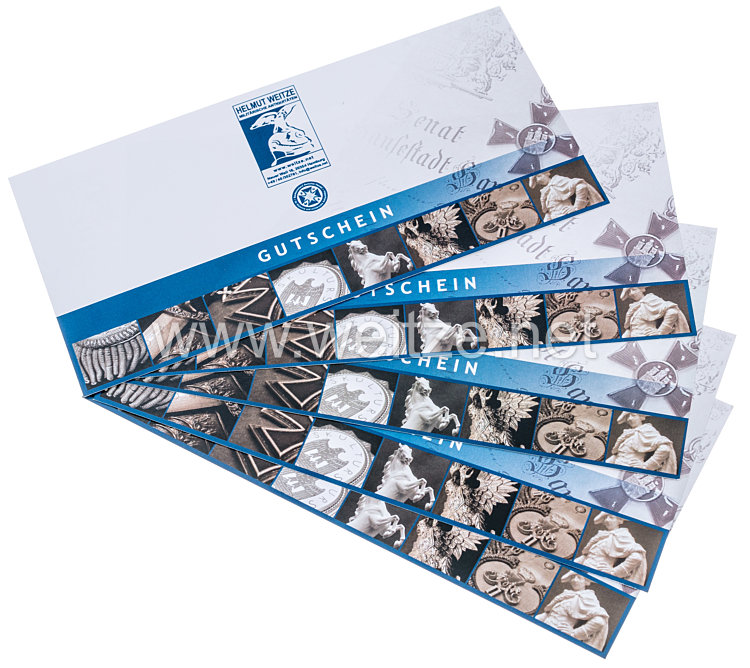
Shopping Voucher in the Amount of 250.00€
While this gift voucher is not itself a military historical object in the strict sense, it represents a modern form of commerce in a collecting field of extraordinary historical significance: militaria. To understand the context of such vouchers in specialized trade, it is necessary to examine the development of collecting military antiques and the associated commercial practices.
The systematic collecting of military objects began in the late 18th and early 19th centuries, when enlightened citizens started preserving historical artifacts as testimonies of past epochs. Initially, interest focused on weapons and armor from the Middle Ages and Renaissance, preserved in private armories of aristocratic houses. With the professionalization of historical science in the 19th century, a scholarly interest in military objects as sources for researching warfare, technology, and social organization also developed.
The actual boom in militaria collecting began after World War I. Veterans brought home souvenirs from battlefields, and a lively trade in medals, badges, uniform parts, and personal equipment developed. In the 1920s and 1930s, the first specialized dealers and auction houses focusing on military antiques emerged. After World War II, this market reached a new dimension as countless military items from various armies became available.
The modern specialized militaria trade established itself in the second half of the 20th century as a specialized industry. Dealers began building extensive inventories and developing expertise in authenticating and evaluating historical military items. The emergence of collectors' associations, specialized journals, and later the internet led to increasing professionalization of the market. Today, a global network of dealers, auction houses, and collectors exists, dedicated to preserving and studying military historical objects.
The voucher as a commercial instrument in the militaria field reflects the modernization of this traditional collecting area. While cash payment or later checks were exclusively common in the past, modern forms of payment and gifts have also become established with the digitalization of trade. Vouchers enable collectors and their relatives to respect the often highly specialized interest in particular epochs, units, or object types without possessing the necessary expertise for an appropriate selection themselves.
The legal framework for trading in militaria is strictly regulated in Germany. The War Weapons Control Act and the Weapons Act precisely define which objects are freely tradable and which require special permits. Deactivated weapons, historical uniforms, medals and decorations, and equipment items fall into different categories. Special sensitivity is required in handling objects from the Nazi era, whose trade is regulated by Section 86a of the Criminal Code and is only permitted for historical-scientific purposes.
Reputable dealers place great emphasis on the authenticity of their objects and educating their customers about historical backgrounds. They function not only as sellers but also as advisors and mediators of historical knowledge. Many specialized shops offer extensive specialist literature, organize lectures, and maintain close contacts with museums and academic institutions. A voucher from such a specialist shop thus represents access to a network of expertise and historical objects.
The significance of collecting militaria lies not in glorifying war but in preserving material testimonies of history. Each object tells stories about the people who wore or used it, about technological developments, and about the social conditions of its time. Medals document military hierarchies and value systems, uniforms show craftsmanship and material use, personal items provide insight into soldiers' daily lives. These objects complement written sources and enable a more comprehensive understanding of military history.
In an era when the last witnesses of the great conflicts of the 20th century are passing away, material transmission gains additional significance. Museums and private collectors jointly preserve cultural heritage that would otherwise be irretrievably lost. The responsible trade in such objects, as practiced by reputable specialist dealers, is an important component of this preservation. A voucher for such a shop is thus more than just a commercial instrument – it is an entry ticket to the fascinating world of military history and a contribution to preserving historical memory.