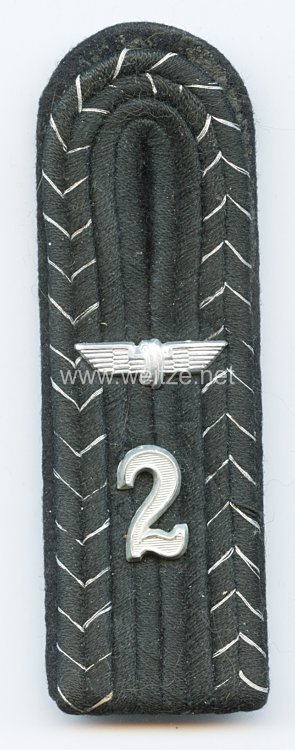
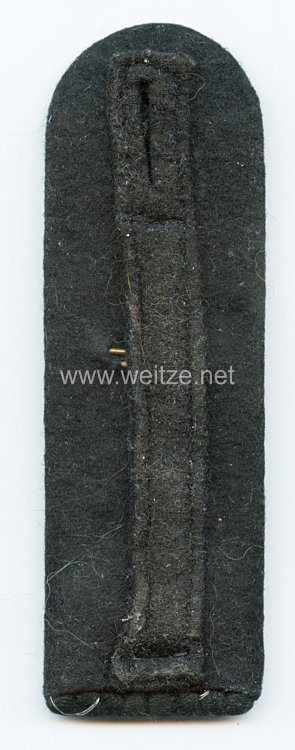
Bahnschutz Single Shoulder Board for a Railway Protection Service Guard
The Bahnschutz single shoulder board represents a rare and fascinating relic from German railway history, closely connected to the development of the Railway Police and the Railway Protection Service. This special uniform component was worn by members of the Bahnschutz, a paramilitary organization responsible for securing the German railway network during the politically turbulent years of the Weimar Republic and particularly during the Nazi era.
The Deutsche Reichsbahn (German State Railway) had always maintained its own security forces to protect its extensive infrastructure. However, with increasing militarization in the 1930s, the Railway Protection Service gained new strategic importance. The Bahnschutzpolizei (Railway Protection Police) was officially established as a uniformed formation on April 1, 1936, and placed under the Reich Transport Ministry. Their duties included protecting railway facilities, bridges, tunnels, and trains, as well as defending against sabotage and maintaining order at railway stations.
The shoulder board, also known as Achselklappe or Schulterklappe in German, served as an important rank insignia and identification element of the uniform. It was attached to the shoulder and enabled quick identification of the wearer's rank and affiliation. The loops present on this specimen served to attach it to the uniform jacket and were typically constructed to ensure secure fastening while allowing replacement during promotions or transfers.
The uniforms of the Bahnschutz were modeled on military standards and featured distinctive coloring. The shoulder boards frequently displayed the Waffenfarbe (branch color) of the Railway Protection Police, which distinguished them from other police and military units. These were typically rendered in dark tones, often adorned with special emblems or symbols referencing the railway.
During World War II, the importance of the Railway Protection Service was further amplified. The railway network was essential to German warfare for troop movements, supply deliveries, and transport of war materials. The Bahnschutz became increasingly militarized in organization and equipment. Members of the Railway Protection Service had to fulfill not only police duties but also defense-related tasks and were integrated into the defense of important transportation hubs.
After the war ended in 1945, the Bahnschutz was dissolved in its previous form. In the German Democratic Republic, the Transportpolizei (Transport Police) was created, while in the Federal Republic of Germany, the Bahnpolizei (Railway Police) was rebuilt under different organizational frameworks. Uniform items from before 1945 were largely destroyed or melted down, making surviving specimens highly sought-after collector's items today.
The rarity of this single shoulder board can be explained by several factors. Many uniform items were destroyed at the end of the war, and Railway Protection units were numerically limited compared to the Wehrmacht or SS. Additionally, shoulder boards were heavily used during service and frequently required replacement, further reducing the survival rate of historical specimens.
For collectors and historians, such objects offer valuable insights into the organizational structure and uniforming practices of German security forces. The preservation in condition 2 indicates a well-preserved specimen that still displays clear details despite its age. Such pieces enable documentation and understanding of the complex history of German transport infrastructure and its security apparatus.
The scholarly significance lies not only in the material composition of the object but also in its testimonial value for a specific epoch of German history, when transport, military, and security apparatus were closely intertwined.