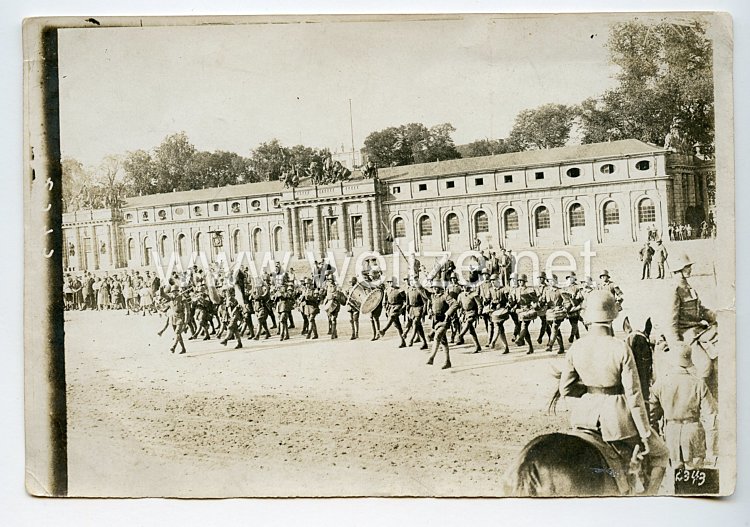
Weimar Republic Photograph, Reichswehr Parade
Historical Context: Photographs of Reichswehr Parades during the Weimar Republic
Photographs depicting Reichswehr parades from the era of the Weimar Republic (1919-1933) represent significant contemporary historical documents that provide insight into military culture and the social position of German armed forces during this turbulent epoch. These images document not only military ceremonies but also reflect the complex political tensions and the particular role of the Reichswehr in Germany's first democracy.
The Reichswehr officially came into existence on January 1, 1921, as the successor organization to the provisional Vorläufige Reichswehr (Provisional Defense Force) that had been formed immediately after World War I. Its structure and size were fundamentally determined by the Treaty of Versailles of June 28, 1919. The victorious powers of World War I restricted the German army to a maximum of 100,000 professional soldiers, including no more than 4,000 officers. This drastic reduction was intended to permanently weaken Germany as a military power and minimize the danger of future aggression.
The organizational structure of the Reichswehr comprised the Reichsheer (army) and the Reichsmarine (navy). The Reichsheer was divided into seven infantry divisions and three cavalry divisions distributed across the Reich territory. Heavy weapons, tanks, military aircraft, and submarines were prohibited by the Treaty of Versailles, which significantly limited tactical possibilities.
Military parades and marches fulfilled several important functions in the Weimar Republic. They served the Reichswehr's self-presentation to the public, demonstrated order and discipline, and maintained military traditions. Such parades were conducted particularly during national holidays, commemoration events, or oath-taking ceremonies. Photographs of these events were produced both by professional military photographers and private photographers, circulating as postcards, press images, or private mementos.
The role of the Reichswehr in the Weimar Republic was problematic from the outset. Under the leadership of General Hans von Seeckt, who served as Chief of Army Command from 1920 to 1926, the Reichswehr developed into a “state within a state.” Von Seeckt shaped the troops' self-image as a non-partisan institution committed to the nation, consciously distancing itself from the democratic republic. Many officers and soldiers of the Reichswehr came from the old imperial army and regarded democracy with skepticism or rejection.
During the numerous crises of the Weimar Republic, the Reichswehr played an ambivalent role. During the Kapp Putsch of 1920, von Seeckt refused to act against the putschist Freikorps units, with the famous words: “Reichswehr does not fire on Reichswehr.” In contrast, the Hitler-Ludendorff Putsch of 1923 in Munich was suppressed, and the Reichswehr struck hard against communist uprisings.
The photographic documentation of Reichswehr parades followed certain visual conventions. Typically, such images show closed formations in marching order, flag ceremonies, march-pasts before high-ranking officers or civilian dignitaries, and military ceremonies. Uniforms conformed to Reichswehr regulations: field-gray uniforms, steel helmets of the 1916/18 model or peaked caps for parade uniform, as well as characteristic equipment with belt buckles and side arms.
The format and condition of historical photographs from this era vary. Common were prints in formats from approximately 6x9 cm to 18x24 cm, as produced by contemporary plate cameras or smaller hand cameras. Image quality ranges from professional studio work to amateur snapshots. Many of these photographs were annotated on the reverse with handwritten notes about location, date, or depicted units.
The historical value of such photographs lies in their function as primary sources. They enable researchers to study military equipment, uniform details, organizational structures, and ceremonial practices. At the same time, they document the public presence of the military in Weimar Republic society and the visual staging of military power despite the restrictions of the Treaty of Versailles.
Collectors and military historians particularly value original photographs from the Weimar period when they are well-preserved and provide as much contextual information as possible. The authenticity of such pieces can be verified through paper type, development technique, format, and possibly stamps or inscriptions. They form important complements to official documents and written sources and contribute to understanding this formative epoch of German history.