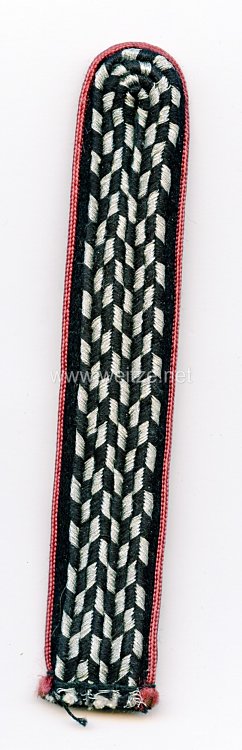
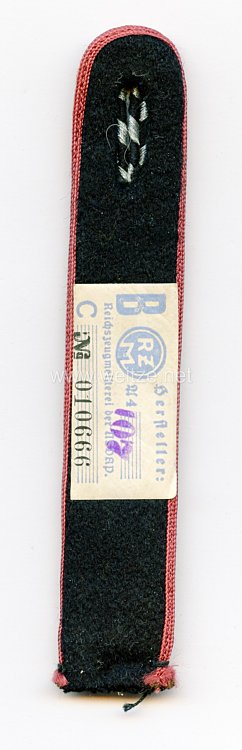
NSKK Shoulder Strap for Enlisted Men
The NSKK shoulder board for enlisted men of Motorgruppe Ostmark represents an authentic artifact of the organizational structure of the National Socialist Motor Corps (NSKK) during the Third Reich era. This uniform component embodies the complex hierarchy and regional organization of a paramilitary formation that played a central role in National Socialist transportation and motorization policy.
The NSKK was founded on April 1, 1931, as a sub-organization of the SA and developed into an independent formation of the NSDAP after the seizure of power in 1933. Under the leadership of NSKK-Korpsführer Adolf Hühnlein, the organization grew to over 500,000 members. Its primary tasks included motor vehicle training, preparation for military motor transport service, and promotion of motorsports in the German Reich.
The Motorgruppe Ostmark was established after the Anschluss of Austria in March 1938. The term “Ostmark” was the official National Socialist designation for the annexed Austrian territory. The organizational integration of Austrian motor vehicle associations into the NSKK proceeded quickly and systematically. Motorgruppe Ostmark became one of the largest regional divisions of the NSKK, headquartered in Vienna, and encompassed all former Austrian territories.
The present shoulder board is distinguished by its wine-red piping, which had specific significance within the NSKK rank insignia system. The color scheme followed the precise regulations of the NSKK uniform regulations, first issued in 1933 and revised several times in subsequent years. Wine-red was the branch color for certain ranks and functional areas within the corps. The piping served for quick visual identification of rank and affiliation.
Shoulder boards for enlisted men were the simplest form of rank insignia in the NSKK. They were worn by the lowest ranks, which included NSKK-Mann, Rottenführer, and Oberrottenführer. Unlike higher ranks, whose shoulder boards featured stars, braids, or other insignia, enlisted men's shoulder boards displayed only the base color and piping, and possibly the group designation.
The characteristic “for sewing in” refers to the practical construction of these uniform items. Unlike clip-on or slip-on variants, these shoulder boards were permanently sewn into the uniform, guaranteeing secure attachment. This was particularly common with the durable service uniforms of enlisted men, designed for daily use and practical activities.
Of particular significance is the RZM label. The abbreviation RZM stands for Reichszeugmeisterei, the central procurement and inspection office of the NSDAP, founded in 1929. Under the direction of Franz Xaver Schwarz, the RZM controlled the manufacture and distribution of all uniforms, insignia, and equipment for NS organizations. The RZM label guaranteed the authenticity and quality of the product and compliance with official regulations. Manufacturers had to possess an RZM license and were assigned specific manufacturer codes. The presence of an RZM label documents the official provenance of the piece and its origin from the regular supply chain.
The production of NSKK uniform items was carried out by a network of licensed manufacturers throughout the Reich territory. After 1938, Austrian textile companies were also integrated into this system. Quality control was strict, and deviations from prescribed measurements, colors, or materials were not tolerated.
The historical classification of such objects requires differentiated consideration. They are material witnesses to a criminal dictatorship and simultaneously document important aspects of everyday history, uniform studies, and organizational structure of the NS regime. The NSKK was closely involved in the preparation and execution of the war, with its members providing motor vehicle technical services for the Wehrmacht and participating in logistical operations.
The research and documentation of such military-historical objects serves the scientific understanding of the NS era and contributes to historical education. They provide insights into organizational structures, uniform studies, and the everyday reality of National Socialist rule.