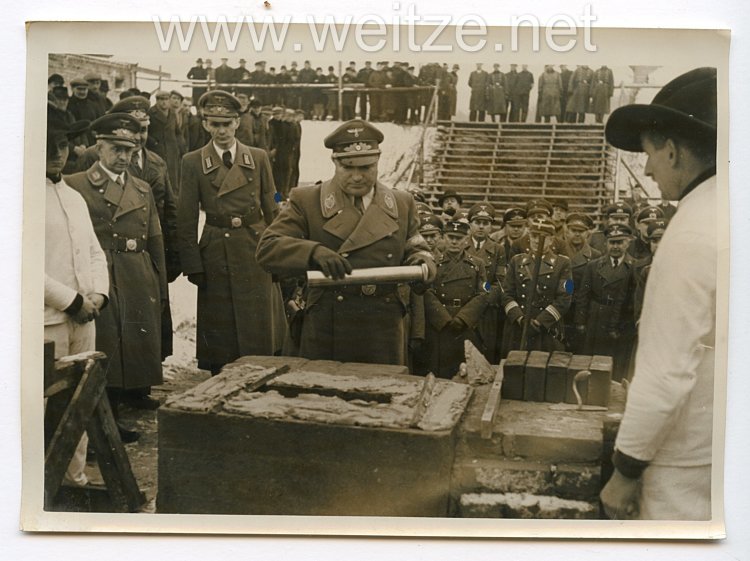
Third Reich Press Photograph. For the Germans Working 15.1.1941

Dimensions approx. 13 x 18 cm, with description on reverse, condition 2. 
303912
30,00

Third Reich Press Photograph. For the Germans Working 15.1.1941

This press photograph from the Third Reich dated January 15, 1941, with the title “Working for the Germans,” represents an important element of the National Socialist propaganda and media machinery during World War II.

Press photographs in the Third Reich were central instruments of information control and ideological influence. After the seizure of power in 1933, the entire press system in the German Reich was subjected to strict control. The Reich Ministry of Public Enlightenment and Propaganda under Joseph Goebbels exercised comprehensive censorship over all media, including newspapers, magazines, and photographic material.

The organization of press photography was primarily conducted through several state-controlled agencies. The most important was the Deutsche Nachrichtenbüro GmbH (DNB), which was formed in 1933 from the merger of several news agencies and effectively held a monopoly on news distribution in the Reich. Additionally, there was Scherl Bilderdienst and other photo agencies subordinate to the Propaganda Ministry.

The date January 15, 1941 falls during a significant phase of World War II. At this time, the German Reich was at the height of its territorial expansion in Europe following the successes of the first war years. The Western Campaign had ended victoriously, France had capitulated, and Britain stood isolated. Preparations for Operation Barbarossa, the invasion of the Soviet Union, were already in full swing, although the attack would not occur until June 1941.

The title “Working for the Germans” suggests the theme of forced labor and the economic exploitation of occupied territories. By January 1941, the Nazi regime had already begun systematically bringing foreign workers into the Reich. This included both civilian workers from occupied areas and prisoners of war. The Propaganda Ministry endeavored to present this practice as “voluntary cooperation” or as a legitimate war measure.

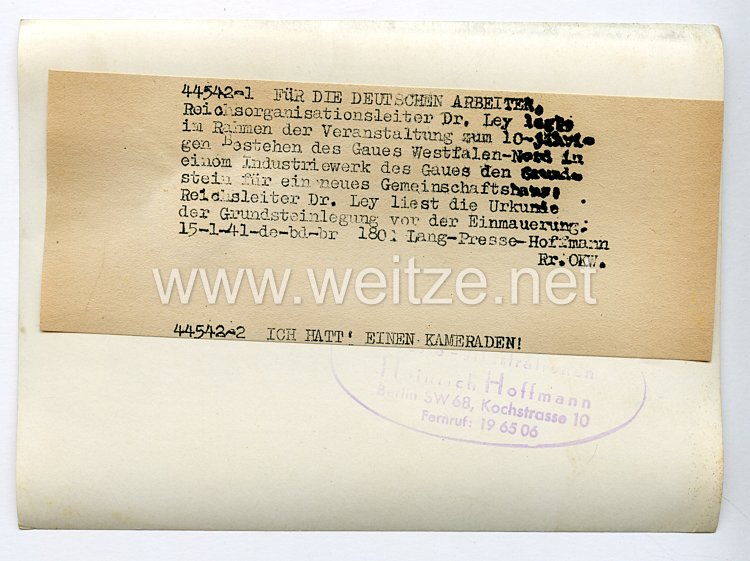
The technical characteristics of such press photographs were standardized. The typical size of approximately 13 x 18 cm corresponded to the then-common format for press prints. The reverse inscription was mandatory and usually contained: a stamp from the issuing agency, the date of recording, an image number, a description of the subject, possibly the photographer's name, and often publication instructions or censorship notes.

The use of such press photographs occurred in the coordinated press of the Reich. Newspapers and magazines were required to use only approved photographic material. The daily press conferences of the Propaganda Ministry not only dictated which topics should be covered but also which images should be used and how they should be commented upon.

The Reich Culture Chamber Law of September 1933 had created the legal basis for controlling everyone working in the media sector. Press photographers had to be members of the Reich Press Chamber, which required political reliability. Jewish photographers and those considered politically unreliable were systematically forced out of the profession.

The authenticity of scenes depicted in such press photographs must be critically questioned. Many shots were staged or at least carefully arranged to convey the desired propagandistic message. The selection of subjects, image composition, and accompanying texts always served to support Nazi ideology and the war effort.

From a historical perspective, such press photographs are today important sources for researching Nazi propaganda. They document not only the events themselves but especially how the regime wanted these events to be perceived. Analysis of such images and their distribution provides insight into the functioning of the propaganda machinery and the mechanisms of public opinion manipulation in the dictatorship.

The collector value and historical significance of such documents lie in their nature as contemporary testimony. They are material remnants of a system of total media control and serve today for education and historical research. Their preservation in archives, museums, and private collections helps make the methods and effectiveness of Nazi propaganda comprehensible for future generations.