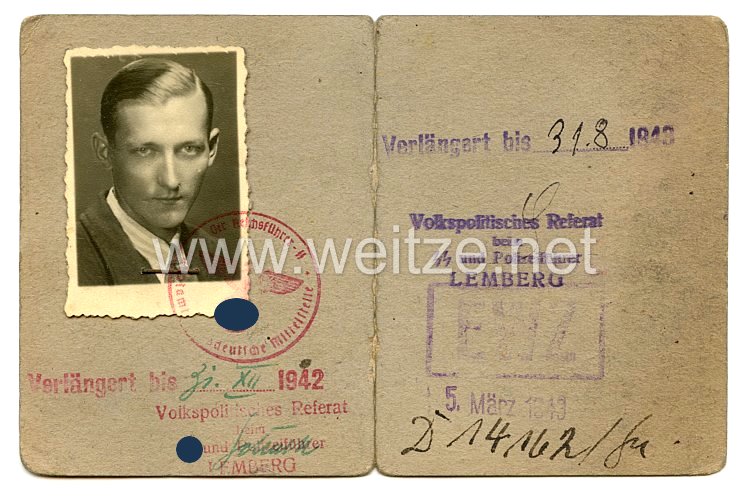
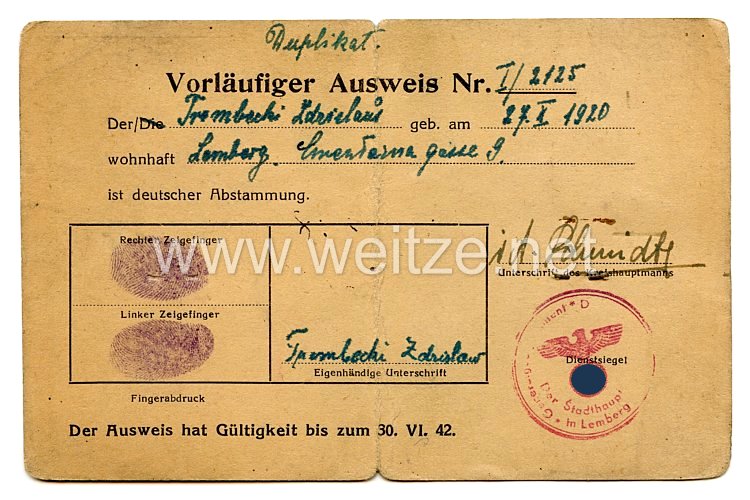
Third Reich - General Government District of Galicia - The City Commandant in Lemberg - Provisional Certificate of German Nationality
Provisional Certificate of German Nationality in the General Government
This Provisional Certificate of German Nationality (Vorläufiger Ausweis der deutschen Volkszugehörigkeit) represents a significant document from the period of Nazi occupation of Eastern Europe. Issued by the City Commandant in Lemberg in the District of Galicia of the General Government, this document embodies the racial policies of the NS regime in the occupied Eastern territories during World War II.
Historical Context: The General Government and District Galicia
Following the invasion of Poland in September 1939, the German Reich established the General Government as an administrative unit for the occupied Polish territories that were not directly incorporated into the Reich. With the launch of Operation Barbarossa in June 1941 and the conquest of Eastern Poland and Soviet Ukraine, the District of Galicia was added as the fifth district to the General Government in August 1941.
Lemberg (present-day Lviv, Ukraine; Polish: Lwów) became the capital of this new district. Before the war, the city had a multi-ethnic population with significant Polish, Jewish, Ukrainian, and German communities. The German occupation administration established a complex hierarchy of administrative offices here, including the Stadthauptmann (City Commandant), who was responsible for local administration.
The German National List and Certificates of Nationality
A central element of Nazi occupation policy was the racial classification of the population in occupied territories. The German National List (Deutsche Volksliste, DVL) was introduced to register and categorize persons of German descent. This list was divided into four categories, with classification having far-reaching consequences for those affected—ranging from privileges to obligations such as military service.
The Provisional Certificate of German Nationality was a document issued to persons whose German descent was established or claimed, but whose final classification had not yet been completed. These certificates were transitional or interim documents that granted holders certain rights and status while bureaucratic verification of ancestry was still ongoing.
Issuance Practice and Administration
The issuance of such documents was subject to strict bureaucratic procedures. Applicants had to prove their German ancestry through various evidence, including birth certificates, baptismal records, genealogical research, and witness testimonies. Verification was carried out by various authorities, with the Volkspolitisches Referat (Ethnic Political Department) attached to the SS and Police Leader playing a central role.
This document for a man born in 1920 shows the typical features of such certificates: a photograph on the reverse for identification and multiple extensions of validity. The final extension until August 31, 1944 by the Ethnic Political Department of the SS and Police Leader in Lemberg occurred at a time when the Soviet offensive was already threatening German positions in Ukraine. Lemberg itself was liberated by the Red Army in July 1944.
Significance and Consequences
Possession of such a certificate had far-reaching effects on the holders' lives. It granted access to better food rations, protection from forced labor and deportation, and simultaneously obligated loyalty to the NS regime. For many people in the occupied territories, the question of ethnic classification was a matter of survival, especially given the brutal occupation policies toward the Slavic and Jewish populations.
The multiple extensions of the document until August 1944 demonstrate that the German administration maintained its bureaucratic procedures even in the face of military defeat. This reflects both the importance the regime attached to racial classification and the hopes of many people to find protection from the ravages of war through German status.
Historical Assessment
Documents such as this Provisional Certificate are today important historical sources for understanding Nazi occupation policy, racial policies, and daily life in occupied territories. They document the bureaucratic penetration of all areas of life by the NS regime and the desperate attempts of many people to survive in a time of extreme violence and persecution.
The used and folded condition of the document testifies to its actual use and makes it an authentic witness to this dark epoch of European history. Such documents serve as reminders of the systematic discrimination and racist ideology that cost millions of people their lives and led Europe into the abyss.