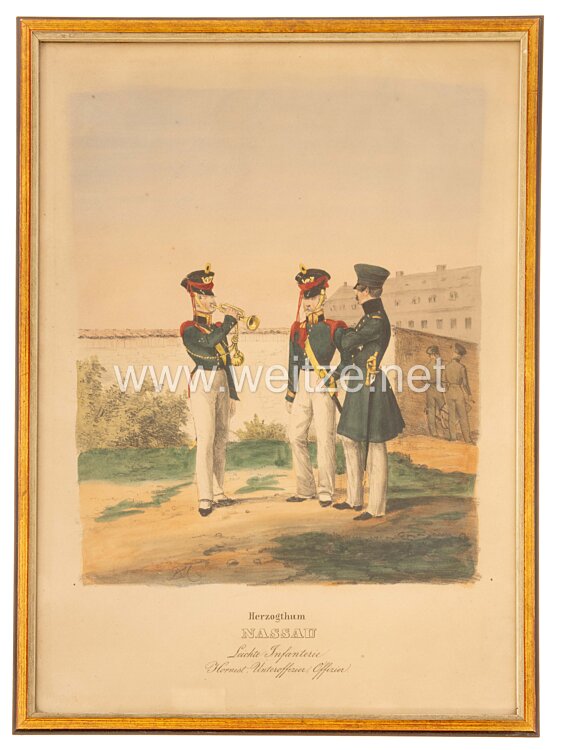
Duchy of Nassau Framed Hand-Colored Lithograph “Light Infantry”

Lithograph by Eckert/Monten, circa 1840. In wooden frame. 26.6 x 37.3 cm. Condition 2.
454012
65,00

Duchy of Nassau Framed Hand-Colored Lithograph “Light Infantry”

This hand-colored lithograph depicts a soldier of the Light Infantry of the Duchy of Nassau and was created around 1840 by the artists Eckert and Monten. This artwork represents an important testimony to military uniform studies and the history of a German middle state during the era between the Napoleonic Wars and the Revolution of 1848.

The Duchy of Nassau came into existence in 1806 through the unification of the Principalities of Nassau-Usingen and Nassau-Weilburg during the formation of the Confederation of the Rhine. As a sovereign state, it existed until 1866, when it was annexed by Prussia after the Austro-Prussian War. The military organization of the duchy reflected the typical structures of German middle states of this epoch, with the army serving both for territorial defense and to fulfill federal obligations within the German Confederation.

The Light Infantry constituted a special branch of troops that differed from line infantry through its specific tactical deployment, training, and often its uniforms. In the first half of the 19th century, light infantry units, often also designated as Jäger or Fusiliers, had the task of operating in dispersed combat, reconnaissance, providing skirmishers, and supporting the heavy line infantry. This method of warfare had proven particularly effective during the Napoleonic Wars.

Military lithography experienced its golden age in the second quarter of the 19th century. The depictions created around 1840 are characterized by precise reproduction of uniform details and careful hand-coloring. Artists like Eckert and Monten specialized in military subjects and created extensive series documenting the uniforms of various German states. These lithographs served not only as documentation but also as models for uniform tailors and as collectibles for contemporaries interested in military matters.

The uniforms of the Nassau light infantry followed the general trends of German military fashion of the time but displayed characteristic peculiarities that identified the duchy. The typical colors of Nassau were orange and blue, with the exact design of the uniforms being specified multiple times through ducal regulations. The accoutrements included specific insignia, button patterns, and facing colors that allowed the connoisseur to immediately recognize affiliation with the Nassau army.

The technical production process of such lithographs was elaborate. First, the motif was drawn in reverse on a lithographic stone, then reproduced through stone printing, and subsequently hand-colored. The hand-coloring was done with watercolors, with experienced colorists paying attention to uniform color application and historical accuracy. This made each copy a unique piece with slight color variations.

The historical significance of such lithographs lies in their documentary value. In an era before color photography, they are important sources for uniform history. Military historians and museums use them to reconstruct historical uniforms and to identify units in contemporary depictions. The creation period around 1840 falls into a phase of relative political stability in the German Confederation, during which uniforms remained largely unchanged.

The framing in a wooden frame corresponds to contemporary practice of presenting such sheets as decorative wall pictures in officers' messes, administrative buildings, or private collections. The stated dimensions of 26.6 x 37.3 cm correspond to a common format for military individual portraits of this time.

The Duchy of Nassau maintained a relatively small but well-trained army. The total strength in peacetime was approximately 2,000 to 3,000 men. The light infantry constituted an important component that could also be deployed outside the duchy if needed due to federal obligations. Nassau participated in various federal contingents and provided troops for joint operations of the German Confederation.

Such lithographs are today sought-after collectibles and important components of military-historical collections. They document not only the military history of individual states but also the development of graphic arts and printing technology in the 19th century. The condition of preservation with the indication “Condition 2” suggests a well-preserved specimen in which the colors are still vivid and no significant damage is present.