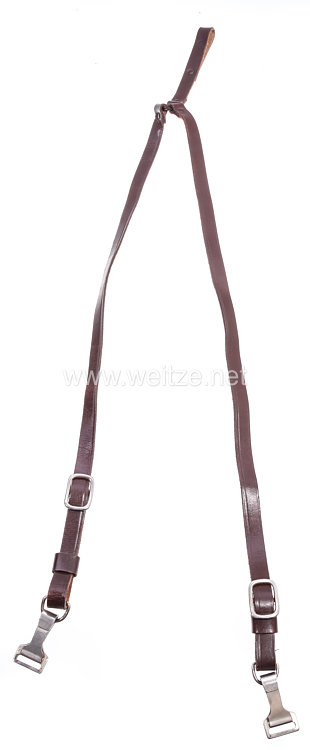
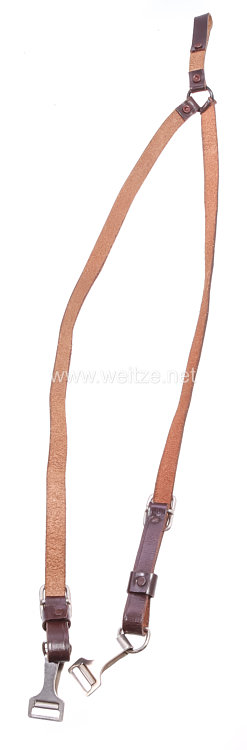
Y-Strap for Leaders of the SA or NSDAP

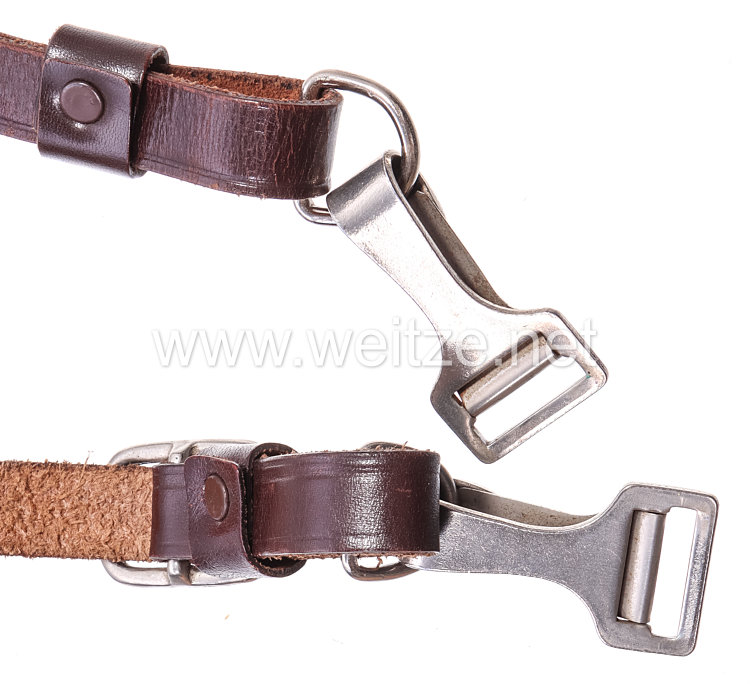
Brown leather version for looping onto the belt, with 2 safety hooks on the D-rings, with impression of a Party eagle on the back loop, condition 2+.
390911
200,00

Y-Strap for Leaders of the SA or NSDAP

The Y-strap (also referred to as belt support strap or shoulder strap) represented an essential component of military and paramilitary equipment during the National Socialist era. This particular specimen was manufactured for leaders of the SA (Sturmabteilung - Storm Detachment) or NSDAP (National Socialist German Workers' Party) and represents the characteristic equipment of the political leadership in the Third Reich.

The Sturmabteilung, founded in August 1921, developed into the paramilitary combat organization of the NSDAP. After the seizure of power in 1933, the SA grew to several million members. The organization had a strictly hierarchical structure with corresponding rank insignia and uniform regulations. The Y-strap was an indispensable element of the service uniform, serving both functional and representative purposes.

The construction from brown leather corresponds to the official clothing regulations of the SA and NSDAP. Brown became the characteristic color of party uniforms, leading to the designation “Brownshirts” for SA members. The leather had to meet certain quality standards and was manufactured by authorized producers who were subject to the strict specifications of the Reich Equipment Administration.

The functional design of this Y-strap shows several characteristic features: Attachment was accomplished through loops on the belt, ensuring a secure connection. The two securing hooks on the D-rings served to fasten the shoulder strap to the belt buckle and prevented slipping of the entire equipment. This construction was particularly important because heavy equipment items such as bayonets, pistol holsters, or canteens were frequently attached to the belt.

Of particular historical significance is the impression of the Party Eagle on the back loop. The Party Eagle of the NSDAP differed from the Reich Eagle in its orientation: it looked over its left wing and held the swastika in its talons. This eagle marked all equipment items and uniform parts of party organizations. The placement on the back loop, a normally invisible part, indicates the precision of manufacturing regulations and possibly also served as an authenticity feature.

The distinction between equipment for ordinary members and leaders was strictly regulated in the SA and NSDAP system. Leader specimens were frequently characterized by higher processing quality, better materials, and specific markings. The Y-strap for leaders was manufactured from higher-quality leather and exhibited more careful workmanship than versions for enlisted ranks.

The procurement and distribution of such equipment items was subject to strict controls. According to SA uniform regulations, which were updated several times, all equipment parts had to be obtained from authorized suppliers. The Reich Equipment Administration supervised production and distribution to ensure uniformity and quality. Each leader was obligated to properly maintain his uniform and equipment.

In the historical context, it must be noted that after the “Röhm Affair” in June 1934, during which the SA leadership was eliminated, the significance of the SA declined considerably. The SS (Schutzstaffel - Protection Squadron) increasingly assumed its functions. Nevertheless, the SA remained in existence until 1945, and its members continued to wear the prescribed uniforms and equipment.

The preservation of such objects raises important questions today. As testimony to a criminal dictatorship, they undoubtedly possess historical documentation value for museums, research institutions, and historical education. They serve as reminders of a dark chapter in German history and contribute to education about the structures and manifestations of National Socialism. The condition rating of “2+” according to the standard scale for military antiques indicates good preservation with only minor signs of use.

In summary, this Y-strap represents a typical element of the paramilitary equipment of SA and NSDAP leadership. Its construction features, material selection, and marking with the Party Eagle correspond to historical regulations and document the precision with which the Nazi regime equipped and presented its organizations.

r